Wang Yujie, Wu Changyi, Han Bin, Xu Fei, Mao Mingfeng, Guo Xiangyang, Wang Jun
Department of Anesthesiology, Peking University Third Hospital, Beijing 100191, P.R. China.
Department of Otolaryngology, 316 Hospital of People's Liberation Army, Beijing 100093, P.R. China.
Mol Med Rep. 2016 Jul;14(1):769-75. doi: 10.3892/mmr.2016.5321. Epub 2016 May 23.
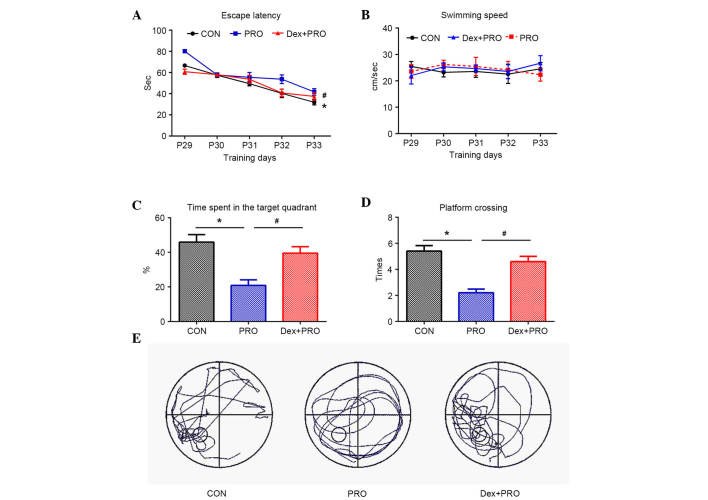
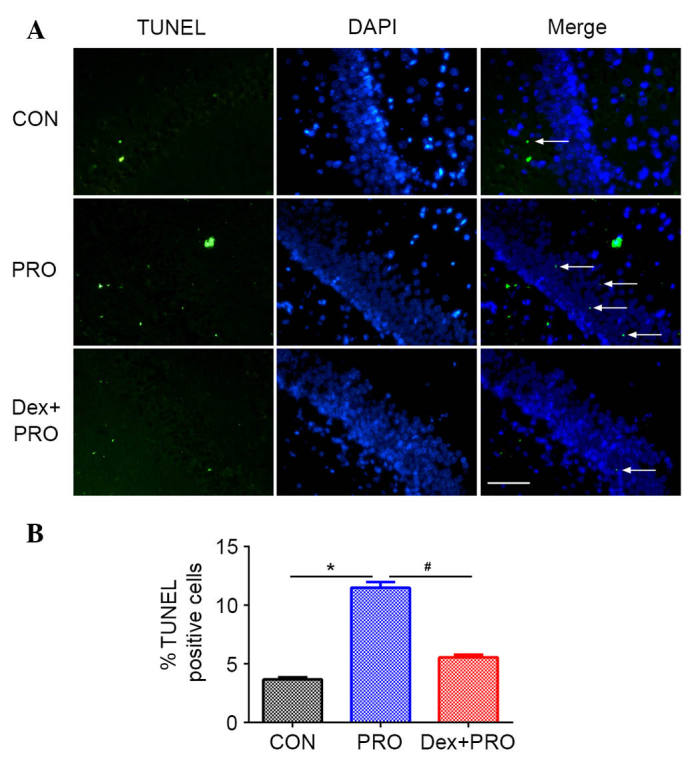
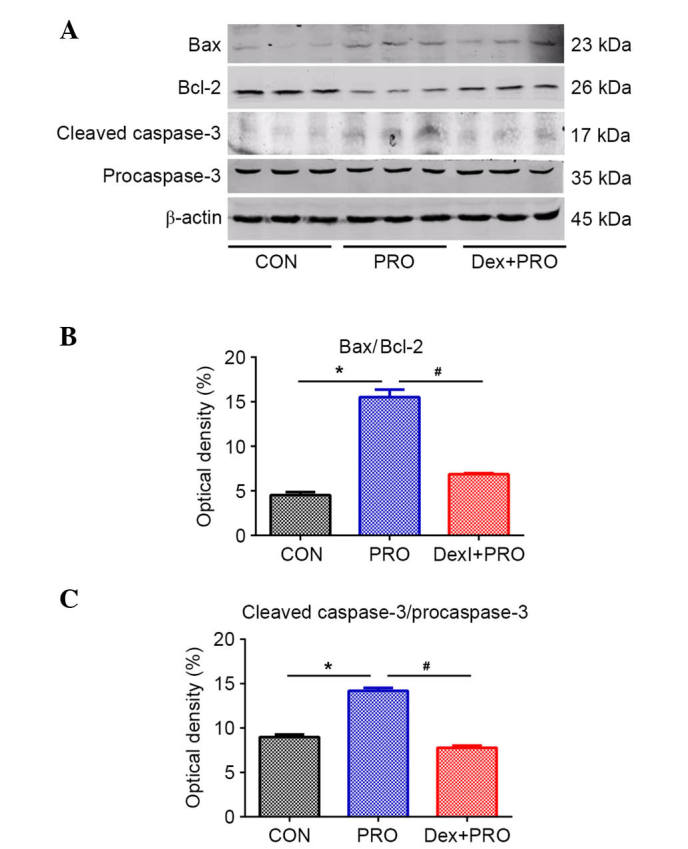
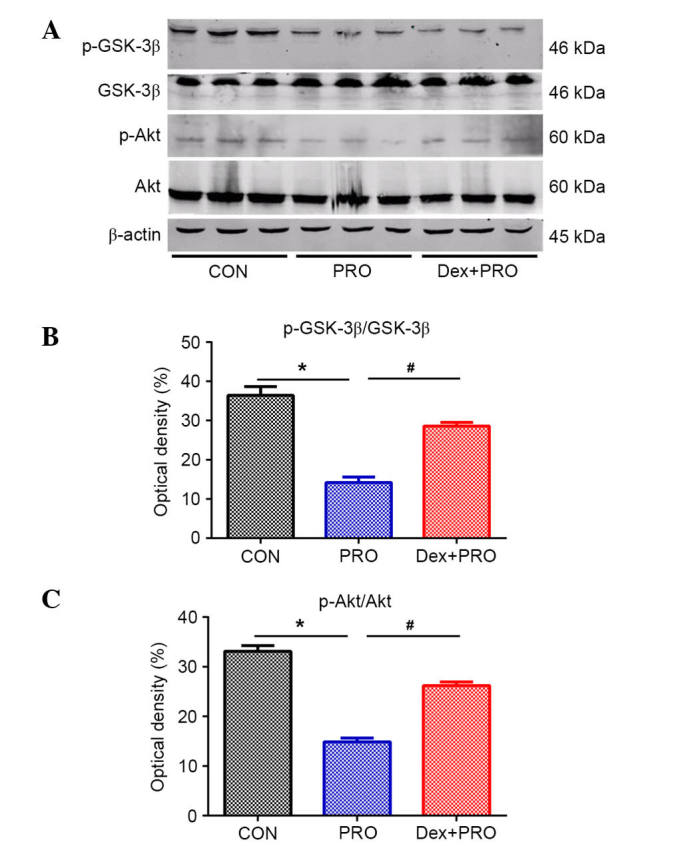
Propofol is one of the most widely used intravenous anesthetics. However, repeated exposure to propofol may cause neurodegeneration in the developing brain. Dexmedetomidine (Dex), an α2 adrenoceptor agonist, has been previously demonstrated to provide neuroprotection against neuroapoptosis and neurocognitive impairments induced by several anesthetics. Thus, the current study aimed to investigate the effect of Dex on neonatal propofol-induced neuroapoptosis and juvenile spatial learning/memory deficits. Propofol (30 mg/kg) was intraperiotoneally administered to 7‑day‑old Sprague Dawley rats (n=75) three times each day at 90 min intervals for seven consecutive days with or without Dex (75 µg/kg) treatment 20 min prior to propofol injection. Following repeated propofol exposure, reduced Akt and GSK‑3β phosphorylation, increased cleaved caspase‑3 expression levels, an increased Bax/Bcl‑2 ratio, and increased terminal deoxynucleotidyl transferase‑mediated dUTP nick‑end labeling (TUNEL)‑positive cells in the CA1 hippocampal subregion were observed. Morris Water Maze testing at postnatal day 29 also demonstrated spatial learning and memory deficits following propofol treatment compared with the control group. Notably, these changes were significantly attenuated by Dex pretreatment. The results of the current study demonstrated that Dex ameliorates the neurocognitive impairment induced by repeated neonatal propofol challenge in rats, partially via its anti‑apoptotic action and normalization of the disruption to the PI3K/Akt/GSK‑3β signaling pathway. The present study provides preliminary evidence demonstrating the safety of propofol on the neonatal brain and the potential use of dexmedetomidine pretreatment in pediatric patients.
丙泊酚是使用最广泛的静脉麻醉药之一。然而,反复接触丙泊酚可能会导致发育中的大脑发生神经退行性变。右美托咪定(Dex)是一种α2肾上腺素能受体激动剂,先前已证明其能为几种麻醉药诱导的神经细胞凋亡和神经认知障碍提供神经保护作用。因此,本研究旨在探讨Dex对新生大鼠丙泊酚诱导的神经细胞凋亡和幼年大鼠空间学习/记忆缺陷的影响。将丙泊酚(30 mg/kg)腹腔注射给7日龄的斯普拉格-道利大鼠(n = 75),每天3次,间隔90分钟,连续7天,在注射丙泊酚前20分钟给予或不给予Dex(75 μg/kg)治疗。反复接触丙泊酚后,观察到海马CA1亚区Akt和GSK-3β磷酸化降低、裂解的caspase-3表达水平升高、Bax/Bcl-2比值增加以及末端脱氧核苷酸转移酶介导的dUTP缺口末端标记(TUNEL)阳性细胞增加。与对照组相比,出生后第29天的莫里斯水迷宫试验也显示丙泊酚处理后存在空间学习和记忆缺陷。值得注意的是,Dex预处理可显著减轻这些变化。本研究结果表明,Dex可改善新生大鼠反复接受丙泊酚刺激诱导的神经认知障碍,部分是通过其抗凋亡作用以及使PI3K/Akt/GSK-3β信号通路的破坏恢复正常。本研究提供了初步证据,证明丙泊酚对新生大脑的安全性以及右美托咪定预处理在儿科患者中的潜在用途。