Buters Jeroen, Alberternst Beate, Nawrath Stefan, Wimmer Maria, Traidl-Hoffmann Claudia, Starfinger Uwe, Behrendt Heidrun, Schmidt-Weber Carsten, Bergmann Karl-Christian
ZAUM - Center of Allergy & Environment, Helmholtz Zentrum München/Technische Universität München, München, Germany ; CK CARE, Christine Kühne Center for Allergy Research and Education, Davos, Switzerland ; ZAUM - Center of Allergy & Environment, Biedersteinerstr. 29, 80802 München, Germany.
Working Group Biodiversity and Landscape Ecology, Friedberg, Germany.
Allergo J Int. 2015;24:108-120. doi: 10.1007/s40629-015-0060-6. Epub 2015 Jul 11.
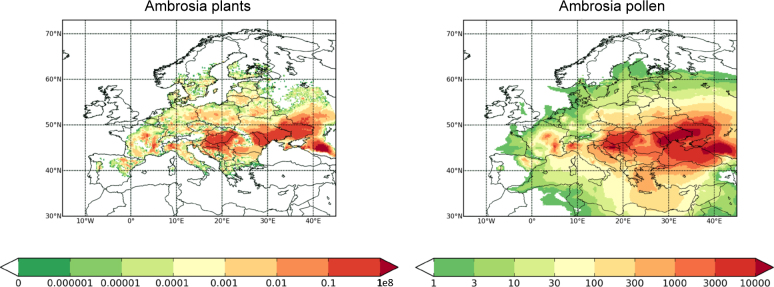
(ragweed) is a neophyte in Europe and Germany, which originated from the United States of America. In the USA the rate of sensitization against ragweed equals that of grass pollen, and without containment the rate of allergic sensitizations against ragweed pollen will clearly increase. Currently, the most frequent sensitizations in Germany are against grass pollen, followed by sensitizations against house dust mite and birch pollen. Ragweed pollen evokes symptoms at about 10 pollen/m3, grass pollen at about 15 pollen/m3. These concentrations of ragweed pollen are only reached on limited occasions in Germany. Ragweed cross-reacts with mugwort () and a correct diagnosis is only feasible with the ragweed specific allergen Amb a 1. Due to cross reactivity with mugwort, new sensitizations against ragweed pollen are not needed to evoke allergic symptoms. The neophyte encounters an already mugwort-sensitized population, extends the pollen season and may provoke new sensitizations. Ragweed sensitizations are characterized by an increased tendency to also affect the lower airways, which is less with mugwort sensitizations. Thus containment of ragweed is needed. Ragweed seeds are imported or spread by contaminated bird feed, the transport of ragweed contaminated soil (also in tyre treads) and agricultural products from infested areas. States bordering on ragweed positive areas, like Brandenburg and Bavaria, are especially at risk and invasion is already underway. Ragweed seeds survive up to 40 years in soil, and so extended timescales for eradication and observations are needed. Germany is, compared to other countries like France (Rhone-Valley), Italy (Po-Valley), Ukraine and Hungary, limited in respect to ragweed infestation. Conditions in Germany are therefore favourable for the containment of ragweed. Switzerland implemented legislation against birdseed contamination by ragweed early during the plants expansion, and obligatory ragweed registration- and eradication showed that ragweed containment is possible. Without counter measures ragweed expansion in Germany will take place, resulting in more allergic disease. Considering the increasing number of allergic individuals, even without ragweed invasion, containment of the neophyte should be actively persued. Unfortunately, time is running out.
豚草是欧洲和德国的外来植物,原产于美国。在美国,对豚草的致敏率与对草花粉的致敏率相当,若不加以控制,对豚草花粉的过敏致敏率将明显上升。目前,德国最常见的致敏原是草花粉,其次是屋尘螨和桦树花粉。豚草花粉在约每立方米10粒花粉时引发症状,草花粉在约每立方米15粒花粉时引发症状。德国仅在有限的情况下才会达到这些豚草花粉浓度。豚草与艾蒿存在交叉反应,只有使用豚草特异性变应原Amb a 1才能进行准确诊断。由于与艾蒿的交叉反应,引发过敏症状并不需要对豚草花粉产生新的致敏。这种外来植物遇到的是已经对艾蒿致敏的人群,延长了花粉季节,并可能引发新的致敏。豚草致敏的特点是更容易影响下呼吸道,而艾蒿致敏对下呼吸道的影响较小。因此,需要控制豚草。豚草种子通过受污染的鸟食、豚草污染土壤(包括轮胎胎面中的土壤)的运输以及来自疫区的农产品进行传播或引入。与豚草阳性地区接壤的州,如勃兰登堡州和巴伐利亚州,尤其面临风险,豚草入侵已经开始。豚草种子在土壤中可存活长达40年,因此需要更长的时间来根除和监测。与法国(罗纳河谷)、意大利(波河河谷)、乌克兰和匈牙利等其他国家相比,德国的豚草侵扰情况较为有限。因此,德国的情况有利于控制豚草。瑞士在豚草扩张初期就实施了针对豚草污染鸟食的立法,强制性的豚草登记和根除表明控制豚草是可行的。如果不采取应对措施,豚草将在德国蔓延,导致更多的过敏性疾病。考虑到过敏个体数量的增加,即使没有豚草入侵,也应积极控制这种外来植物。不幸的是,时间紧迫。