Lee Seung-Ah, Yuen Jason J, Jiang Hongfeng, Kahn Barbara B, Blaner William S
Department of Medicine, College of Physicians and Surgeons, Columbia University, New York, NY.
Division of Endocrinology, Diabetes, and Metabolism, Department of Medicine, Beth Israel Deaconess Medical Center, Harvard Medical School, Boston, MA.
Hepatology. 2016 Nov;64(5):1534-1546. doi: 10.1002/hep.28659. Epub 2016 Jul 4.
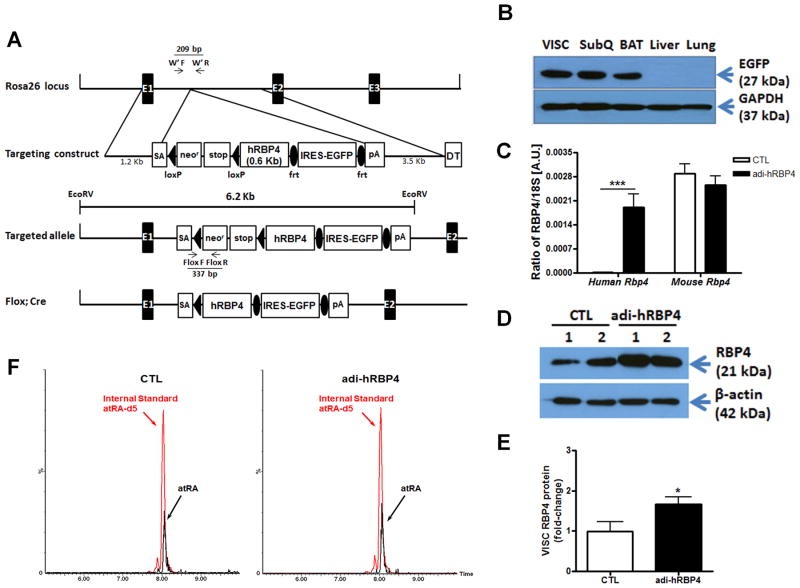
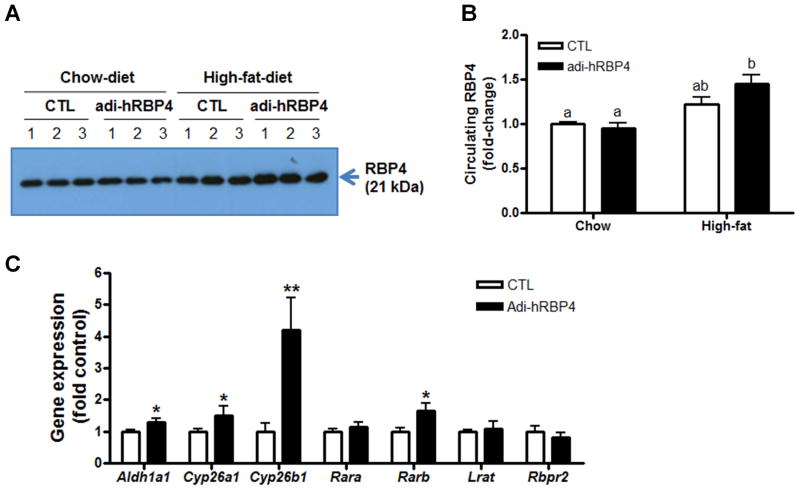
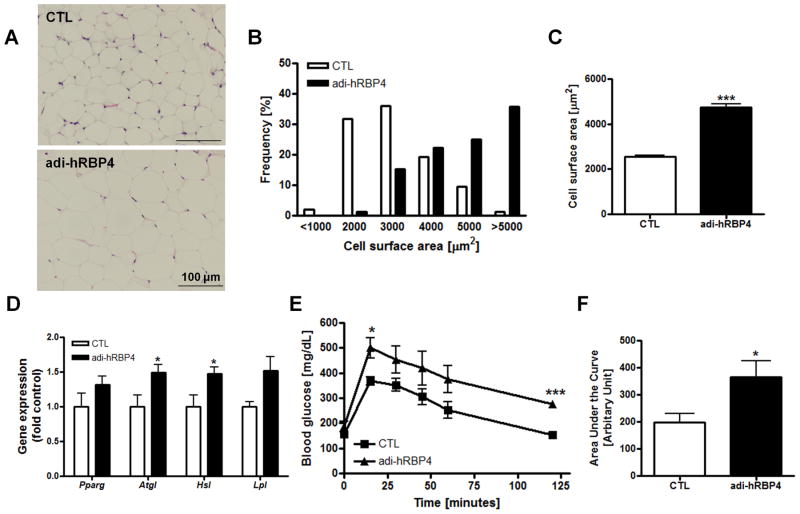
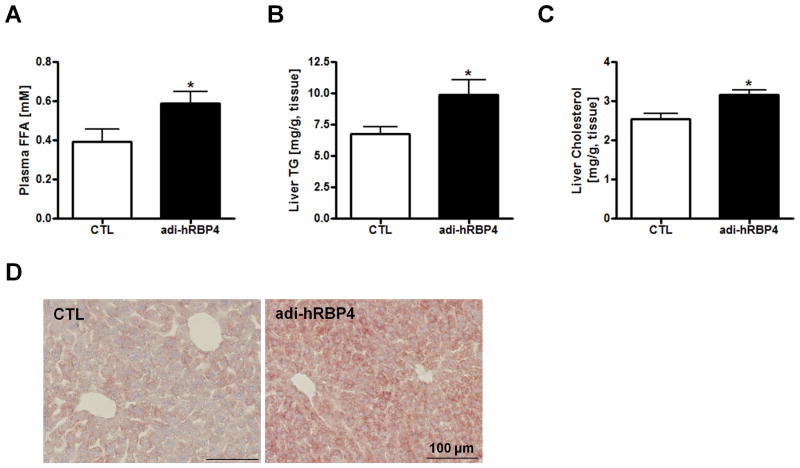
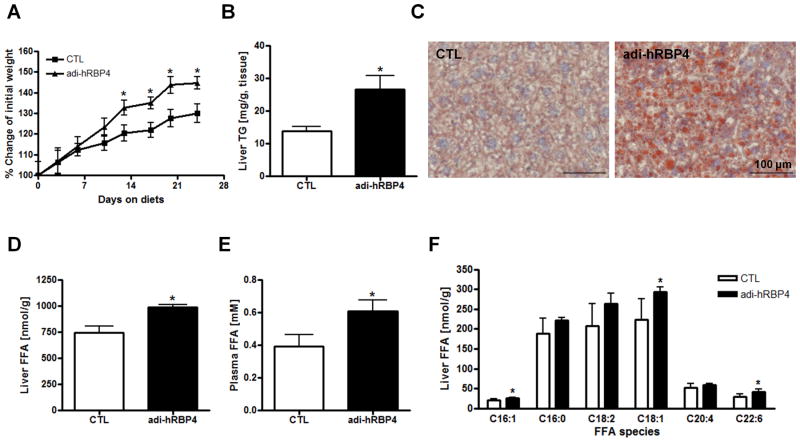
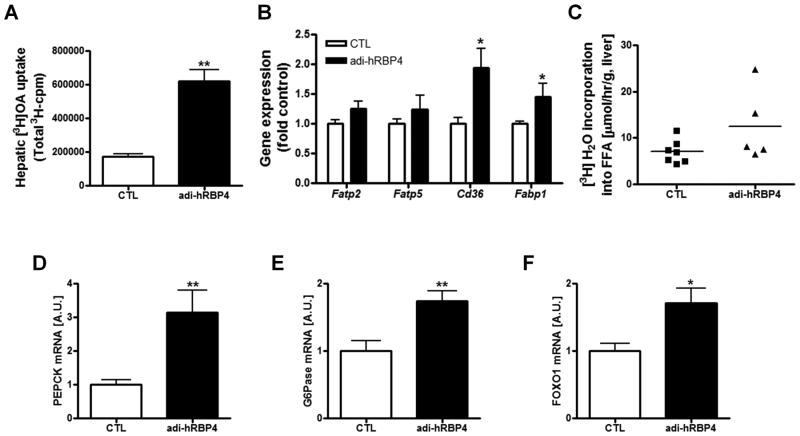
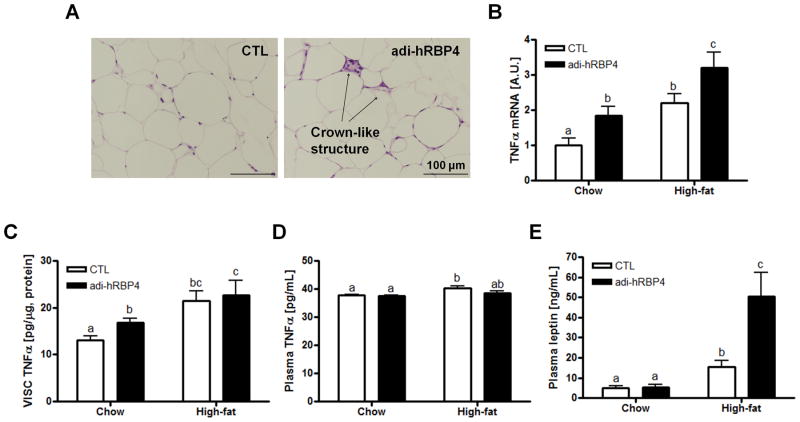
There is considerable evidence that both retinoids and retinol-binding protein 4 (RBP4) contribute to the development of liver disease. To understand the basis for this, we generated and studied transgenic mice that express human RBP4 (hRBP4) specifically in adipocytes. When fed a chow diet, these mice show an elevation in adipose total RBP4 (mouse RBP4 + hRBP4) protein levels. However, no significant differences in plasma RBP4 or retinol levels or in hepatic or adipose retinoid (retinol, retinyl ester, and all-trans-retinoic acid) levels were observed. Strikingly, male adipocyte-specific hRBP4 mice fed a standard chow diet display significantly elevated hepatic triglyceride levels at 3-4 months of age compared to matched littermate controls. When mice were fed a high-fat diet, this hepatic phenotype, as well as other metabolic phenotypes (obesity and glucose intolerance), worsened. Because adipocyte-specific hRBP4 mice have increased tumor necrosis factor-α and leptin expression and crown-like structures in adipose tissue, our data are consistent with the notion that adipose tissue is experiencing RBP4-induced inflammation that stimulates increased lipolysis within adipocytes. Our data further establish that elevated hepatic triglyceride levels result from increased hepatic uptake of adipose-derived circulating free fatty acids. We obtained no evidence that elevated hepatic triglyceride levels arise from increased hepatic de novo lipogenesis, decreased hepatic free fatty acid oxidation, or decreased very-low-density lipoprotein secretion.
Our investigations establish that RBP4 expressed in adipocytes induces hepatic steatosis arising from primary effects occurring in adipose tissue. (Hepatology 2016;64:1534-1546).
有大量证据表明,类视黄醇和视黄醇结合蛋白4(RBP4)都与肝脏疾病的发展有关。为了理解其背后的机制,我们构建并研究了在脂肪细胞中特异性表达人RBP4(hRBP4)的转基因小鼠。当喂食普通饲料时,这些小鼠脂肪组织中的总RBP4(小鼠RBP4 + hRBP4)蛋白水平升高。然而,在血浆RBP4或视黄醇水平、肝脏或脂肪组织类视黄醇(视黄醇、视黄酯和全反式维甲酸)水平方面未观察到显著差异。引人注目的是,与同窝对照小鼠相比,喂食标准普通饲料的雄性脂肪细胞特异性hRBP4小鼠在3 - 4月龄时肝脏甘油三酯水平显著升高。当小鼠喂食高脂饮食时,这种肝脏表型以及其他代谢表型(肥胖和葡萄糖不耐受)会恶化。由于脂肪细胞特异性hRBP4小鼠脂肪组织中肿瘤坏死因子-α和瘦素表达增加以及出现冠状结构,我们的数据与脂肪组织正在经历RBP4诱导的炎症从而刺激脂肪细胞内脂解增加这一观点一致。我们的数据进一步证实,肝脏甘油三酯水平升高是由于肝脏对脂肪来源的循环游离脂肪酸摄取增加所致。我们没有获得证据表明肝脏甘油三酯水平升高是由于肝脏从头脂肪生成增加、肝脏游离脂肪酸氧化减少或极低密度脂蛋白分泌减少所致。
我们的研究证实,脂肪细胞中表达的RBP4会诱导肝脏脂肪变性,这是由脂肪组织中发生的原发性效应引起的。(《肝脏病学》2016年;64卷:1534 - 1546页)