Huber Wolfgang, Huber Toni, Baum Stephan, Franzen Michael, Schmidt Christian, Stadlbauer Thomas, Beitz Analena, Schmid Roland M, Schmid Sebastian
From the II. Medizinische Klinik und Poliklinik (WH, AB, RMS), Klinik für Anaesthesiologie (SS), Klinik und Poliklinik für Vaskuläre und Endovaskuläre Chirurgie (TS) and Krankenhausapotheke (SB), Klinikum rechts der Isar der Technischen Universität München; München; Caritas-Krankenhaus St. Josef, Klinik für Urologie, Regensburg (TH); Kliniken des Landkreises Neumarkt i.d.OPf., Medizinische Klinik I, Neumarkt in der Oberpfalz (CS), Germany; and Universitätsklinik für Innere Medizin I, Landeskrankenhaus, Salzburg (MF), Austria.
Medicine (Baltimore). 2016 May;95(21):e3720. doi: 10.1097/MD.0000000000003720.
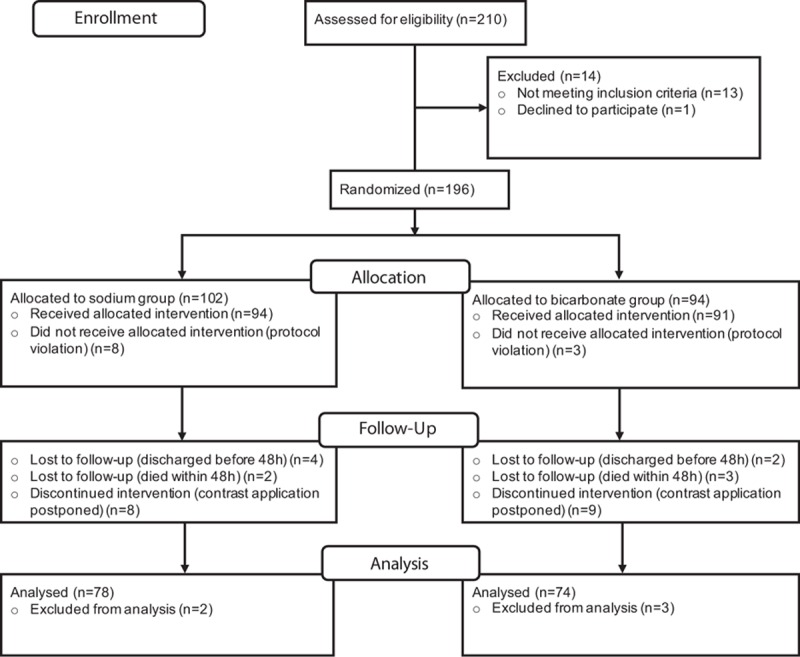
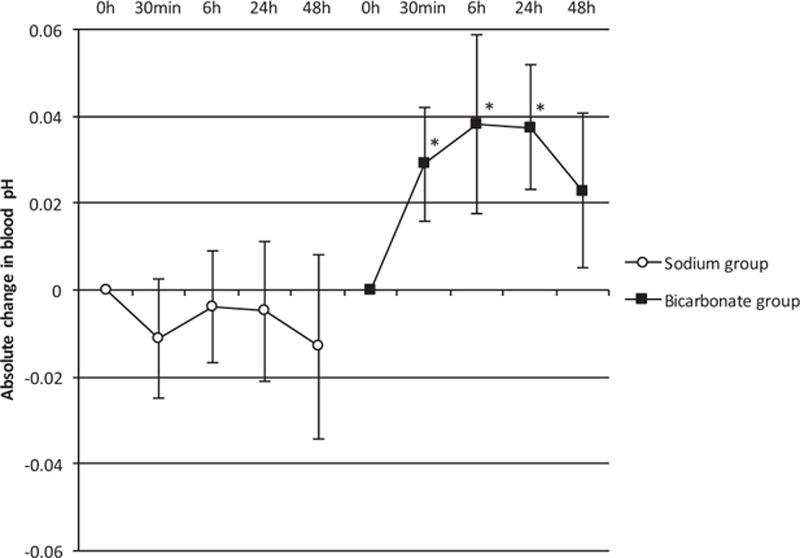
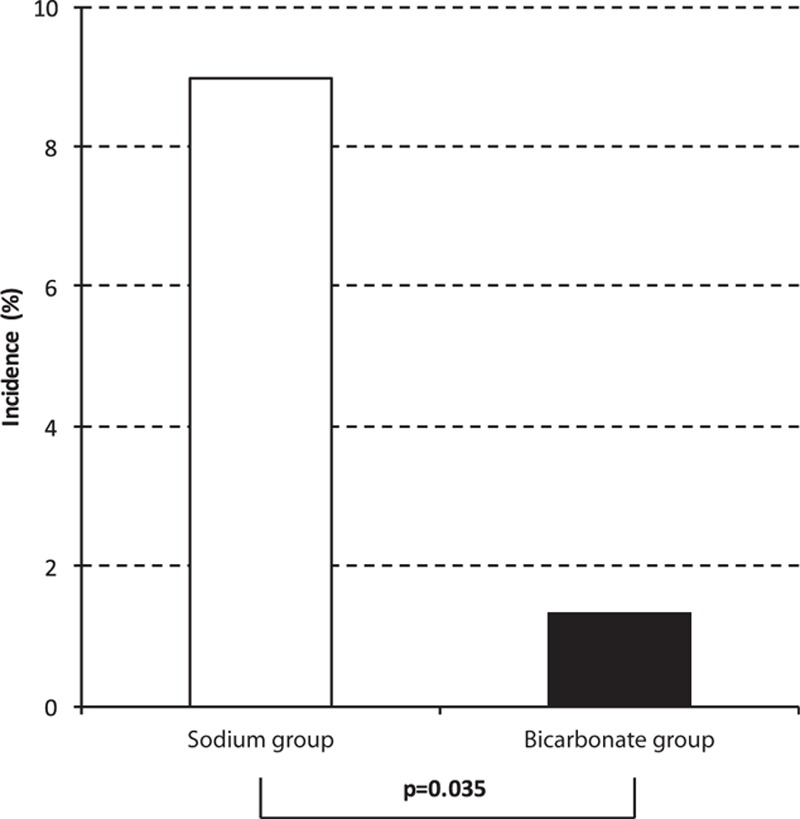
In this study, we investigated whether hydration with sodium bicarbonate is superior to hydration with saline in addition to theophylline (both groups) in the prophylaxis of contrast-induced nephropathy (CIN). It was a prospective, randomized, double-blinded study in a university hospital on 2 general intensive care units (63% of investigations) and normal wards.After approval of the local ethics committee and informed consent 152 patients with screening serum creatinine ≥1.1 mg/dL and/or at least 1 additional risk factor for CIN undergoing intravascular contrast media (CM) exposure were randomized to receive a total of 9 mL/kg bicarbonate 154 mmol/L (group B; n = 74) or saline 0.9% (group S; n = 78) hydration within 7 h in addition to intravenous application of 200 mg theophylline. Serum creatinine was determined immediately before, 24 and 48 h after CM exposure. As primary endpoint we investigated the incidence of CIN (increase of serum creatinine ≥0.5 mg/dL and/or ≥25% within 48 h of CM).Both groups were comparable regarding baseline characteristics. Incidence of CIN was significantly less frequent with bicarbonate compared to sodium hydration (1/74 [1.4%] vs 7/78 [9.0%]; P = 0.035). Time course of serum creatinine was more favorable in group B with decreases in serum creatinine after 24 h (-0.084 mg/dL [95% confidence interval: -0.035 to -0.133 mg/dL]; P = 0.008) and 48 h (-0.093 mg/dL (-0.025 to -0.161 mg/dL); P = 0.007) compared to baseline which were not observed in group S.In patients at increased risk of CIN receiving prophylactic theophylline, hydration with sodium bicarbonate reduces contrast-induced renal impairment compared to hydration with saline.
在本研究中,我们调查了在使用茶碱(两组均使用)的基础上,用碳酸氢钠进行水化治疗在预防对比剂肾病(CIN)方面是否优于用生理盐水进行水化治疗。这是一项在大学医院展开的前瞻性、随机、双盲研究,涉及2个综合重症监护病房(占研究的63%)和普通病房。经当地伦理委员会批准并获得知情同意后,152例筛查血清肌酐≥1.1mg/dL和/或至少有1个其他CIN危险因素且即将接受血管内造影剂(CM)注射的患者被随机分组,在7小时内接受总量为9mL/kg的154mmol/L碳酸氢钠(B组;n = 74)或0.9%生理盐水(S组;n = 78)水化治疗,同时静脉注射200mg茶碱。在CM注射前、注射后24小时和48小时测定血清肌酐。作为主要终点,我们调查了CIN的发生率(CM注射后48小时内血清肌酐升高≥0.5mg/dL和/或≥25%)。两组在基线特征方面具有可比性。与生理盐水水化治疗相比,碳酸氢钠水化治疗的CIN发生率显著更低(1/74 [1.4%] 对7/78 [9.0%];P = 0.035)。与S组未观察到的情况相比,B组血清肌酐的时间进程更有利,在24小时后血清肌酐下降(-0.084mg/dL [95%置信区间:-0.035至-0.133mg/dL];P = 0.008),48小时后也下降(-0.093mg/dL [-0.025至-0.161mg/dL];P = 0.007)。在接受预防性茶碱治疗且CIN风险增加的患者中,与生理盐水水化治疗相比,碳酸氢钠水化治疗可减轻对比剂引起的肾功能损害。