Garley Ashley, Eckert Erin, Sie Ali, Ye Maurice, Malm Keziah, Afari Edwin A, Sawadogo Mamadou, Herrera Samantha, Ivanovich Elizabeth, Ye Yazoume
MEASURE Evaluation, ICF International, 530 Gaither Road, Suite 500, Rockville, MD, 20850, USA.
President's Malaria Initiative, US Agency for International Development, Washington DC, USA.
Malar J. 2016 May 28;15(1):300. doi: 10.1186/s12936-016-1354-y.
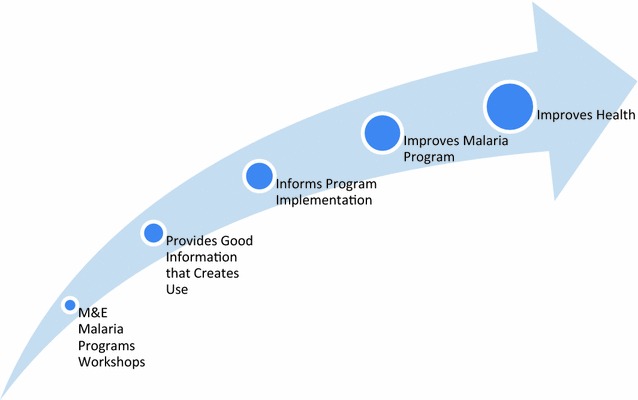
Malaria control interventions in most endemic countries have intensified in recent years and so there is a need for a robust monitoring and evaluation (M&E) system to measure progress and achievements. Providing programme and M&E officers with the appropriate skills is a way to strengthen malaria's M&E systems and enhance information use for programmes' implementation. This paper describes a recent effort in capacity strengthening for malaria M&E in sub-Saharan Africa (SSA).
From 2010 to 2014, capacity-strengthening efforts consisted of organizing regional in-person workshops for M&E of malaria programmes for Anglophone and Francophone countries in SSA in collaboration with partners from Ghana and Burkina Faso. Open-sourced online courses were also available in English. A post-workshop assessment was conducted after 5 years to assess the effects of these regional workshops and identify gaps in capacity.
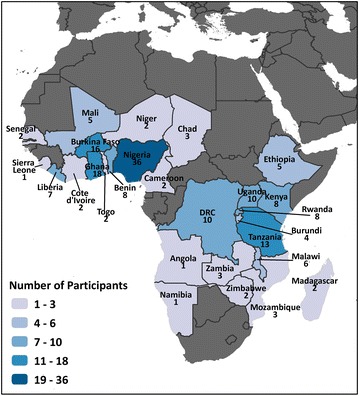
The regional workshops trained 181 participants from 28 countries from 2010 to 2014. Trained participants were from ministries of health, national malaria control and elimination programmes, non-governmental organizations, and development partners. The average score (%) for participants' knowledge tests increased from pretest to posttest for Anglophone workshops (2011: 59 vs. 76, 2012: 41 vs. 63, 2013: 51 vs. 73; 2014: 50 vs. 74). Similarly, Francophone workshop posttest scores increased, but were lower than Anglophone due to higher scores at pretest. (2011: 70 vs. 76, 2012: 74 vs. 79, 2013: 61 vs. 68; 2014: 64 vs. 75). Results of the post-workshop assessment revealed that participants retained practical M&E knowledge and skills for malaria programs, but there is a need for a module on malaria surveillance adapted to the pre-elimination context.
The workshops were successful because of the curriculum content, facilitation quality, and the engagement of partner institutions with training expertise. Results from the post-workshop assessment will guide the curriculum's development and restructuring for the next phase of workshops. Country-specific malaria M&E capacity needs assessments may also inform this process as countries reduce malaria burden.
近年来,大多数疟疾流行国家加强了疟疾防控干预措施,因此需要一个强大的监测与评价(M&E)系统来衡量进展和成果。为项目和监测与评价人员提供适当技能是加强疟疾监测与评价系统以及提高信息用于项目实施的一种方式。本文描述了撒哈拉以南非洲(SSA)近期在加强疟疾监测与评价能力方面所做的努力。
2010年至2014年,能力加强工作包括与来自加纳和布基纳法索的合作伙伴合作,为撒哈拉以南非洲的英语和法语国家组织疟疾项目监测与评价区域现场研讨会。还提供了英语的开源在线课程。5年后进行了研讨会后评估,以评估这些区域研讨会的效果并确定能力差距。
2010年至2014年,区域研讨会培训了来自28个国家的181名参与者。受训参与者来自卫生部、国家疟疾防控和消除项目、非政府组织以及发展伙伴。英语研讨会参与者的知识测试平均得分(%)从前测到后测有所提高(2011年:59对76,2012年:41对63,2013年:51对73;2014年:50对74)。同样,法语研讨会的后测分数也有所提高,但由于前测分数较高,低于英语研讨会(2011年:70对76,2012年:74对79,2013年:61对68;2014年:64对75)。研讨会后评估结果显示,参与者保留了疟疾项目的实际监测与评价知识和技能,但需要一个适应消除前背景的疟疾监测模块。
由于课程内容、促进质量以及具有培训专业知识的伙伴机构的参与,这些研讨会取得了成功。研讨会后评估结果将指导下一阶段研讨会课程的开发和重组。随着各国减少疟疾负担,特定国家的疟疾监测与评价能力需求评估也可能为这一过程提供信息。