• 文献检索
  • 文档翻译
  • 深度研究
  • 学术资讯
  • Suppr Zotero 插件Zotero 插件
  • 邀请有礼
  • 套餐&价格
  • 历史记录
应用&插件
Suppr Zotero 插件Zotero 插件浏览器插件Mac 客户端Windows 客户端微信小程序
定价
高级版会员购买积分包购买API积分包
服务
文献检索文档翻译深度研究API 文档MCP 服务
关于我们
关于 Suppr公司介绍联系我们用户协议隐私条款
关注我们

Suppr 超能文献

核心技术专利:CN118964589B侵权必究
粤ICP备2023148730 号-1Suppr @ 2026

文献检索

告别复杂PubMed语法,用中文像聊天一样搜索,搜遍4000万医学文献。AI智能推荐,让科研检索更轻松。

立即免费搜索

文件翻译

保留排版,准确专业,支持PDF/Word/PPT等文件格式,支持 12+语言互译。

免费翻译文档

深度研究

AI帮你快速写综述,25分钟生成高质量综述,智能提取关键信息,辅助科研写作。

立即免费体验

亚太地区疟疾消除国家监测系统评估

An assessment of national surveillance systems for malaria elimination in the Asia Pacific.

作者信息

Mercado Chris Erwin G, Ekapirat Nattwut, Dondorp Arjen M, Maude Richard J

机构信息

Mahidol Oxford Tropical Medicine Research Unit, Faculty of Tropical Medicine, Mahidol University, Bangkok, Thailand.

Department of Tropical Hygiene, Faculty of Tropical Medicine, Mahidol University, Bangkok, Thailand.

出版信息

Malar J. 2017 Mar 21;16(1):127. doi: 10.1186/s12936-017-1774-3.

DOI:10.1186/s12936-017-1774-3
PMID:28327180
原文链接:https://pmc.ncbi.nlm.nih.gov/articles/PMC5361802/
Abstract

BACKGROUND

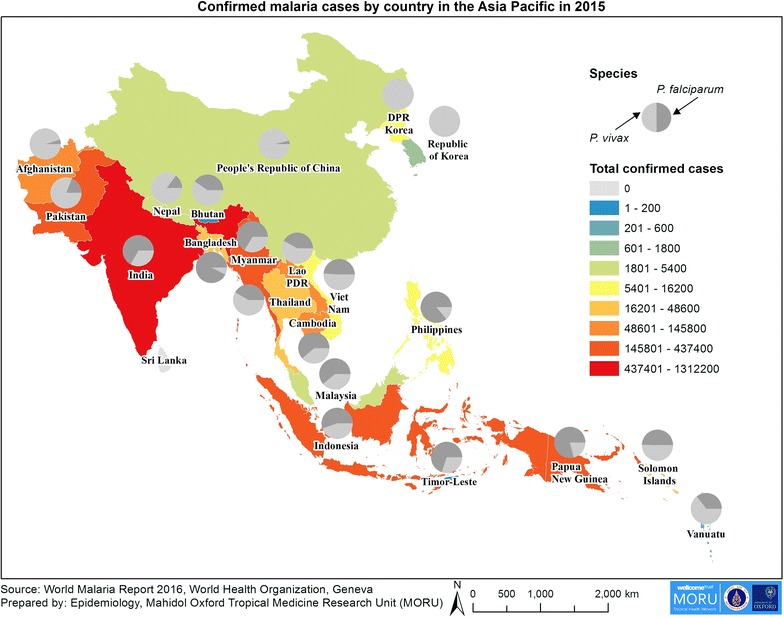
Heads of Government from Asia and the Pacific have committed to a malaria-free region by 2030. In 2015, the total number of confirmed cases reported to the World Health Organization by 22 Asia Pacific countries was 2,461,025. However, this was likely a gross underestimate due in part to incidence data not being available from the wide variety of known sources. There is a recognized need for an accurate picture of malaria over time and space to support the goal of elimination. A survey was conducted to gain a deeper understanding of the collection of malaria incidence data for surveillance by National Malaria Control Programmes in 22 countries identified by the Asia Pacific Leaders Malaria Alliance.

METHODS

In 2015-2016, a short questionnaire on malaria surveillance was distributed to 22 country National Malaria Control Programmes (NMCP) in the Asia Pacific. It collected country-specific information about the extent of inclusion of the range of possible sources of malaria incidence data and the role of the private sector in malaria treatment. The findings were used to produce recommendations for the regional heads of government on improving malaria surveillance to inform regional efforts towards malaria elimination.

RESULTS

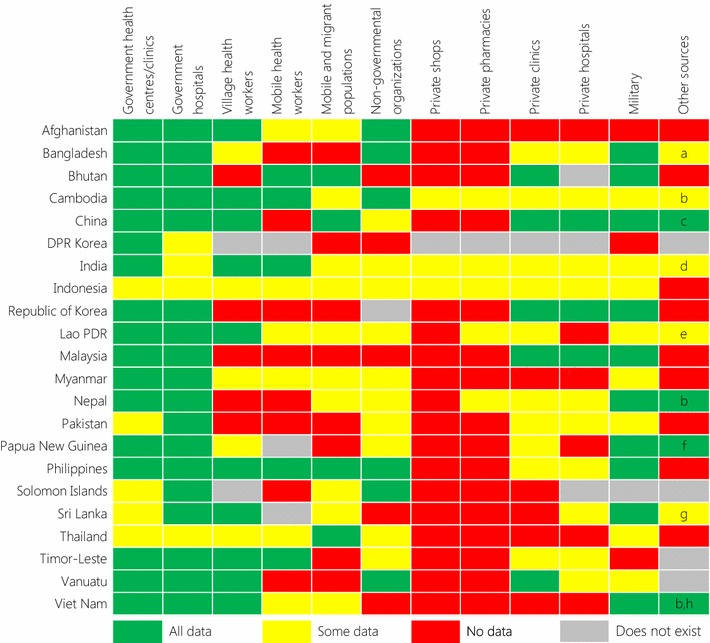
A survey response was received from all 22 target countries. Most of the malaria incidence data collected by NMCPs originated from government health facilities, while many did not collect comprehensive data from mobile and migrant populations, the private sector or the military. All data from village health workers were included by 10/20 countries and some by 5/20. Other sources of data included by some countries were plantations, police and other security forces, sentinel surveillance sites, research or academic institutions, private laboratories and other government ministries. Malaria was treated in private health facilities in 19/21 countries, while anti-malarials were available in private pharmacies in 16/21 and private shops in 6/21. Most countries use primarily paper-based reporting.

CONCLUSIONS

Most collected malaria incidence data in the Asia Pacific is from government health facilities while data from a wide variety of other known sources are often not included in national surveillance databases. In particular, there needs to be a concerted regional effort to support inclusion of data on mobile and migrant populations and the private sector. There should also be an emphasis on electronic reporting and data harmonization across organizations. This will provide a more accurate and up to date picture of the true burden and distribution of malaria and will be of great assistance in helping realize the goal of malaria elimination in the Asia Pacific by 2030.

摘要

背景

亚太地区各国政府首脑已承诺到2030年实现无疟疾区域目标。2015年,22个亚太国家向世界卫生组织报告的确诊病例总数为2461025例。然而,这很可能是严重低估,部分原因是无法从各种已知来源获取发病率数据。人们认识到需要准确了解疟疾在时间和空间上的情况,以支持消除疟疾的目标。开展了一项调查,以更深入地了解亚太领导人疟疾联盟确定的22个国家的国家疟疾控制规划为监测目的收集疟疾发病率数据的情况。

方法

2015 - 2016年,向亚太地区22个国家的国家疟疾控制规划发放了一份关于疟疾监测的简短问卷。问卷收集了各国关于疟疾发病率数据可能来源的纳入范围以及私营部门在疟疾治疗中的作用的具体信息。研究结果用于为地区政府首脑提出改进疟疾监测的建议,为该地区消除疟疾的努力提供参考。

结果

收到了所有22个目标国家的调查回复。国家疟疾控制规划收集的大多数疟疾发病率数据源自政府卫生设施,而许多规划未从流动和移民人口、私营部门或军队收集全面数据。20个国家中有10个将乡村卫生工作者提供的所有数据纳入,5个国家部分纳入。一些国家纳入的其他数据来源包括种植园、警察和其他安全部队、哨点监测点、研究或学术机构、私人实验室以及其他政府部委。21个国家中有19个国家的私营卫生设施提供疟疾治疗,21个国家中有16个国家的私人药店有抗疟药出售,21个国家中有6个国家的私人商店有抗疟药出售。大多数国家主要采用纸质报告。

结论

亚太地区收集的大多数疟疾发病率数据来自政府卫生设施,而来自各种其他已知来源的数据通常未纳入国家监测数据库。特别是,需要区域共同努力,支持纳入流动和移民人口以及私营部门的数据。还应强调电子报告和各组织间的数据协调统一。这将更准确、及时地反映疟疾的真实负担和分布情况,对助力实现亚太地区到2030年消除疟疾的目标大有帮助。
https://cdn.ncbi.nlm.nih.gov/pmc/blobs/37dd/5361802/599b81239e89/12936_2017_1774_Fig2_HTML.jpg
https://cdn.ncbi.nlm.nih.gov/pmc/blobs/37dd/5361802/84f3293b1d26/12936_2017_1774_Fig1_HTML.jpg
https://cdn.ncbi.nlm.nih.gov/pmc/blobs/37dd/5361802/599b81239e89/12936_2017_1774_Fig2_HTML.jpg
https://cdn.ncbi.nlm.nih.gov/pmc/blobs/37dd/5361802/84f3293b1d26/12936_2017_1774_Fig1_HTML.jpg
https://cdn.ncbi.nlm.nih.gov/pmc/blobs/37dd/5361802/599b81239e89/12936_2017_1774_Fig2_HTML.jpg

相似文献

1
An assessment of national surveillance systems for malaria elimination in the Asia Pacific.亚太地区疟疾消除国家监测系统评估
Malar J. 2017 Mar 21;16(1):127. doi: 10.1186/s12936-017-1774-3.
2
Targeting populations at higher risk for malaria: a survey of national malaria elimination programmes in the Asia Pacific.针对疟疾高风险人群:亚太地区国家疟疾消除计划调查
Malar J. 2016 May 10;15(1):271. doi: 10.1186/s12936-016-1319-1.
3
Active case detection for malaria elimination: a survey among Asia Pacific countries.消除疟疾的主动病例检测:亚太国家调查。
Malar J. 2013 Oct 9;12:358. doi: 10.1186/1475-2875-12-358.
4
Gaps in research and capacity development for malaria surveillance and response in the Asia-Pacific: meeting report.亚太地区疟疾监测和应对方面的研究和能力建设差距:会议报告。
Malar J. 2023 Mar 10;22(1):91. doi: 10.1186/s12936-023-04459-9.
5
Folic acid supplementation and malaria susceptibility and severity among people taking antifolate antimalarial drugs in endemic areas.在流行地区,服用抗叶酸抗疟药物的人群中,叶酸补充剂与疟疾易感性和严重程度的关系。
Cochrane Database Syst Rev. 2022 Feb 1;2(2022):CD014217. doi: 10.1002/14651858.CD014217.
6
Implementing parasite genotyping into national surveillance frameworks: feedback from control programmes and researchers in the Asia-Pacific region.将寄生虫基因分型纳入国家监测框架:来自亚太地区控制项目和研究人员的反馈。
Malar J. 2020 Jul 27;19(1):271. doi: 10.1186/s12936-020-03330-5.
7
Malaria elimination gaining ground in the Asia Pacific.在亚太地区,疟疾消除工作取得进展。
Malar J. 2012 Oct 18;11:346. doi: 10.1186/1475-2875-11-346.
8
Eliminating malaria in Malaysia: the role of partnerships between the public and commercial sectors in Sabah.在马来西亚消除疟疾:沙巴州公共部门与商业部门之间伙伴关系的作用。
Malar J. 2014 Jan 21;13:24. doi: 10.1186/1475-2875-13-24.
9
Engaging the private sector in malaria surveillance: a review of strategies and recommendations for elimination settings.让私营部门参与疟疾监测:消除疟疾环境下的策略与建议综述
Malar J. 2017 Jun 14;16(1):252. doi: 10.1186/s12936-017-1901-1.
10
Costing electronic private sector malaria surveillance in the Greater Mekong Subregion.大湄公河次区域电子私营部门疟疾监测成本核算。
Malar J. 2021 Apr 20;20(1):192. doi: 10.1186/s12936-021-03727-w.

引用本文的文献

1
Baseline assessment of front-line health system capacity in vector-borne disease surveillance and response in Papua New Guinea.巴布亚新几内亚病媒传播疾病监测与应对中一线卫生系统能力的基线评估。
PLOS Glob Public Health. 2025 Apr 30;5(4):e0004108. doi: 10.1371/journal.pgph.0004108. eCollection 2025.
2
Identification of breeding habitats and kdr mutations in Anopheles spp. in South Korea.韩国按蚊属的繁殖栖息地和 kdr 突变的鉴定。
Malar J. 2023 Dec 16;22(1):381. doi: 10.1186/s12936-023-04821-x.
3
A scoping review on laboratory surveillance in the WHO Southeast Asia Region: Past, present and the future.

本文引用的文献

1
Examples of coupled human and environmental systems from the extractive industry and hydropower sector interfaces.采矿业与水电行业界面中人类与环境耦合系统的实例。
Proc Natl Acad Sci U S A. 2016 Dec 20;113(51):14528-14535. doi: 10.1073/pnas.1605678113. Epub 2016 Oct 24.
2
Village malaria worker performance key to the elimination of artemisinin-resistant malaria: a Western Cambodia health system assessment.乡村疟疾防治人员的表现是消除青蒿素耐药性疟疾的关键:柬埔寨西部卫生系统评估
Malar J. 2016 May 20;15(1):282. doi: 10.1186/s12936-016-1322-6.
3
Risk and Control of Mosquito-Borne Diseases in Southeast Asian Rubber Plantations.
世界卫生组织东南亚区域实验室监测工作:过去、现在与未来范围性综述。
J Glob Health. 2023 Apr 21;13:04028. doi: 10.7189/jogh.13.04028.
4
Gaps in research and capacity development for malaria surveillance and response in the Asia-Pacific: meeting report.亚太地区疟疾监测和应对方面的研究和能力建设差距:会议报告。
Malar J. 2023 Mar 10;22(1):91. doi: 10.1186/s12936-023-04459-9.
5
Malaria Control, Elimination, and Prevention as Components of Health Security: A Review.疟疾防控、消除和预防作为卫生安全的组成部分:综述。
Am J Trop Med Hyg. 2022 Sep 6;107(4):747-753. doi: 10.4269/ajtmh.22-0038. Print 2022 Oct 12.
6
Private Sector Contributions to National Malaria Surveillance Systems in Elimination Settings: Lessons Learned from Cambodia, Lao PDR, Myanmar, and Vietnam.私营部门对消除环境中国家疟疾监测系统的贡献:柬埔寨、老挝人民民主共和国、缅甸和越南的经验教训。
Am J Trop Med Hyg. 2022 Dec 19;108(2_Suppl):14-23. doi: 10.4269/ajtmh.22-0147. Print 2023 Feb 2.
7
Motivation to test, treat, and report malaria cases: a quantitative assessment among private sector providers in the Greater Mekong Subregion.动机测试、治疗和报告疟疾病例:大湄公河次区域私营部门提供者的定量评估。
Malar J. 2022 Mar 9;21(1):82. doi: 10.1186/s12936-022-04108-7.
8
A small window into the status of malaria in North Korea: estimation of imported malaria incidence among visitors from South Korea.朝鲜疟疾状况的一扇小窗:从韩国入境游客中估算输入性疟疾病例。
Epidemiol Health. 2020;42:e2020068. doi: 10.4178/epih.e2020068. Epub 2020 Nov 21.
9
Addressing budget reduction and reallocation on health-related resources during COVID-19 pandemic in malaria-endemic countries.在疟疾流行国家应对 COVID-19 大流行期间与卫生相关资源的削减和重新分配问题。
Malar J. 2020 Nov 16;19(1):411. doi: 10.1186/s12936-020-03488-y.
10
Antibody Profiles to Antigens Over Time Characterize Acute and Long-Term Malaria Exposure in an Area of Low and Unstable Transmission.抗体谱随时间变化特征揭示低且不稳定传播地区急性和长期疟疾感染情况。
Am J Trop Med Hyg. 2020 Dec;103(6):2189-2197. doi: 10.4269/ajtmh.19-0480. Epub 2020 Oct 27.
东南亚橡胶种植园中蚊媒疾病的风险与防控
Trends Parasitol. 2016 May;32(5):402-415. doi: 10.1016/j.pt.2016.01.009. Epub 2016 Feb 19.
4
Feasibility of an innovative electronic mobile system to assist health workers to collect accurate, complete and timely data in a malaria control programme in a remote setting in Kenya.一种创新型电子移动系统在肯尼亚偏远地区疟疾控制项目中协助卫生工作者收集准确、完整和及时数据的可行性。
Malar J. 2015 Nov 4;14:430. doi: 10.1186/s12936-015-0965-z.
5
Cost effectiveness and resource allocation of Plasmodium falciparum malaria control in Myanmar: a modelling analysis of bed nets and community health workers.缅甸恶性疟原虫疟疾控制的成本效益与资源分配:蚊帐和社区卫生工作者的模型分析
Malar J. 2015 Sep 29;14:376. doi: 10.1186/s12936-015-0886-x.
6
Information systems to support surveillance for malaria elimination.支持疟疾消除监测的信息系统。
Am J Trop Med Hyg. 2015 Jul;93(1):145-152. doi: 10.4269/ajtmh.14-0257. Epub 2015 May 26.
7
Current situation and challenges in implementing Malaria control strategies in Pakistan.巴基斯坦实施疟疾控制策略的现状与挑战
Crit Rev Microbiol. 2016 Aug;42(4):588-93. doi: 10.3109/1040841X.2014.973368. Epub 2014 Oct 30.
8
Spatial and temporal epidemiology of clinical malaria in Cambodia 2004-2013.2004 - 2013年柬埔寨临床疟疾的时空流行病学
Malar J. 2014 Sep 30;13:385. doi: 10.1186/1475-2875-13-385.
9
The challenge of artemisinin resistance can only be met by eliminating Plasmodium falciparum malaria across the Greater Mekong subregion.只有在大湄公河次区域消除恶性疟原虫疟疾,才能应对青蒿素耐药性的挑战。
Malar J. 2014 Jul 27;13:286. doi: 10.1186/1475-2875-13-286.
10
Patient satisfaction and uptake of private-sector run malaria diagnosis clinics in a post-conflict district in Sri Lanka.斯里兰卡冲突后地区私营部门运营的疟疾诊断诊所的患者满意度及接受情况。
BMC Public Health. 2014 Jun 23;14:641. doi: 10.1186/1471-2458-14-641.