Clare John D J, Linden Daniel W, Anderson Eric M, MacFarland David M
College of Natural Resources University of Wisconsin Stevens Point Stevens Point Wisconsin.
New York Cooperative Fish and Wildlife Research Unit College of Natural Resources Cornell University Ithaca New York.
Ecol Evol. 2016 May 10;6(12):3884-97. doi: 10.1002/ece3.2170. eCollection 2016 Jun.
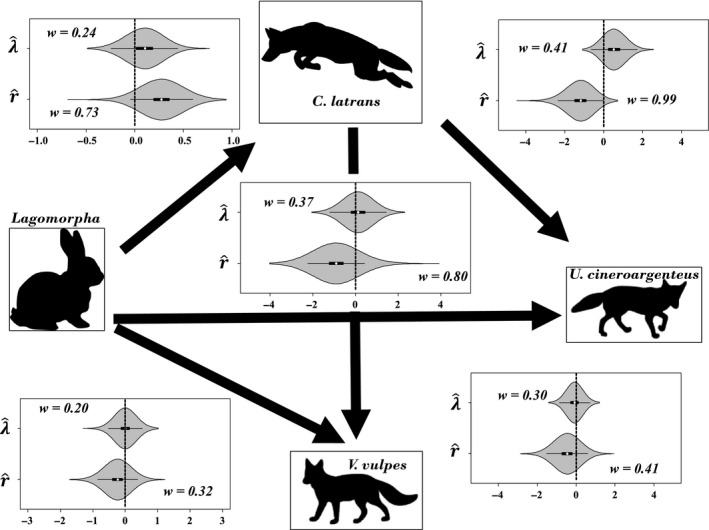
Understanding the conditions that facilitate top predator effects upon mesopredators and prey is critical for predicting where these effects will be significant. Intraguild predation (IGP) and the ecology of fear are hypotheses used to describe the effects of top predators upon mesopredators and prey species, but make different assumptions about organismal space use. The IGP hypothesis predicts that mesopredator resource acquisition and risk are positively correlated, creating a fitness deficit. But if shared prey also avoid a top predator, then mesopredators may not have to choose between risk and reward. Prey life history may be a critical predictor of how shared prey respond to predation and may mediate mesopredator suppression. We used hierarchical models of species distribution and abundance to test expectations of IGP using two separate triangular relationships between a large carnivore, smaller intraguild carnivore, and shared mammalian prey with different life histories. Following IGP, we expected that a larger carnivore would suppress a smaller carnivore if the shared prey species did not spatially avoid the large carnivore at broad scales. If prey were fearful over broad scales, we expected less evidence of mesopredator suppression. We tested these theoretical hypotheses using remote camera detections across a large spatial extent. Lagomorphs did not appear to avoid coyotes, and fox detection probability was lower as coyote abundance increased. In contrast, white-tailed deer appeared to avoid areas of increased wolf use, and coyote detection probability was not reduced at sites where wolves occurred. These findings suggest that mesopredator suppression by larger carnivores may depend upon the behavior of shared prey, specifically the spatial scale at which they perceive risk. We further discuss how extrinsic environmental factors may contribute to mesopredator suppression.
了解促进顶级捕食者对中捕食者和猎物产生影响的条件对于预测这些影响将在何处显著至关重要。公会内部捕食(IGP)和恐惧生态学是用于描述顶级捕食者对中捕食者和猎物物种影响的假说,但对生物空间利用做出了不同的假设。IGP假说预测,中捕食者的资源获取与风险呈正相关,从而导致适合度不足。但如果共享猎物也避开顶级捕食者,那么中捕食者可能不必在风险和回报之间做出选择。猎物的生活史可能是共享猎物对捕食做出反应的关键预测指标,并且可能介导中捕食者的抑制作用。我们使用物种分布和丰度的层次模型,通过大型食肉动物、较小的公会内部食肉动物以及具有不同生活史的共享哺乳动物猎物之间的两种独立三角关系来检验IGP的预期。按照IGP理论,如果共享猎物物种在大尺度上没有在空间上避开大型食肉动物,我们预计大型食肉动物会抑制较小的食肉动物。如果猎物在大尺度上感到恐惧,我们预计中捕食者受到抑制的证据会更少。我们使用在大空间范围内的远程相机检测来检验这些理论假说。兔形目动物似乎没有避开郊狼,并且随着郊狼数量的增加,狐狸的检测概率降低。相比之下,白尾鹿似乎避开了狼使用增加的区域,并且在有狼出现的地点,郊狼的检测概率并没有降低。这些发现表明,大型食肉动物对中捕食者的抑制作用可能取决于共享猎物的行为,特别是它们感知风险的空间尺度。我们进一步讨论了外部环境因素可能如何促成中捕食者的抑制作用。