
社区居住老年人基于人群样本中的肌肉减少症与死亡率
Sarcopenia and mortality among a population-based sample of community-dwelling older adults.
作者信息
Brown Justin C, Harhay Michael O, Harhay Meera N
机构信息
Center for Clinical Epidemiology and Biostatistics University of Pennsylvania School of Medicine Philadelphia PA USA.
Division of Nephrology, Department of Medicine Drexel University College of Medicine Philadelphia PA USA.
出版信息
J Cachexia Sarcopenia Muscle. 2016 Jun;7(3):290-8. doi: 10.1002/jcsm.12073. Epub 2015 Oct 15.
BACKGROUND
Sarcopenia is a risk-factor for all-cause mortality among older adults, but it is unknown if sarcopenia predisposes older adults to specific causes of death. Further, it is unknown if the prognostic role of sarcopenia differs between males and females, and obese and non-obese individuals.
METHODS
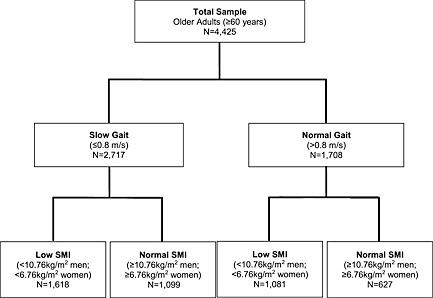
A population-based cohort study among 4425 older adults from the Third National Health and Nutrition Survey (1988-1994). Muscle mass was quantified using bioimpedance analysis, and muscle function was quantified using gait speed. Multivariable-adjusted Cox regression analysis examined the relationship between sarcopenia and mortality outcomes.
RESULTS
The mean age of study participants was 70.1 years. The prevalence of sarcopenia was 36.5%. Sarcopenia associated with an increased risk of all-cause mortality [hazard ratio (HR): 1.29 (95% confidence interval (95% CI): 1.13-1.47); P < 0.001] among males and females. Sarcopenia associated with an increased risk of cardiovascular-specific mortality among females [HR: 1.61 (95% CI: 1.22-2.12); P = 0.001], but not among males [HR: 1.07 (95% CI: 0.81-1.40; P = .643); P interaction = 0.079]. Sarcopenia was not associated with cancer-specific mortality among males and females [HR: 1.07 (95% CI: 0.78-1.89); P = 0.672]. Sarcopenia associated with an increased risk of mortality from other causes (i.e. non-cardiovascular and non-cancer) among males and females [HR: 1.32 (95% CI: 1.07-1.62); P = 0.008]. Obesity, defined using body mass index (P interaction = 0.817) or waist circumference (P interaction = 0.219) did not modify the relationship between sarcopenia and all-cause mortality.
CONCLUSIONS
Sarcopenia is a prevalent syndrome that is associated with premature mortality among community-dwelling older adults. The prognostic value of sarcopenia may vary by cause-specific mortality and differ between males and females.
背景
肌肉减少症是老年人全因死亡率的一个危险因素,但尚不清楚肌肉减少症是否会使老年人易患特定的死亡原因。此外,肌肉减少症的预后作用在男性和女性、肥胖和非肥胖个体之间是否存在差异也尚不清楚。
方法
基于第三次全国健康与营养调查(1988 - 1994年)中的4425名老年人开展一项基于人群的队列研究。使用生物电阻抗分析对肌肉量进行量化,使用步速对肌肉功能进行量化。多变量调整后的Cox回归分析检验了肌肉减少症与死亡结局之间的关系。
结果
研究参与者的平均年龄为70.1岁。肌肉减少症的患病率为36.5%。肌肉减少症与男性和女性全因死亡率风险增加相关[风险比(HR):1.29(95%置信区间(95%CI):1.13 - 1.47);P < 0.001]。肌肉减少症与女性心血管疾病特异性死亡率风险增加相关[HR:1.61(95%CI:1.22 - 2.12);P = 0.001],但与男性无关[HR:1.07(95%CI:0.81 - 1.40;P = 0.643);P交互作用 = 0.079]。肌肉减少症与男性和女性癌症特异性死亡率无关[HR:1.07(95%CI:0.78 - 1.89);P = 0.672]。肌肉减少症与男性和女性其他原因(即非心血管疾病和非癌症)导致的死亡风险增加相关[HR:1.32(95%CI:1.07 - 1.62);P = 0.008]。使用体重指数(P交互作用 = 0.817)或腰围(P交互作用 = 0.219)定义的肥胖并未改变肌肉减少症与全因死亡率之间的关系。
结论
肌肉减少症是一种普遍存在的综合征,与社区居住老年人的过早死亡相关。肌肉减少症的预后价值可能因特定病因死亡率而异,且在男性和女性之间存在差异。


 Zotero 插件