Environmental and Cancer Epidemiology Unit, National Centre for Epidemiology, Carlos III Institute of Health, Avda. Monforte de Lemos 5, 28029, Madrid, Spain.
Consortium for Biomedical Research in Epidemiology and Public Health (CIBER en Epidemiología y Salud Pública (CIBERESP)), Madrid, Spain.
Environ Sci Pollut Res Int. 2016 Sep;23(17):17664-75. doi: 10.1007/s11356-016-6806-y. Epub 2016 May 30.
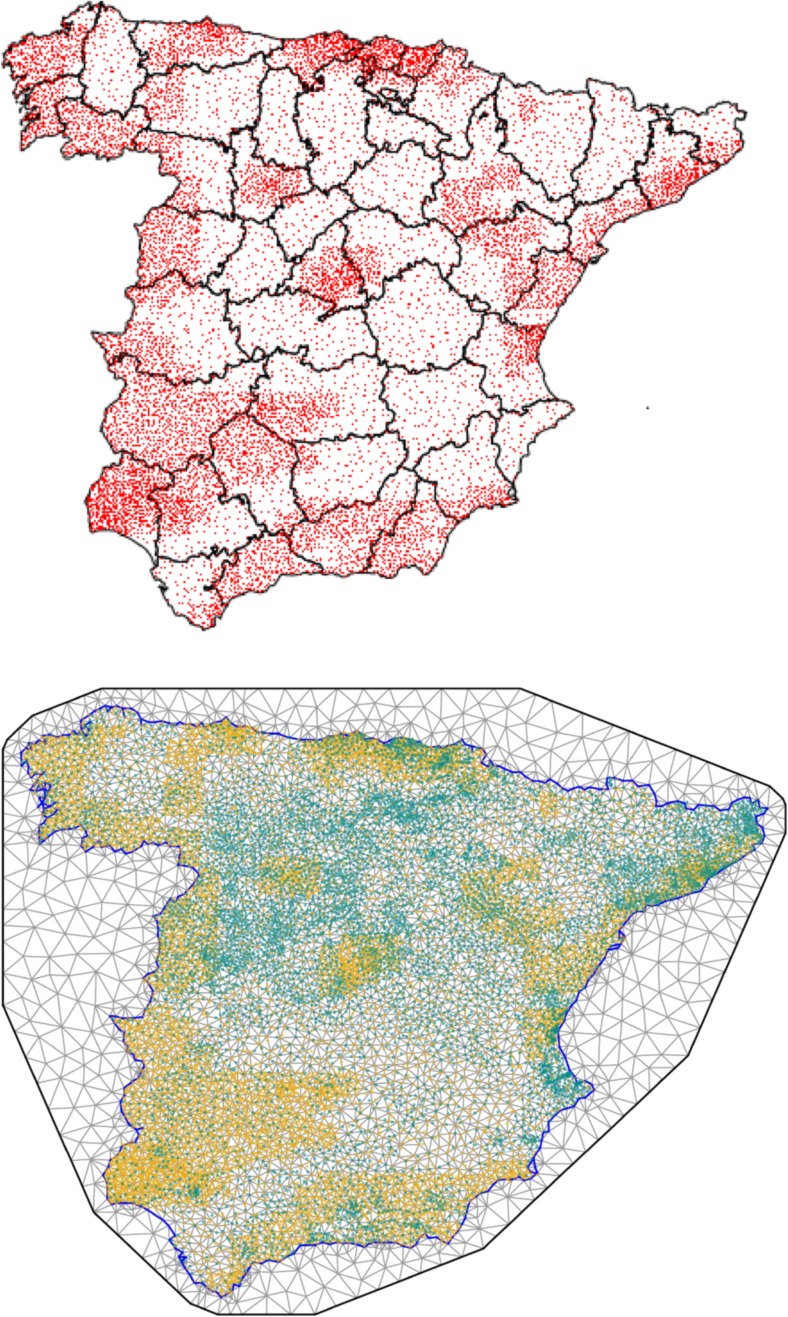
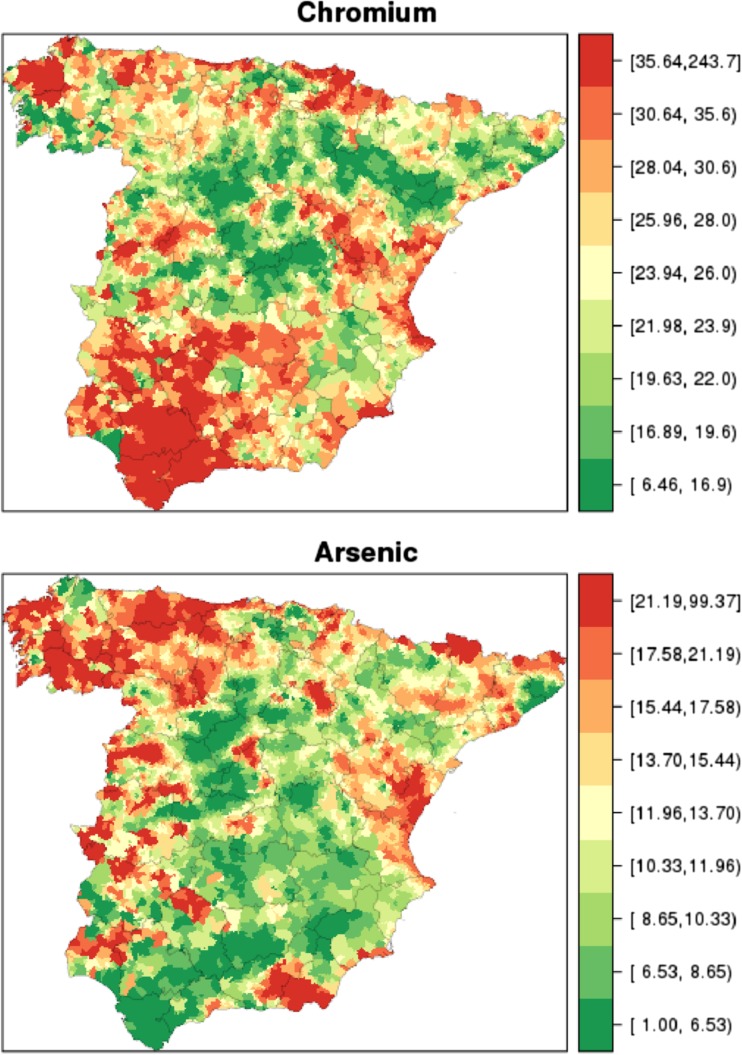
Spatio-temporal cancer mortality studies in Spain have revealed patterns for some tumours which display a distribution that is similar across the sexes and persists over time. Such characteristics would be common to tumours that shared risk factors, including the chemical soil composition. The objective of the present study is to assess the association between levels of chromium and arsenic in soil and the cancer mortality. This is an ecological cancer mortality study at municipal level, covering 861,440 cancer deaths in 7917 Spanish mainland towns from 1999 to 2008. Chromium and arsenic topsoil levels (partial extraction) were determined by ICP-MS at 13,317 sampling points. To estimate the effect of these concentrations on mortality, we fitted Besag, York and Mollié models, which included, as explanatory variables, each town's chromium and arsenic soil levels, estimated by kriging. In addition, we also fitted geostatistical-spatial models including sample locations and town centroids (non-aligned data), using the integrated nested Laplace approximation (INLA) and stochastic partial differential equations (SPDE). All results were adjusted for socio-demographic variables and proximity to industrial emissions. The results showed a statistical association in men and women alike, between arsenic soil levels and mortality due to cancers of the stomach, pancreas, lung and brain and non-Hodgkin's lymphomas (NHL). Among men, an association was observed with cancers of the prostate, buccal cavity and pharynx, oesophagus, colorectal and kidney. Chromium topsoil levels were associated with mortality among women alone, in cancers of the upper gastrointestinal tract, breast and NHL. Our results suggest that chronic exposure arising from low levels of arsenic and chromium in topsoil could be a potential risk factor for developing cancer.
西班牙的时空癌症死亡率研究揭示了一些肿瘤的分布模式,这些肿瘤在性别之间分布相似,并随着时间的推移而持续存在。这些特征可能与具有共同危险因素的肿瘤有关,包括土壤的化学成分。本研究的目的是评估土壤中铬和砷水平与癌症死亡率之间的关系。这是一项在市级层面进行的癌症死亡率生态研究,涵盖了 1999 年至 2008 年西班牙大陆 7917 个城镇的 861440 例癌症死亡病例。通过电感耦合等离子体质谱法(ICP-MS)在 13317 个采样点测定了土壤中铬和砷的表层水平(部分提取)。为了估计这些浓度对死亡率的影响,我们拟合了 Besag、York 和 Mollié 模型,这些模型将每个城镇的铬和砷土壤水平作为解释变量纳入其中,这些水平是通过克里金法估计的。此外,我们还拟合了包括样本位置和城镇质心(非对齐数据)的地质统计空间模型,使用集成嵌套拉普拉斯近似法(INLA)和随机偏微分方程(SPDE)。所有结果均根据社会人口统计学变量和与工业排放的接近程度进行了调整。结果表明,砷土壤水平与男女两性的胃癌、胰腺癌、肺癌和脑癌以及非霍奇金淋巴瘤(NHL)死亡率之间存在统计学关联。在男性中,前列腺癌、口腔、咽、食管、结直肠和肾癌也存在关联。在女性中,土壤上层的铬水平与上消化道、乳房和 NHL 癌症的死亡率有关。我们的研究结果表明,土壤上层中低水平的砷和铬导致的慢性暴露可能是癌症发生的潜在危险因素。