Jen-Ai Hospital, Taichung City 41265, Taiwan.
BMC Public Health. 2013 Apr 10;13:330. doi: 10.1186/1471-2458-13-330.
Numerous studies have examined the association between heavy metal contamination (including arsenic [As], cadmium [Cd], chromium [Cr], copper [Cu], mercury [Hg], nickel [Ni], lead [Pb], and zinc [Zn]) and lung cancer. However, data from previous studies on pathological cell types are limited, particularly regarding exposure to low-dose soil heavy metal contamination. The purpose of this study was to explore the association between soil heavy metal contamination and lung cancer incidence by specific cell type in Taiwan.
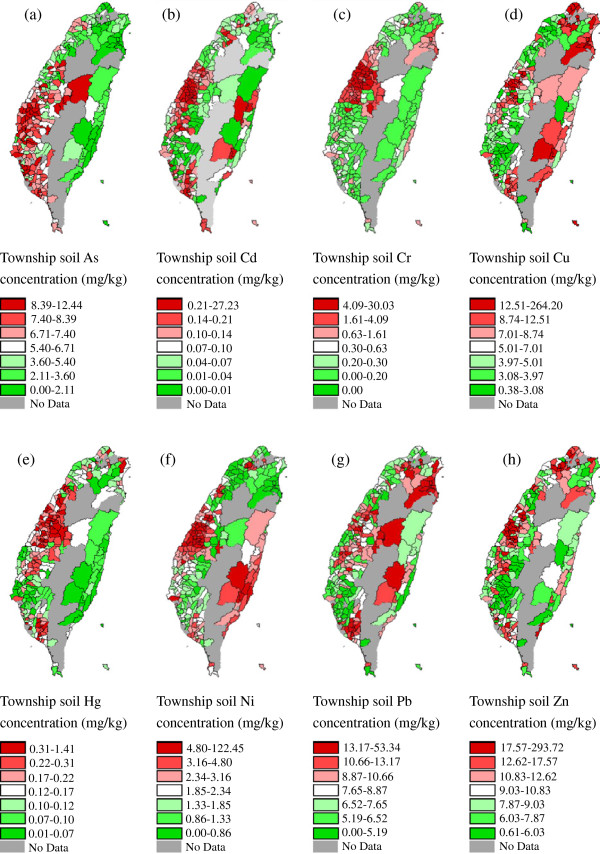
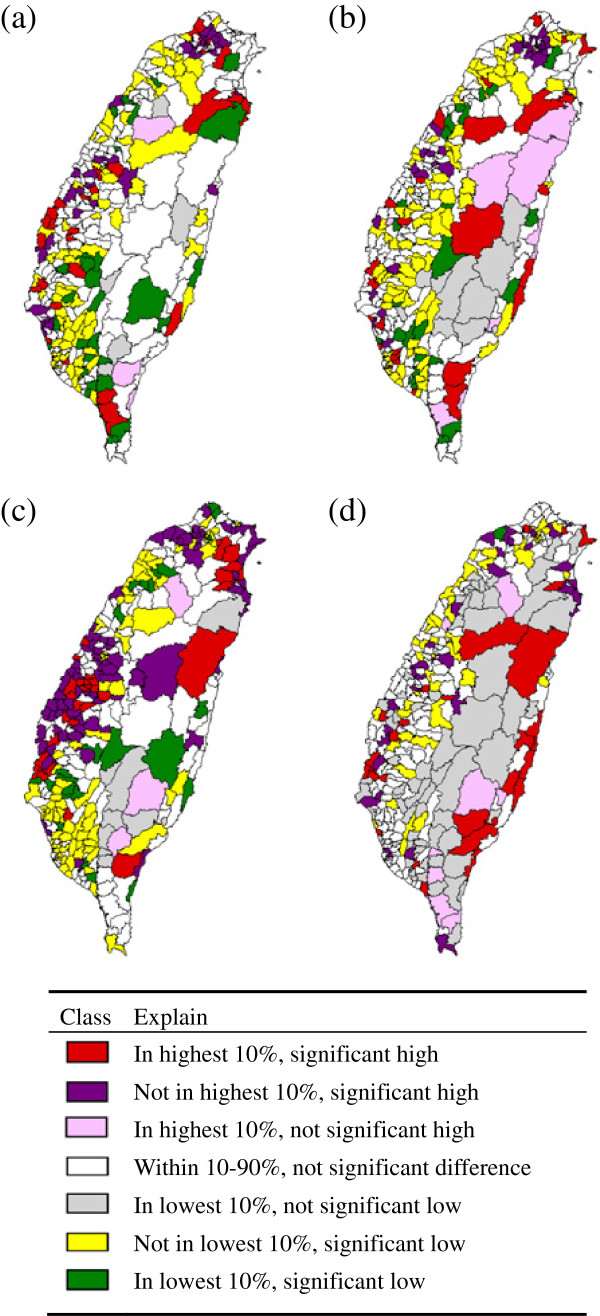
We conducted an ecological study and calculated the annual averages of eight soil heavy metals (i.e., As, Cd, Cr, Cu, Hg, Ni, Pb, and Zn) by using data from the Taiwan Environmental Protection Administration from1982 to 1986. The age-standardized incidence rates of lung cancer according to two major pathological types (adenocarcinoma [AC] and squamous cell carcinoma [SCC]) were obtained from the National Cancer Registry Program conducted in Taiwan from 2001 to 2005. A geographical information system was used to plot the maps of soil heavy metal concentration and lung cancer incidence rates. Poisson regression models were used to obtain the adjusted relative ratios (RR) and 95% confidence intervals (CI) for the lung cancer incidence associated with soil heavy metals.
For males, the trend test for lung SCC incidence caused by exposure to Cr, Cu, Hg, Ni, and Zn showed a statistically significant dose-response relationship. However, for lung AC, only Cu and Ni had a significant dose-response relationship. As for females, those achieving a statistically significant dose-response relationship for the trend test were Cr (P = 0.02), Ni (P = 0.02), and Zn (P= 0.02) for lung SCC, and Cu (P < 0.01) and Zn (P = 0.02) for lung AC.
The current study suggests that a dose-response relationship exists between low-dose soil heavy metal concentration and lung cancer occurrence by specific cell-type; however, the relevant mechanism should be explored further.
许多研究都考察了重金属污染(包括砷[As]、镉[Cd]、铬[Cr]、铜[Cu]、汞[Hg]、镍[Ni]、铅[Pb]和锌[Zn])与肺癌之间的关联。然而,之前关于特定细胞类型的研究数据有限,特别是关于低剂量土壤重金属污染暴露的研究。本研究旨在探讨台湾地区土壤重金属污染与肺癌特定细胞类型发病之间的关系。
我们进行了一项生态学研究,根据台湾环境保护署 1982 年至 1986 年的数据,计算了八种土壤重金属(即 As、Cd、Cr、Cu、Hg、Ni、Pb 和 Zn)的年平均值。从 2001 年至 2005 年台湾癌症登记计划中获得了肺癌的年龄标准化发病率,根据两种主要的病理类型(腺癌[AC]和鳞状细胞癌[SCC])进行了划分。使用地理信息系统绘制了土壤重金属浓度和肺癌发病率的地图。使用泊松回归模型获得了与土壤重金属相关的肺癌发病率的调整相对比(RR)和 95%置信区间(CI)。
对于男性,Cr、Cu、Hg、Ni 和 Zn 暴露引起的肺癌 SCC 发病率的趋势检验呈统计学显著剂量-反应关系。然而,对于肺癌 AC,只有 Cu 和 Ni 具有显著的剂量-反应关系。对于女性,Cr(P = 0.02)、Ni(P = 0.02)和 Zn(P = 0.02)与肺癌 SCC,以及 Cu(P < 0.01)和 Zn(P = 0.02)与肺癌 AC 的趋势检验达到统计学显著剂量-反应关系。
本研究表明,低剂量土壤重金属浓度与特定细胞类型肺癌的发生之间存在剂量-反应关系;然而,相关机制仍需进一步探讨。