Schirmack Janosch, Fiebrandt Marcel, Stapelmann Katharina, Schulze-Makuch Dirk
Astrobiology Research Group, Center for Astronomy and Astrophysics, Technical University Berlin (TUB), Berlin 10623, Germany.
Biomedical Applications of Plasma Technology, Institute for Electrical Engineering and Plasma Technology (AEPT), Ruhr University Bochum (RUB), Bochum 44801, Germany.
Life (Basel). 2016 May 26;6(2):22. doi: 10.3390/life6020022.
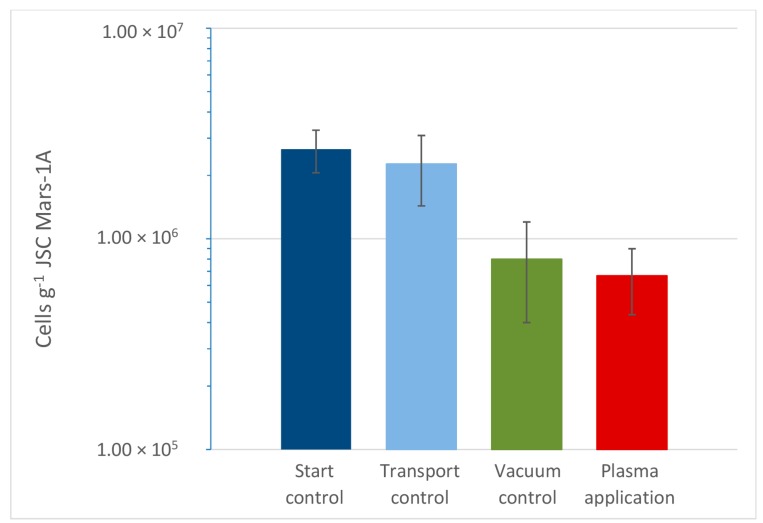
We used Ar plasma-sterilization at a temperature below 80 °C to examine its effects on the viability of microorganisms when intermixed with tested soil. Due to a relatively low temperature, this method is not thought to affect the properties of a soil, particularly its organic component, to a significant degree. The method has previously been shown to work well on spacecraft parts. The selected microorganism for this test was Deinococcus radiodurans R1, which is known for its remarkable resistance to radiation effects. Our results showed a reduction in microbial counts after applying a low temperature plasma, but not to a degree suitable for a sterilization of the soil. Even an increase of the treatment duration from 1.5 to 45 min did not achieve satisfying results, but only resulted in in a mean cell reduction rate of 75% compared to the untreated control samples.
我们在80°C以下的温度使用氩等离子体灭菌,以检验其与受试土壤混合时对微生物活力的影响。由于温度相对较低,该方法被认为不会对土壤性质,特别是其有机成分产生显著影响。此前已证明该方法在航天器部件上效果良好。本次试验选用的微生物是耐辐射奇异球菌R1,它以对辐射效应具有显著抗性而闻名。我们的结果表明,施加低温等离子体后微生物数量减少,但减少程度不适用于土壤灭菌。即使将处理时间从1.5分钟增加到45分钟,也未取得令人满意的结果,与未处理的对照样品相比,平均细胞减少率仅为75%。