Wang Meiyan, He Bin, Wang Yuhuan, Wu Fuchen, Chen Xuefeng, Wang Wenting, Yang Xue
Shihezi University School of Medicine, Shihezi, Xinjiang, China.
PLoS One. 2016 May 31;11(5):e0156382. doi: 10.1371/journal.pone.0156382. eCollection 2016.
Paying attention to and improving the mental health of the informal caregivers of disabled elders has become a global public health priority. This study focused on low-income female Uyghur and Kazakh informal caregivers of disabled elders residing in China's far west. It investigated the prevalence of and the major related factors of depressive emotion.
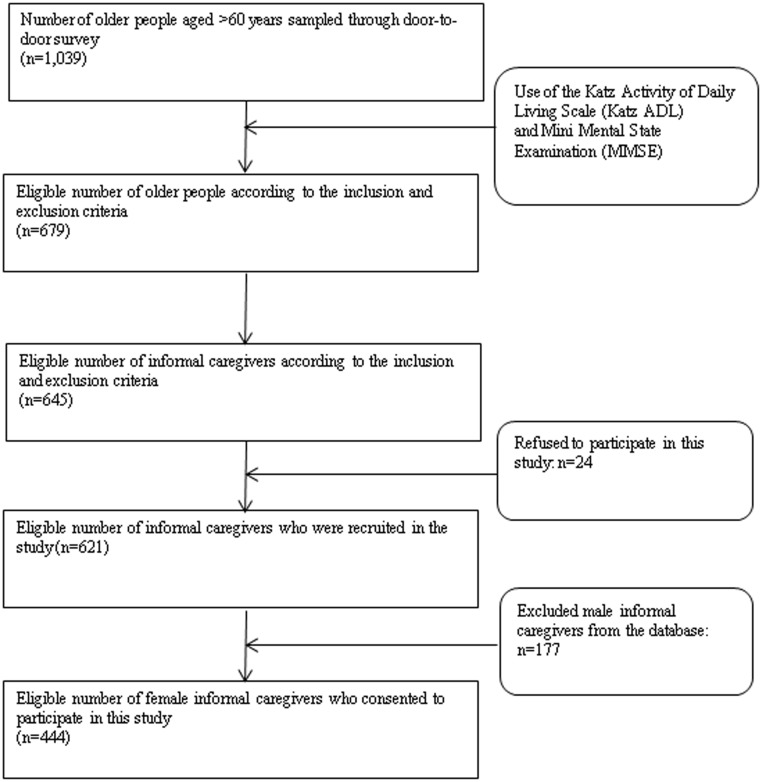
A cross-sectional study was performed from September 2013 to January 2014 in Shawan Prefectures, Tuokexun Prefectures, Bole Prefecture and Urumchi city. Shawan Prefecture has the highest proportion of Kazakhs, whereas Tuokexun Prefectures, Bole Prefecture and Urumchi city have the highest proportion of Uyghurs in Muslim ethnic Uygur and Kazakh communities. Xinjiang Uyghur Autonomous Region is located in remote western China; this area is approximately 3,105 km (1,929 miles) away from Beijing. A total of 444 female Uyghur and Kazakh informal caregivers of disabled elders participated in this study. The self-rating depression scale, the Zarit burden interview, and the SF-36 questionnaire were used to evaluate the state of caregiver depression, caregiver burden, and quality of life (QOL), respectively. Statistical analyses were performed using multivariate logistic regression analyses, correlation with Spearman's rho and independent-sample t-tests; a P-value of <0.05 was considered statistically significant.
Up to 38.5% (n = 217) of informal caregivers reported having depression, whereas 61.5% (n = 273) of them reported a lack of depression. Age of disabled elders more than 60 years old, total hours spent on caring daily≥8h, duration of caring≥5 years, negative self-evaluation of health condition, having caregiver burden, elders' medium degree of disability and elders' heavy degree of disability had a higher risk of caregiver depression. By contrast, daughter/daughter-in-law of disabled elders; unemployed carers, family's per capita income >US$235.48(1500 yuan), high social support, and high QOL of disabled elders were each associated with a lower risk of depressive emotion. Moreover, informal caregivers with depression obtained high care burden scores; at the same time, disabled elders who were looked after by caregivers with depression obtained low QOL scores.
Our findings suggest that the demographics characteristics of informal caregivers, and caregiver burden, and the disabled elders' degree of disability and QOL had the most significant correlation with depressive emotion among women informal caregivers. The results had a enlighten that these variables should be considered while planning interventions to improve depression of informal caregivers.
关注并改善残疾老年人非正式照料者的心理健康已成为全球公共卫生的重点。本研究聚焦于居住在中国最西部的低收入维吾尔族和哈萨克族残疾老年人的女性非正式照料者,调查了抑郁情绪的患病率及主要相关因素。
2013年9月至2014年1月在沙湾县、托克逊县、博乐市和乌鲁木齐市开展了一项横断面研究。沙湾县哈萨克族比例最高,而托克逊县、博乐市和乌鲁木齐市在穆斯林民族维吾尔族和哈萨克族社区中维吾尔族比例最高。新疆维吾尔自治区位于中国西部偏远地区,距北京约3105公里(1929英里)。共有444名维吾尔族和哈萨克族残疾老年人的女性非正式照料者参与了本研究。分别使用自评抑郁量表、扎里特负担访谈量表和SF-36问卷来评估照料者的抑郁状态、照料者负担和生活质量(QOL)。采用多因素逻辑回归分析、Spearman秩相关分析和独立样本t检验进行统计分析;P值<0.05被认为具有统计学意义。
高达38.5%(n = 217)的非正式照料者报告有抑郁,而61.5%(n = 273)的人报告无抑郁。60岁以上残疾老年人、每日照料总时长≥8小时、照料时长≥5年、对自身健康状况负面自评、有照料者负担、老年人中度残疾和重度残疾的照料者患抑郁的风险较高。相比之下,残疾老年人的女儿/儿媳、无业照料者、家庭人均收入>235.48美元(1500元人民币)、社会支持高以及残疾老年人生活质量高,各自与抑郁情绪风险较低相关。此外,有抑郁的非正式照料者获得的照料负担得分高;同时,由有抑郁的照料者照顾的残疾老年人获得的生活质量得分低。
我们的研究结果表明,非正式照料者的人口统计学特征、照料者负担以及残疾老年人的残疾程度和生活质量与女性非正式照料者的抑郁情绪最显著相关。这些结果启示,在规划改善非正式照料者抑郁的干预措施时应考虑这些变量。