Takahashi Hirotaka, Uematsu Atsushi, Yamanaka Satoshi, Imamura Mei, Nakajima Tatsuro, Doi Kousuke, Yasuoka Saki, Takahashi Chikako, Takeda Hiroyuki, Sawasaki Tatsuya
Proteo-Science Center (PROS), Ehime University, 3 Bunkyo-cho, Matsuyama, Ehime 790-8577, Japan.
PLoS One. 2016 Jun 1;11(6):e0156718. doi: 10.1371/journal.pone.0156718. eCollection 2016.
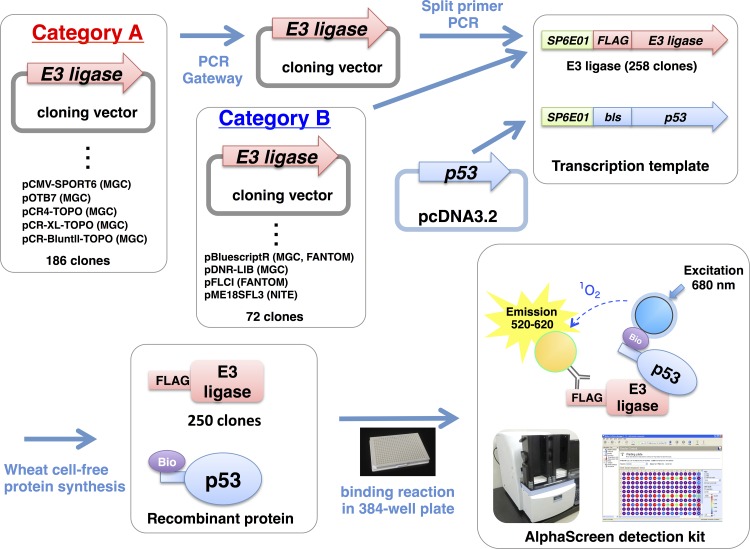
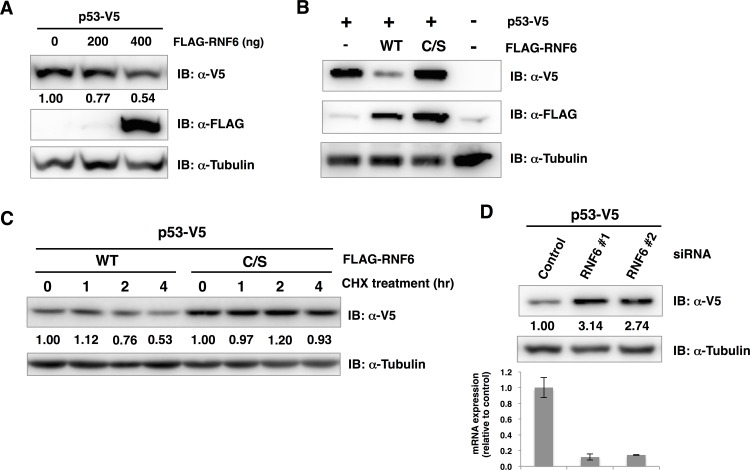
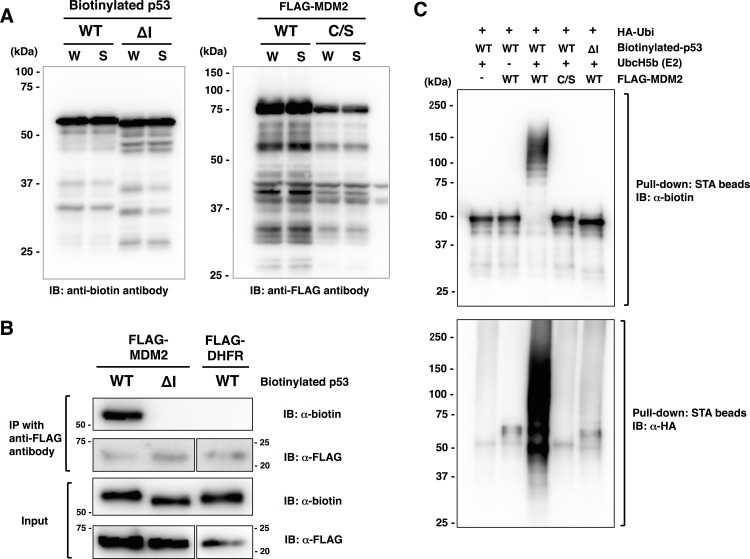
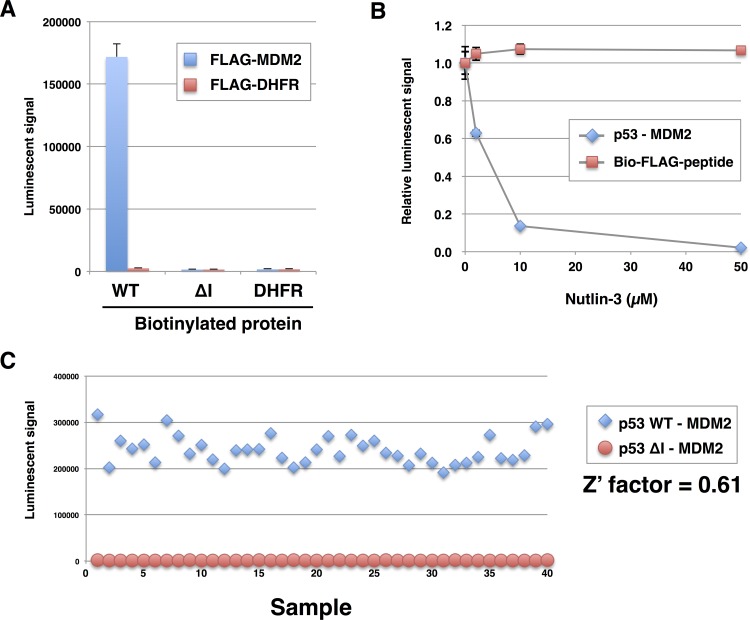
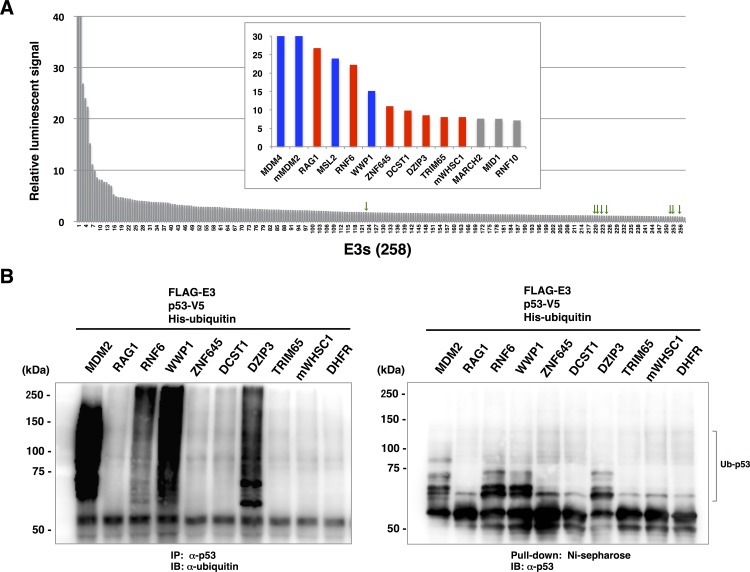
Ubiquitination is a key post-translational modification in the regulation of numerous biological processes in eukaryotes. The primary roles of ubiquitination are thought to be the triggering of protein degradation and the regulation of signal transduction. During protein ubiquitination, substrate specificity is mainly determined by E3 ubiquitin ligase (E3). Although more than 600 genes in the human genome encode E3, the E3s of many target proteins remain unidentified owing to E3 diversity and the instability of ubiquitinated proteins in cell. We demonstrate herein a novel biochemical analysis for the identification of E3s targeting specific proteins. Using wheat cell-free protein synthesis system, a protein array containing 227 human and 23 mouse recombinant E3s was synthesized. To establish the high-throughput binding assay using AlphaScreen technology, we selected MDM2 and p53 as the model combination of E3 and its target protein. The AlphaScreen assay specifically detected the binding of p53 and MDM2 in a crude translation mixture. Then, a comprehensive binding assay using the E3 protein array was performed. Eleven of the E3s showed high binding activity, including four previously reported E3s (e.g., MDM2, MDM4, and WWP1) targeting p53. This result demonstrated the reliability of the assay. Another interactors, RNF6 and DZIP3-which there have been no report to bind p53-were found to ubiquitinate p53 in vitro. Further analysis showed that RNF6 decreased the amount of p53 in H1299 cells in E3 activity-dependent manner. These results suggest the possibility that the RNF6 ubiquitinates and degrades p53 in cells. The novel in vitro screening system established herein is a powerful tool for finding novel E3s of a target protein.
泛素化是真核生物中众多生物过程调控的关键翻译后修饰。泛素化的主要作用被认为是触发蛋白质降解和调节信号转导。在蛋白质泛素化过程中,底物特异性主要由E3泛素连接酶(E3)决定。尽管人类基因组中有600多个基因编码E3,但由于E3的多样性以及细胞中泛素化蛋白的不稳定性,许多靶蛋白的E3仍未被鉴定。我们在此展示了一种用于鉴定靶向特定蛋白质的E3的新型生化分析方法。利用小麦无细胞蛋白质合成系统,合成了包含227种人类和23种小鼠重组E3的蛋白质阵列。为了建立使用AlphaScreen技术的高通量结合分析方法,我们选择MDM2和p53作为E3及其靶蛋白的模型组合。AlphaScreen分析在粗翻译混合物中特异性检测到p53和MDM2的结合。然后,使用E3蛋白质阵列进行了全面的结合分析。其中11种E3显示出高结合活性,包括4种先前报道的靶向p53的E3(如MDM2、MDM4和WWP1)。这一结果证明了该分析方法的可靠性。另外发现了两个此前没有报道与p53结合的相互作用蛋白RNF6和DZIP3,它们在体外能使p53泛素化。进一步分析表明,RNF6以E3活性依赖的方式降低了H1299细胞中p53的含量。这些结果提示RNF6在细胞中使p53泛素化并降解的可能性。本文建立的新型体外筛选系统是寻找靶蛋白新型E3的有力工具。