Enard Kimberly R, Dolan Mullen Patricia, Kamath Geetanjali R, Dixon Nickell M, Volk Robert J
Department of Health Management and Policy, Saint Louis University, 3545 Lafayette Avenue, Saint Louis, MO, USA.
Department of Health Promotion and Behavioral Sciences, The University of Texas School of Public Health, 7000 Fannin Street, UCT Suite 2522, Houston, TX, 77030, USA.
BMC Med Inform Decis Mak. 2016 Jun 6;16:64. doi: 10.1186/s12911-016-0303-6.
Shared decision-making (SDM) is considered a key component of high quality cancer care and may be supported by patient decision aids (PtDAs). Many patients, however, face multiple social disadvantages that may influence their ability to fully participate in SDM or to use PtDAs; additionally, these social disadvantages are among the determinants of health associated with greater cancer risk, unwarranted variations in care and worse outcomes. The purpose of this systematic review is to describe the extent to which disadvantaged social groups in the United States (US) have been included in trials of cancer-related PtDAs and to highlight strategies, lessons learned and future opportunities for developing and evaluating PtDAs that are appropriate for disadvantaged populations.
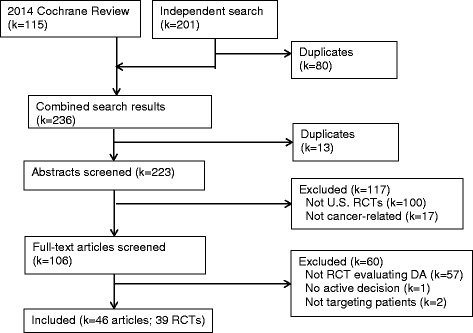
We selected cancer-related US studies from the Cochrane 2014 review of PtDAs and added RCTs meeting Cochrane criteria from searches of PubMed, CINAHL, PsycINFO (January 2010 to December 2013); and reference lists. Two reviewers independently screened titles/abstracts; three reviewers independently screened full text articles, performed data extraction and assessed: 1) inclusion of participants based on seven indicators of social disadvantage (limited education; female gender; uninsured or Medicaid status; non-U.S. nativity; non-White race or Hispanic ethnicity; limited English proficiency; low-literacy), and 2) attention to social disadvantage in the development or evaluation of PtDAs.
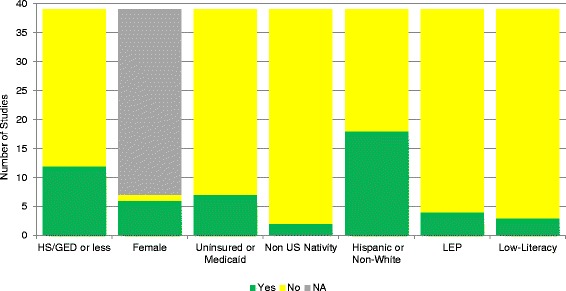
Twenty-three of 39 eligible RCTs included participants from at least one disadvantaged subgroup, most frequently racial/ethnic minorities or individuals with limited education and/or low-literacy. Seventeen studies discussed strategies and lessons learned in attending to the needs of disadvantaged social groups in PtDA development; 14 studies targeted disadvantaged groups or addressed subgroup differences in PtDA evaluation.
The diversity of the US population is represented in a majority of cancer-related PtDA RCTs, but fewer studies have tailored PtDAs to address the multiple social disadvantages that may impact patients' participation in SDM. More detailed attention to the comprehensive range of social factors that determine cancer risk, variations in care and outcomes is needed in the development and evaluation of PtDAs for disadvantaged populations.
Registered 24 October 2014 in PROSPERO International prospective register of systematic reviews ( CRD42014014470 ).
共同决策(SDM)被视为高质量癌症护理的关键组成部分,患者决策辅助工具(PtDAs)可能会对此提供支持。然而,许多患者面临多种社会不利因素,这些因素可能会影响他们充分参与共同决策或使用患者决策辅助工具的能力;此外,这些社会不利因素是与更高癌症风险、不必要的护理差异和更差预后相关的健康决定因素之一。本系统评价的目的是描述美国弱势群体在癌症相关患者决策辅助工具试验中的纳入程度,并强调为弱势群体开发和评估合适的患者决策辅助工具的策略、经验教训和未来机会。
我们从Cochrane 2014年对患者决策辅助工具的综述中选取了美国癌症相关研究,并通过检索PubMed、CINAHL、PsycINFO(2010年1月至2013年12月)以及参考文献列表,补充了符合Cochrane标准的随机对照试验(RCTs)。两名评审员独立筛选标题/摘要;三名评审员独立筛选全文文章、进行数据提取并评估:1)根据七个社会不利指标(教育程度有限;女性;未参保或医疗补助状况;非美国本土出生;非白人种族或西班牙裔;英语水平有限;低识字率)纳入参与者,以及2)在患者决策辅助工具的开发或评估中对社会不利因素的关注。
39项符合条件的随机对照试验中有23项纳入了至少一个弱势群体亚组的参与者,最常见的是少数种族/族裔或教育程度有限和/或识字率低的个体。17项研究讨论了在患者决策辅助工具开发中关注弱势群体需求的策略和经验教训;14项研究针对弱势群体或在患者决策辅助工具评估中探讨了亚组差异。
大多数癌症相关患者决策辅助工具随机对照试验体现了美国人口的多样性,但针对可能影响患者参与共同决策的多种社会不利因素而量身定制患者决策辅助工具的研究较少。在为弱势群体开发和评估患者决策辅助工具时,需要更详细地关注决定癌症风险、护理差异和预后的一系列社会因素。
于2014年10月24日在PROSPERO国际系统评价前瞻性注册库中注册(CRD42014014470)。