Mogami Sachiko, Sadakane Chiharu, Nahata Miwa, Mizuhara Yasuharu, Yamada Chihiro, Hattori Tomohisa, Takeda Hiroshi
Tsumura Research Laboratories, Tsumura &Co., Ibaraki 300-1192, Japan.
Pathophysiology and Therapeutics, Faculty of Pharmaceutical Sciences, Hokkaido University, Sapporo, Hokkaido 060-0812, Japan.
Sci Rep. 2016 Jun 8;6:27516. doi: 10.1038/srep27516.
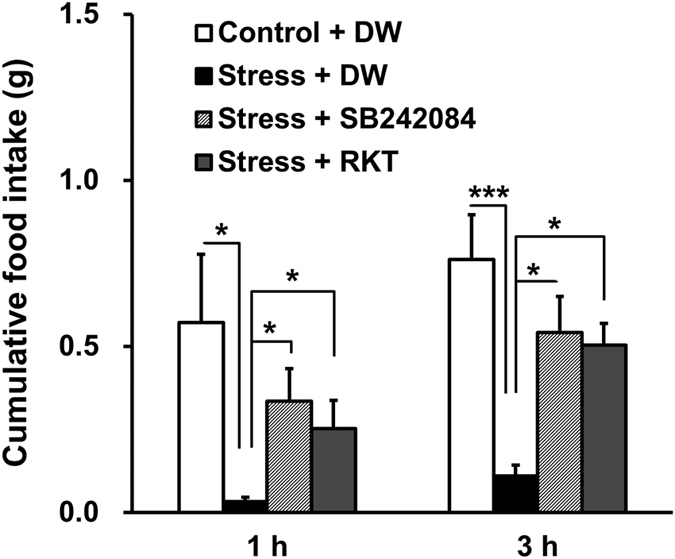
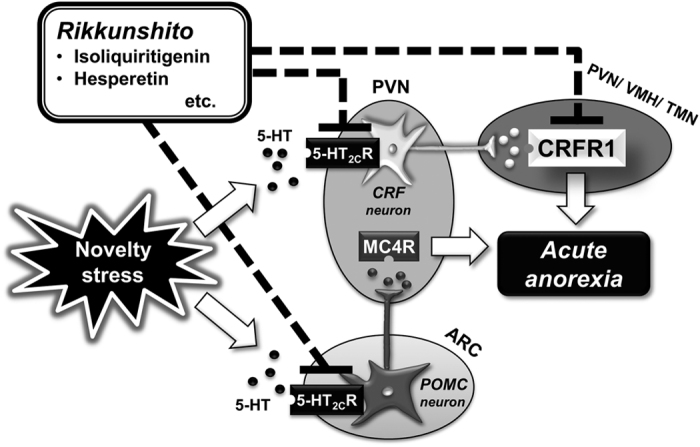
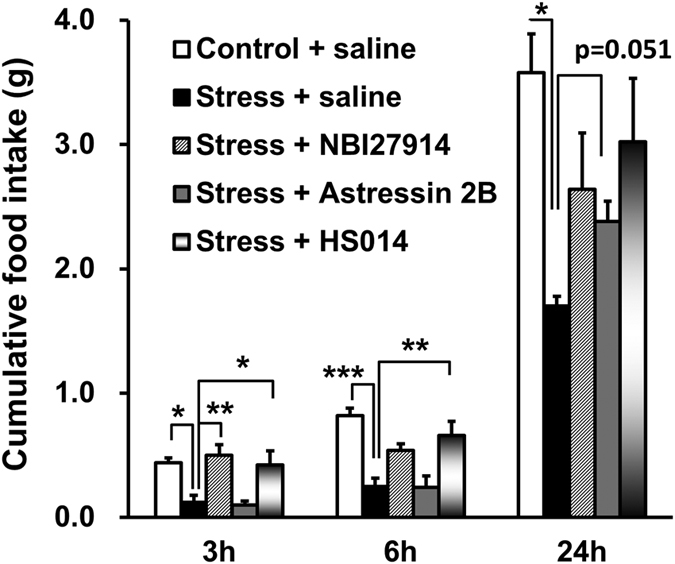
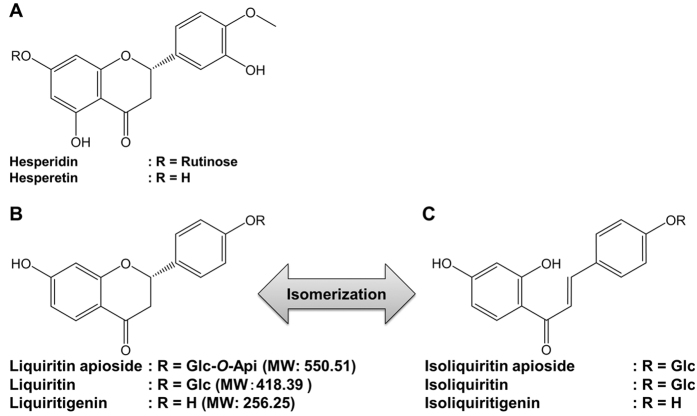
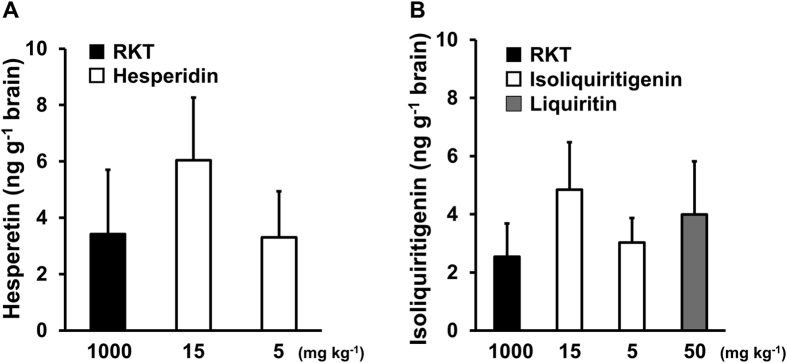
Rikkunshito (RKT), a Kampo medicine, has been reported to show an ameliorative effect on sustained hypophagia after novelty stress exposure in aged mice through serotonin 2C receptor (5-HT2CR) antagonism. We aimed to determine (1) whether the activation of anorexigenic neurons, corticotropin-releasing factor (CRF), and pro-opiomelanocortin (POMC) neurons, is involved in the initiation of hypophagia induced by novelty stress in aged mice; (2) whether the ameliorative effect of RKT is associated with CRF and POMC neurons and downstream signal transduction; and (3) the plasma and brain distribution of the active components of RKT. The administration of RKT or 5-HT2CR, CRF receptor 1 (CRFR1), and melanocortin-4 receptor antagonists significantly restored the decreased food intake observed in aged male C57BL/6 mice in the early stage after novelty stress exposure. Seven components of RKT exhibited antagonistic activity against CRFR1. Hesperetin and isoliquiritigenin, which showed antagonistic effects against both CRFR1 and 5-HT2CR, were distributed in the plasma and brain of male Sprague-Dawley rats after a single oral administration of RKT. In conclusion, the ameliorative effect of RKT in this model is assumed to be at least partly due to brain-distributed active components possessing 5-HT2CR and CRFR1 antagonistic activities.
汉方药物理气剂(RKT)已被报道,通过拮抗血清素2C受体(5-HT2CR),对老年小鼠在新异应激暴露后持续的摄食减少具有改善作用。我们旨在确定:(1)厌食性神经元、促肾上腺皮质激素释放因子(CRF)和阿黑皮素原(POMC)神经元的激活是否参与老年小鼠新异应激诱导的摄食减少的起始过程;(2)RKT的改善作用是否与CRF和POMC神经元及下游信号转导相关;以及(3)RKT活性成分在血浆和脑内的分布情况。给予RKT或5-HT2CR、CRF受体1(CRFR1)和黑皮质素-4受体拮抗剂,可显著恢复老年雄性C57BL/6小鼠在新异应激暴露后早期观察到的食物摄入量减少。RKT的七种成分表现出对CRFR1的拮抗活性。在单次口服RKT后,对CRFR1和5-HT2CR均表现出拮抗作用的橙皮素和异甘草素分布于雄性Sprague-Dawley大鼠的血浆和脑内。总之,在该模型中,RKT的改善作用被认为至少部分归因于脑内分布的具有5-HT2CR和CRFR1拮抗活性的活性成分。