Park Young-Min, Lee Bun-Hee
Department of Psychiatry, Ilsan Paik Hospital, Inje University College of Medicine, Goyang, Republic of Korea.
Department of Psychiatry, Seoul Eunpyeong Hospital, Seoul, Republic of Korea.
Neuropsychiatr Dis Treat. 2016 May 17;12:1221-7. doi: 10.2147/NDT.S104188. eCollection 2016.
The aim of this observational study was to determine whether subthreshold bipolarity affects treatment response and remission in patients with major depressive disorder receiving antidepressant (AD) monotherapy over a 6-month follow-up period.
Seventy-eight patients with major depressive disorder were stratified into two subgroups according to the presence of subthreshold bipolarity, identified using the Korean version of the Mood Disorder Questionnaire (K-MDQ), which classifies patients as positive for a screening of bipolarity based on the cutoff for the total K-MDQ score (ie, 7 points). They received AD monotherapy such as escitalopram, sertraline, paroxetine, or tianeptine for 6 months. The Beck Depression Inventory (BDI), Hamilton Depression Rating Scale (HAMD), Hamilton Anxiety Scale, and Beck Scale for Suicide Ideation were applied at baseline, 1 week, 3 weeks, 2 months, 3 months, and 6 months.
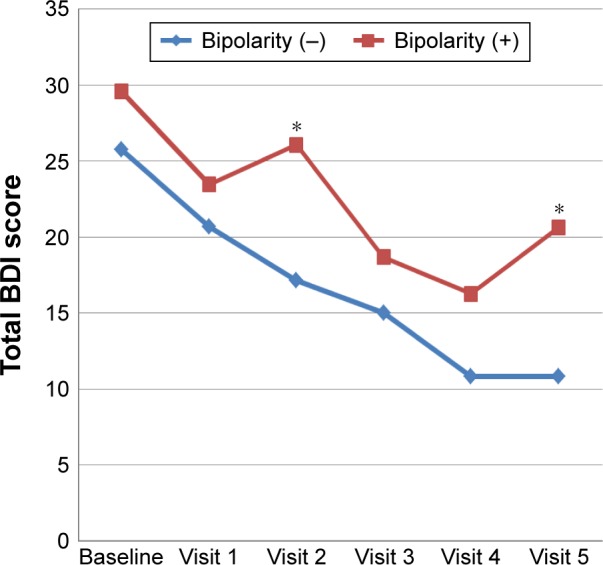
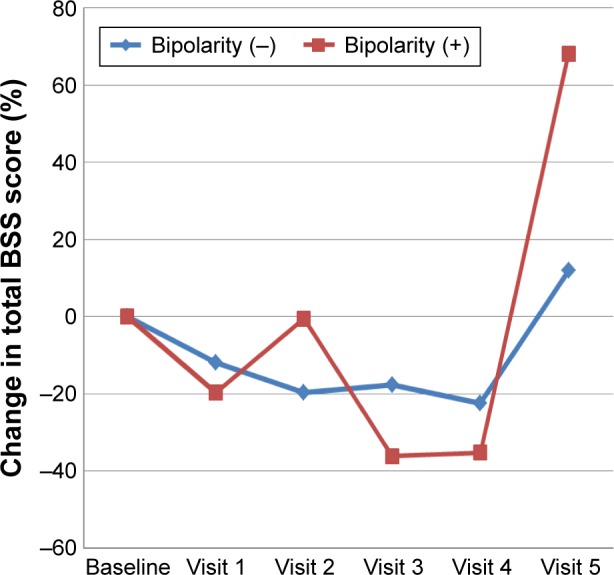
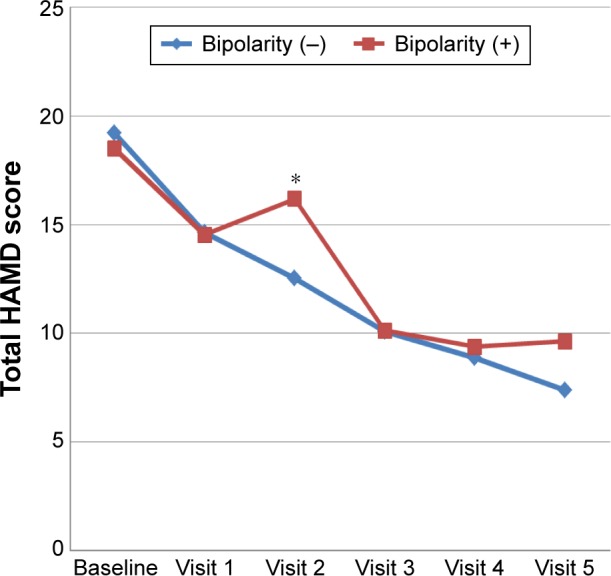
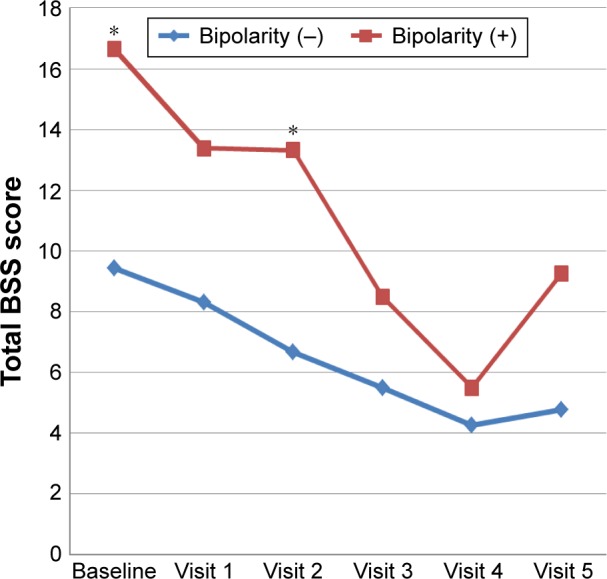
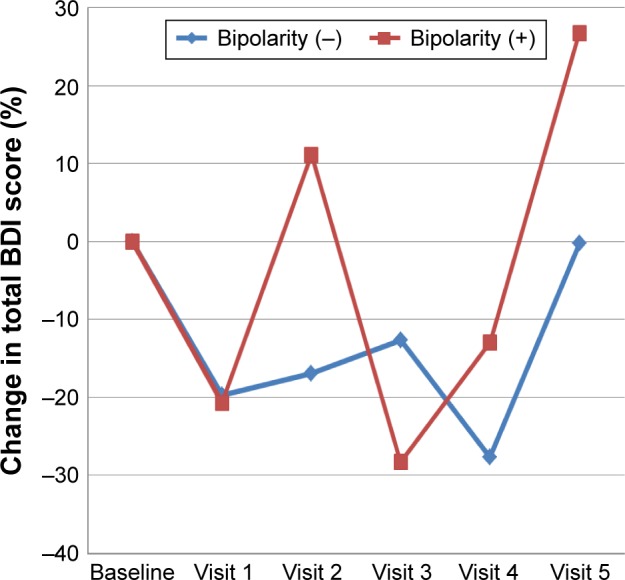
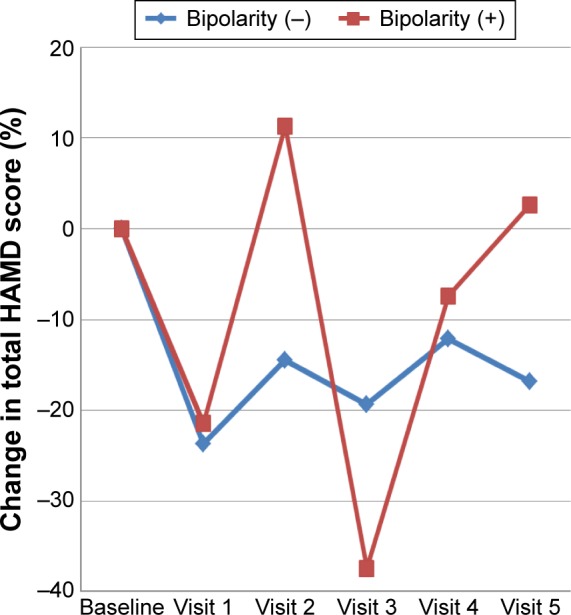
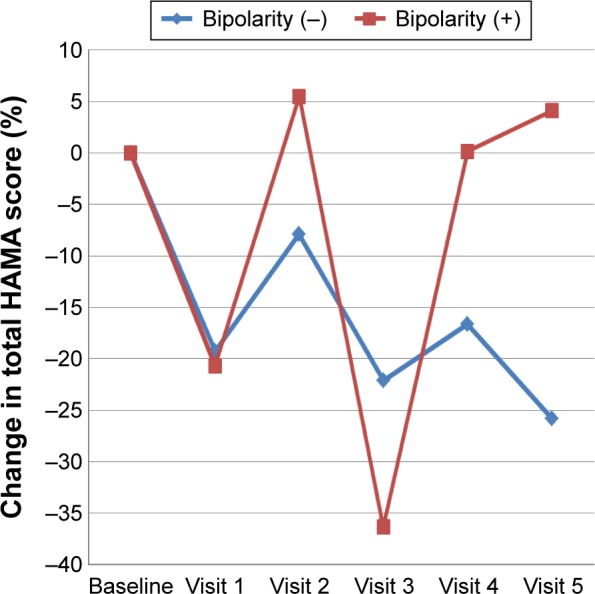
The mean HAMD, BDI, and Beck Scale for Suicide Ideation scores were higher in the bipolarity group than in the nonbipolarity group at 3 weeks. The mean BDI score was also higher in the bipolarity group than in the nonbipolarity group at 6 months. Evaluation of the ratio of improvement for each scale revealed different patterns of percentage changes between the two groups over the 6-month follow-up period. Furthermore, the response and remission rates (as assessed using BDI and HAMD scores) were higher in the nonbipolarity group than in the bipolarity group, with the exception of HAMD scores at the 3-week follow-up time point.
The findings of this study showed that depressed patients with bipolarity had a worse response to AD monotherapy than did those without bipolarity.
这项观察性研究的目的是确定阈下双相情感障碍是否会影响接受抗抑郁药(AD)单药治疗的重度抑郁症患者在6个月随访期内的治疗反应和缓解情况。
78例重度抑郁症患者根据阈下双相情感障碍的存在情况分为两个亚组,使用韩国版心境障碍问卷(K-MDQ)进行识别,该问卷根据K-MDQ总分的临界值(即7分)将患者分类为双相情感障碍筛查阳性。他们接受了艾司西酞普兰、舍曲林、帕罗西汀或噻奈普汀等AD单药治疗6个月。在基线、1周、3周、2个月、3个月和6个月时应用贝克抑郁量表(BDI)、汉密尔顿抑郁评定量表(HAMD)、汉密尔顿焦虑量表和贝克自杀意念量表。
双相情感障碍组在3周时的平均HAMD、BDI和贝克自杀意念量表得分高于非双相情感障碍组。双相情感障碍组在6个月时的平均BDI得分也高于非双相情感障碍组。对各量表改善率的评估显示,在6个月的随访期内,两组之间的百分比变化模式不同。此外,除了在3周随访时间点的HAMD得分外,非双相情感障碍组的反应率和缓解率(根据BDI和HAMD得分评估)高于双相情感障碍组。
本研究结果表明,患有双相情感障碍的抑郁症患者对AD单药治疗的反应比没有双相情感障碍的患者更差。