Guo Qiuyan, Mao Xia, Zhang Yanqiong, Meng Shuqin, Xi Yue, Ding Yi, Zhang Xiaocun, Dai Yuntao, Liu Xia, Wang Chao, Li Yuting, Lin Na
Institute of Chinese Materia Medica, China Academy of Chinese Medical Sciences, Beijing, 100700, China.
Department of Pathology, Beijing Jishuitan Hospital, Peking University, Beijing, 100035, China.
J Transl Med. 2016 Jun 8;14(1):165. doi: 10.1186/s12967-016-0921-x.
Guizhi-Shaoyao-Zhimu decoction (GSZD) has been extensively used for rheumatoid arthritis (RA) therapy. Marked therapeutic efficacy of GSZD acting on RA has been demonstrated in several long-term clinical trials without any significant side effects. However, its pharmacological mechanisms remain unclear due to a lack of appropriate scientific methodology.
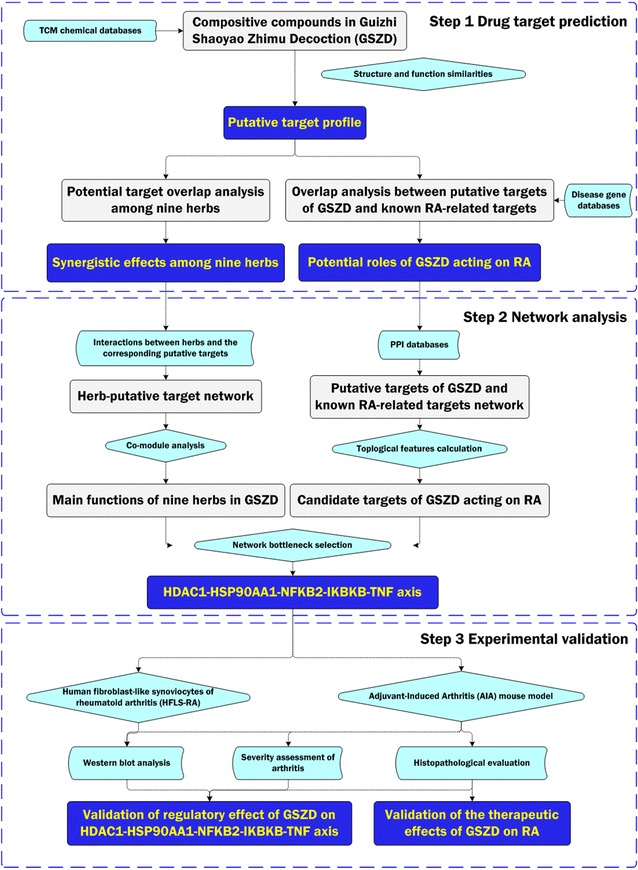
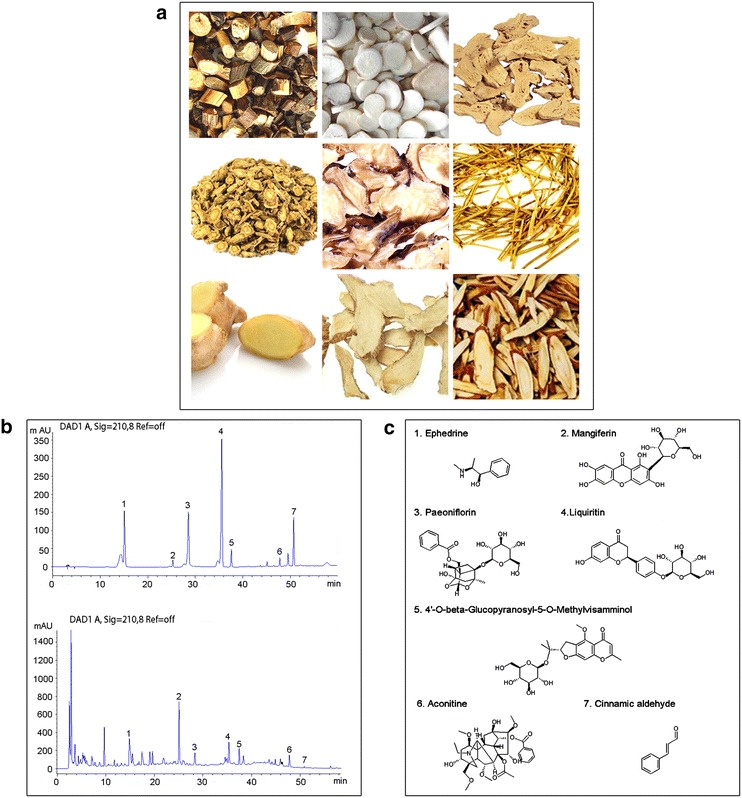
GSZD's mechanisms of action were investigated using an integrative approach that combined drug target prediction, network analysis, and experimental validation.
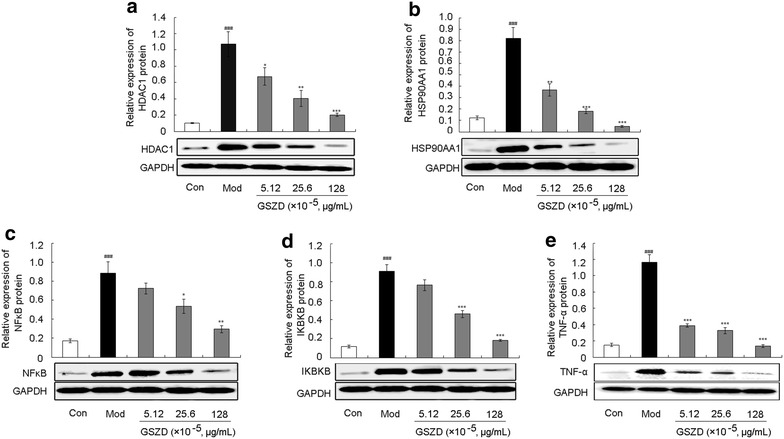
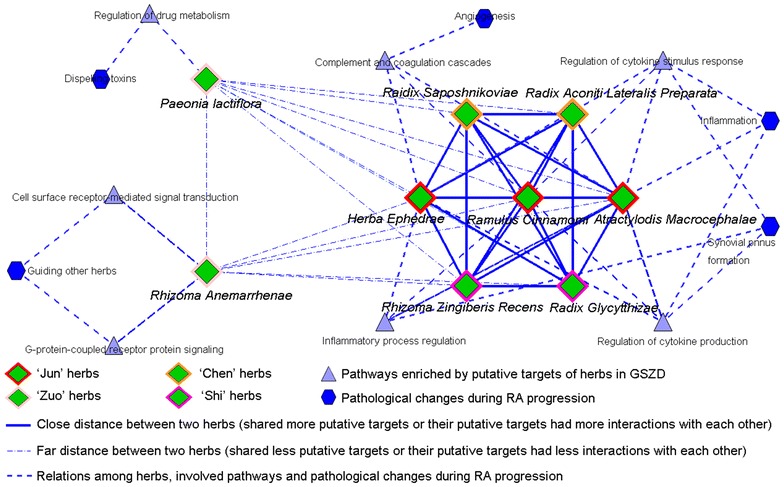
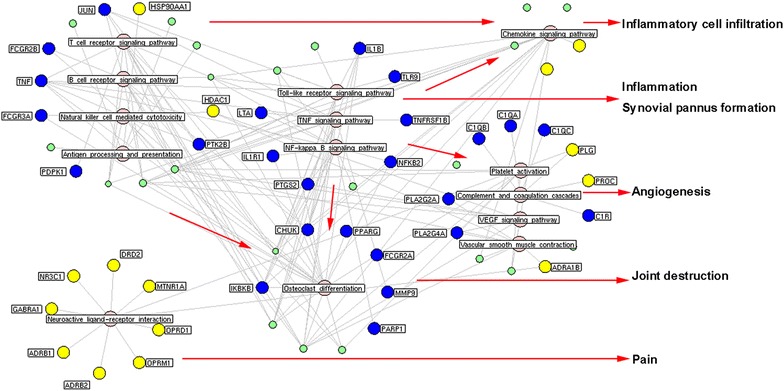
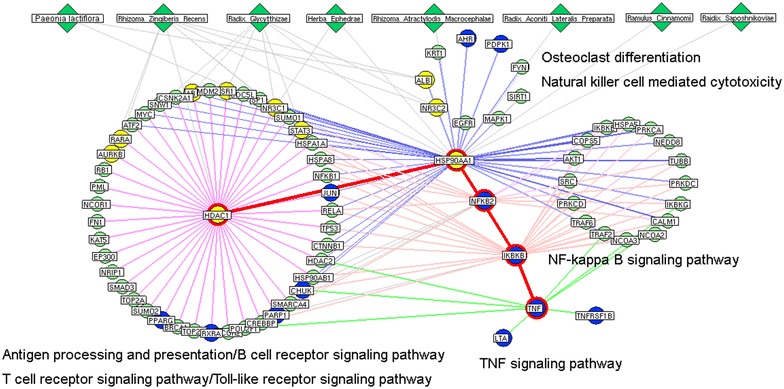
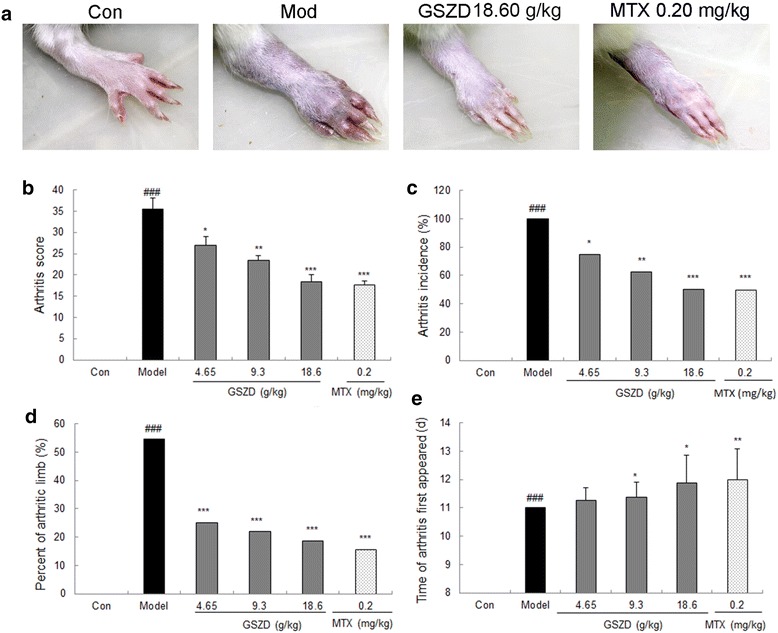
A total of 77 putative targets were identified for 165 assessed chemical components of GSZD. After calculating the topological features of the nodes and edges in the created drug-target network, we identified a candidate GSZD-targeted signal axis that contained interactions between two putative GSZD targets [histone deacetylase 1 (HDAC1) and heat shock protein 90 kDa alpha, class A member 1 (HSP90AA1)] and three known RA-related targets [NFKB2; inhibitor of kappa light polypeptide gene enhancer in B-cells, kinase beta (IKBKB); and tumor necrosis factor-alpha (TNF-α)]. This signal axis could connect different functional modules that are significantly associated with various RA-related signaling pathways, including T/B cell receptor, Toll-like receptor, NF-kappa B and TNF pathways, as well as osteoclast differentiation. Furthermore, the therapeutic effects and putative molecular mechanisms of GSZD's actions on RA were experimentally validated in vitro and in vivo.
GSZD may partially attenuate RA by reversing inflammation-immune system imbalance and regulating the HDAC1-HSP90AA1-NFKB2-IKBKB-TNF-α signaling axis.
桂枝芍药知母汤(GSZD)已被广泛用于类风湿性关节炎(RA)的治疗。在多项长期临床试验中已证明GSZD对RA具有显著的治疗效果,且无任何明显副作用。然而,由于缺乏适当的科学方法,其药理机制仍不清楚。
采用药物靶点预测、网络分析和实验验证相结合的综合方法研究GSZD的作用机制。
共鉴定出GSZD 165种评估化学成分的77个潜在靶点。在计算所创建的药物-靶点网络中节点和边的拓扑特征后,我们确定了一个候选的GSZD靶向信号轴,该信号轴包含两个潜在的GSZD靶点[组蛋白去乙酰化酶1(HDAC1)和热休克蛋白90 kDaα A类成员1(HSP90AA1)]与三个已知的RA相关靶点[NFKB2;B细胞中κ轻链多肽基因增强子抑制剂激酶β(IKBKB);和肿瘤坏死因子-α(TNF-α)]之间的相互作用。该信号轴可以连接与各种RA相关信号通路显著相关的不同功能模块,包括T/B细胞受体、Toll样受体、NF-κB和TNF通路,以及破骨细胞分化。此外,在体外和体内通过实验验证了GSZD对RA作用的治疗效果和推定的分子机制。
GSZD可能通过逆转炎症-免疫系统失衡和调节HDAC1-HSP90AA1-NFKB2-IKBKB-TNF-α信号轴来部分减轻RA。