INSERM, UMR 957, Equipe Labellisée Ligue 2012, Physiopathologie de la Résorption Osseuse et Thérapie des Tumeurs Osseuses Primitives, Université de Nantes, 1 Rue Gaston Veil, 44035 Nantes, France.
INSERM, UMR 957, Equipe Labellisée Ligue 2012, Physiopathologie de la Résorption Osseuse et Thérapie des Tumeurs Osseuses Primitives, Université de Nantes, 1 Rue Gaston Veil, 44035 Nantes, France Nantes University Hospital, Nantes 44035, France Department of Oncology and Human Metabolism, The University of Sheffield, Sheffield S10 2RX, U.K.
Biosci Rep. 2016 Aug 5;36(4). doi: 10.1042/BSR20160150. Print 2016 Aug.
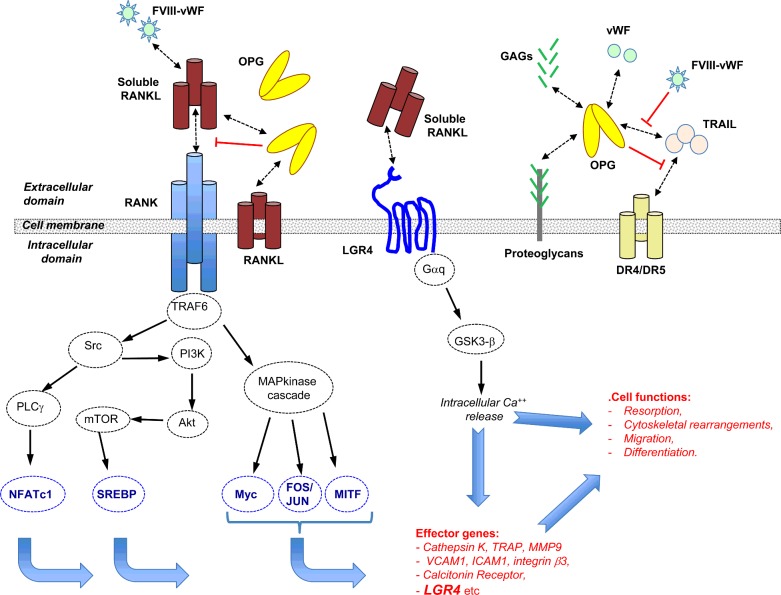
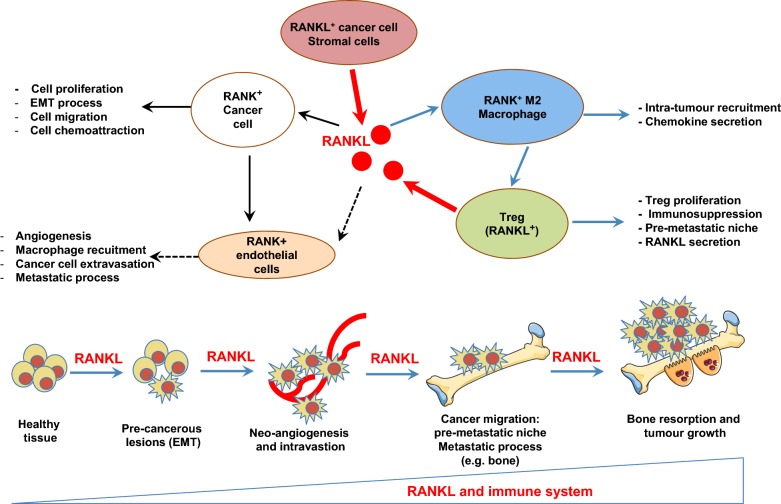
Oncogenic events combined with a favourable environment are the two main factors in the oncological process. The tumour microenvironment is composed of a complex, interconnected network of protagonists, including soluble factors such as cytokines, extracellular matrix components, interacting with fibroblasts, endothelial cells, immune cells and various specific cell types depending on the location of the cancer cells (e.g. pulmonary epithelium, osteoblasts). This diversity defines specific "niches" (e.g. vascular, immune, bone niches) involved in tumour growth and the metastatic process. These actors communicate together by direct intercellular communications and/or in an autocrine/paracrine/endocrine manner involving cytokines and growth factors. Among these glycoproteins, RANKL (receptor activator nuclear factor-κB ligand) and its receptor RANK (receptor activator nuclear factor), members of the TNF and TNFR superfamilies, have stimulated the interest of the scientific community. RANK is frequently expressed by cancer cells in contrast with RANKL which is frequently detected in the tumour microenvironment and together they participate in every step in cancer development. Their activities are markedly regulated by osteoprotegerin (OPG, a soluble decoy receptor) and its ligands, and by LGR4, a membrane receptor able to bind RANKL. The aim of the present review is to provide an overview of the functional implication of the RANK/RANKL system in cancer development, and to underline the most recent clinical studies.
致癌事件加上有利的环境是肿瘤发生过程中的两个主要因素。肿瘤微环境由一个复杂的、相互关联的网络组成,包括可溶性因子如细胞因子、细胞外基质成分,与成纤维细胞、内皮细胞、免疫细胞和各种特定细胞类型相互作用,这取决于癌细胞的位置(例如肺上皮、成骨细胞)。这种多样性定义了特定的“龛位”(例如血管龛位、免疫龛位、骨龛位),参与肿瘤生长和转移过程。这些参与者通过直接细胞间通讯和/或通过涉及细胞因子和生长因子的自分泌/旁分泌/内分泌方式相互交流。在这些糖蛋白中,RANKL(核因子-κB 配体受体激活剂)及其受体 RANK(核因子-κB 受体激活剂),属于 TNF 和 TNFR 超家族成员,引起了科学界的兴趣。RANK 经常在癌细胞中表达,而 RANKL 则经常在肿瘤微环境中检测到,它们共同参与癌症发展的每一个步骤。它们的活性被骨保护素(OPG,一种可溶性诱饵受体)及其配体和 LGR4 显著调节,LGR4 是一种能够结合 RANKL 的膜受体。本综述的目的是概述 RANK/RANKL 系统在癌症发展中的功能意义,并强调最近的临床研究。