Jin Peng, Li Tao, Li Xueqi, Shen Xinghua, Zhao Yanru
Cardiovascular Center, The Fourth Affiliated Hospital, Harbin Medical University, Harbin, Heilongjiang 150001, P.R. China.
Exp Ther Med. 2016 Jun;11(6):2163-2170. doi: 10.3892/etm.2016.3236. Epub 2016 Apr 8.
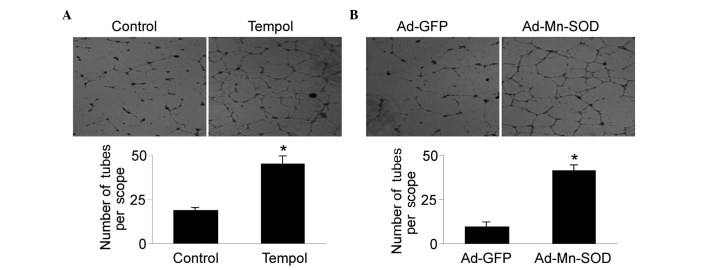
Myocardial infarction is a major contributor to morbidity and mortality in diabetes, which is characterized by inadequate angiogenesis and consequent poor blood reperfusion in the diabetic ischemic heart. The aim of the present study was to investigate the effect that oxidative stress in endothelial progenitor cells (EPCs) has on cardiac angiogenesis in diabetic mice. EPCs derived from diabetic mice revealed reductions in superoxide dismutase (SOD) expression levels and activity compared with those from normal mice. An endothelial tube formation assay showed that angiogenesis was markedly delayed for diabetic EPCs, compared with normal controls. EPCs subjected to various pretreatments were tested as a cell therapy in a diabetic mouse model of myocardial infarction. Induction of oxidative stress in normal EPCs by HO or small interfering RNA-mediated knockdown of SOD reduced their angiogenic activity in the ischemic myocardium of the diabetic mice. Conversely, cell therapy using EPCs from diabetic mice following SOD gene overexpression or treatment with the antioxidant Tempol normalized their ability to promote angiogenesis. These results indicate that decreased expression levels of SOD in EPCs contribute to impaired angiogenesis. In addition, normalization of diabetic EPCs by ex vivo SOD gene therapy accelerates the ability of the EPCs to promote angiogenesis and improve cardiac function when used as a cell therapy following myocardial infarction in diabetic mice.
心肌梗死是导致糖尿病患者发病和死亡的主要因素,其特征是血管生成不足以及糖尿病缺血性心脏随之出现的血液再灌注不良。本研究的目的是探讨内皮祖细胞(EPCs)中的氧化应激对糖尿病小鼠心脏血管生成的影响。与正常小鼠来源的EPCs相比,糖尿病小鼠来源的EPCs超氧化物歧化酶(SOD)表达水平和活性降低。内皮管形成试验表明,与正常对照组相比,糖尿病EPCs的血管生成明显延迟。对经过各种预处理的EPCs在糖尿病心肌梗死小鼠模型中作为细胞疗法进行了测试。通过HO或小干扰RNA介导的SOD基因敲低在正常EPCs中诱导氧化应激,降低了它们在糖尿病小鼠缺血心肌中的血管生成活性。相反,在SOD基因过表达或用抗氧化剂Tempol处理后,使用糖尿病小鼠来源的EPCs进行细胞疗法可使其促进血管生成的能力恢复正常。这些结果表明,EPCs中SOD表达水平降低导致血管生成受损。此外,在糖尿病小鼠心肌梗死后作为细胞疗法使用时,通过体外SOD基因疗法使糖尿病EPCs恢复正常可加速EPCs促进血管生成和改善心脏功能的能力。