Parks Christine G, Hoppin Jane A, De Roos Anneclaire J, Costenbader Karen H, Alavanja Michael C, Sandler Dale P
Epidemiology Branch, National Institute of Environmental Health Sciences, National Institutes of Health (NIH), Department of Health and Human Services (DHHS), Research Triangle Park, North Carolina, USA.
Environ Health Perspect. 2016 Nov;124(11):1728-1734. doi: 10.1289/EHP129. Epub 2016 Jun 10.
Farming has been associated with rheumatoid arthritis (RA), but the role of pesticides is not known.
We examined associations between RA and pesticides or other agricultural exposures among female spouses of licensed pesticide applicators in the Agricultural Health Study.
Women were enrolled between 1993 and 1997 and followed through 2010. Cases (n = 275 total, 132 incident), confirmed by a physician or by self-reported use of disease modifying antirheumatic drugs, were compared with noncases (n = 24,018). Odds ratios (OR) and 95% confidence intervals (CI) were estimated using logistic regression models adjusted for age, state, and smoking pack-years.
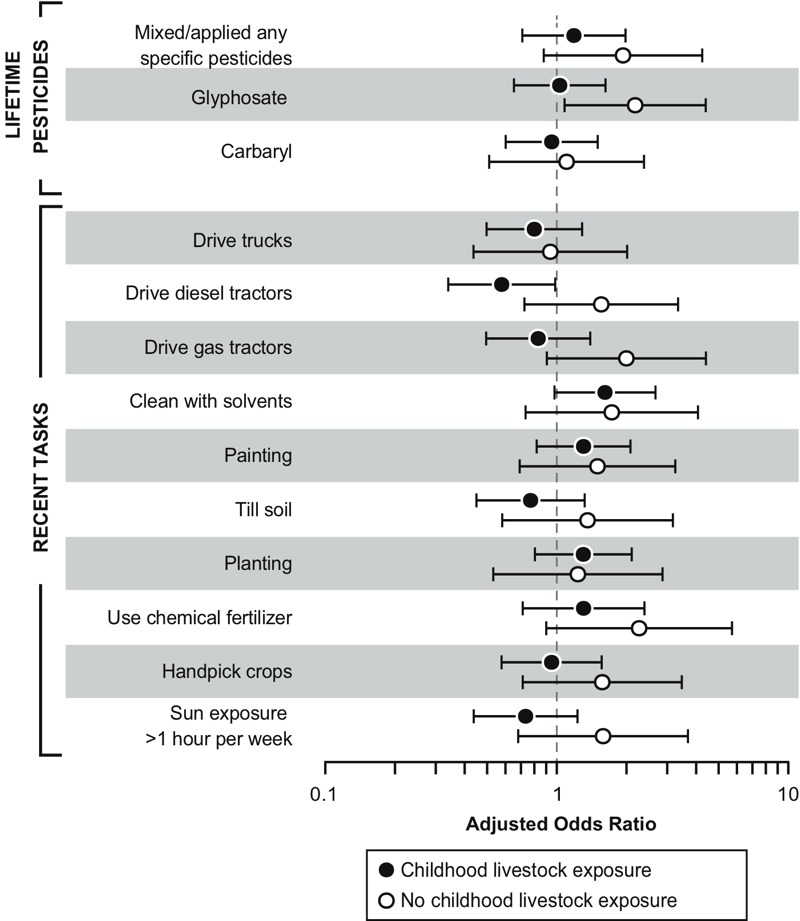
Overall, women with RA were somewhat more likely to have reported lifetime use of any specific pesticide versus no pesticides (OR = 1.4; 95% CI: 1.0, 1.6). Of the 15 pesticides examined, maneb/mancozeb (OR = 3.3; 95% CI: 1.5, 7.1) and glyphosate (OR = 1.4; 95% CI: 1.0, 2.1) were associated with incident RA compared with no pesticide use. An elevated, but non-statistically significant association with incident RA was seen for DDT (OR = 1.9; 95% CI: 0.97, 3.6). Incident RA was also associated with the application of chemical fertilizers (OR = 1.7; 95% CI: 1.1, 2.7) and cleaning with solvents (OR = 1.6; 95% CI: 1.1, 2.4), but inversely associated with lifetime livestock exposure as a child and adult (OR = 0.48; 95% CI: 0.24, 0.97) compared with no livestock exposure.
Our results suggest that specific agricultural pesticides, solvents, and chemical fertilizers may increase the risk of RA in women, while exposures involving animal contact may be protective. Citation: Parks CG, Hoppin JA, De Roos AJ, Costenbader KH, Alavanja MC, Sandler DP. 2016. Rheumatoid arthritis in Agricultural Health Study spouses: associations with pesticides and other farm exposures. Environ Health Perspect 124:1728-1734; http://dx.doi.org/10.1289/EHP129.
务农与类风湿关节炎(RA)有关,但农药的作用尚不清楚。
我们在农业健康研究中调查了有执照的农药施用者的女性配偶中RA与农药或其他农业暴露之间的关联。
1993年至1997年招募女性并随访至2010年。由医生确诊或自我报告使用改善病情抗风湿药物的病例(共275例,其中132例为新发病例)与非病例(24,018例)进行比较。使用经年龄、州和吸烟包年数调整的逻辑回归模型估计比值比(OR)和95%置信区间(CI)。
总体而言,与未使用任何特定农药的女性相比,患RA的女性终生使用任何特定农药的可能性略高(OR = 1.4;95%CI:1.0,1.6)。在检测的15种农药中,与未使用农药相比,代森锰锌(OR = 3.3;95%CI:1.5,7.1)和草甘膦(OR = 1.4;95%CI:1.0,2.1)与新发病例的RA相关。滴滴涕与新发病例的RA有升高但无统计学意义的关联(OR = 1.9;95%CI:0.97,3.6)。新发病例的RA还与化肥施用(OR = 1.7;95%CI:1.1,2.7)和用溶剂清洁(OR = 1.6;95%CI:1.1,2.4)有关,但与儿童期和成年期终生接触家畜相比无家畜接触(OR = 0.48;95%CI:0.24,0.97)呈负相关。
我们的结果表明,特定的农业农药、溶剂和化肥可能会增加女性患RA的风险,而涉及动物接触的暴露可能具有保护作用。引文:Parks CG, Hoppin JA, De Roos AJ, Costenbader KH, Alavanja MC, Sandler DP. 2016. 农业健康研究配偶中的类风湿关节炎:与农药和其他农场暴露的关联。环境健康展望124:1728 - 1734;http://dx.doi.org/10.1289/EHP129。