Nath Kavindra, Nelson David S, Putt Mary E, Leeper Dennis B, Garman Bradley, Nathanson Katherine L, Glickson Jerry D
Department of Radiology, Perelman School of Medicine, University of Pennsylvania, Philadelphia, Pennsylvania, United States of America.
Biostatistics & Epidemiology, Perelman School of Medicine, University of Pennsylvania, Philadelphia, Pennsylvania, United States of America.
PLoS One. 2016 Jun 10;11(6):e0157125. doi: 10.1371/journal.pone.0157125. eCollection 2016.
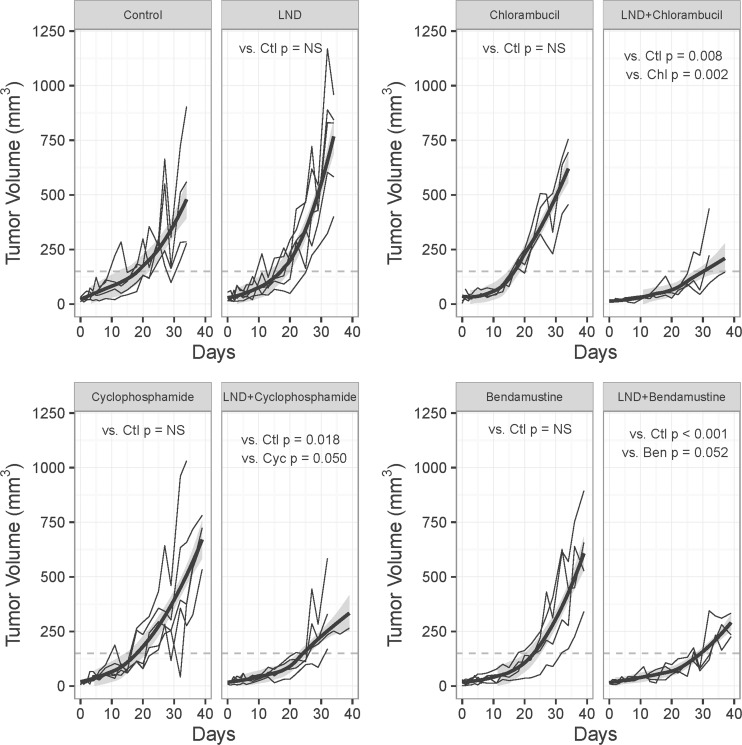
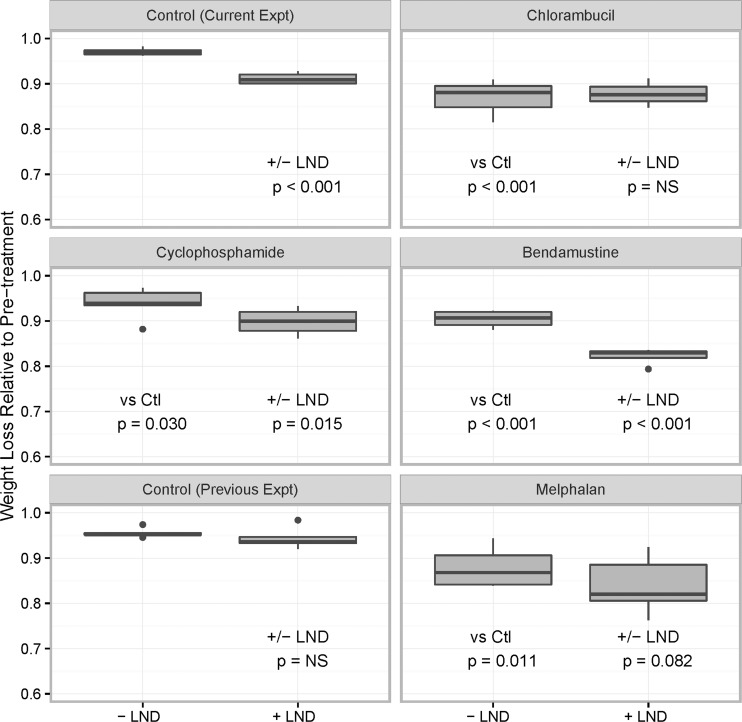
Previous NMR studies demonstrated that lonidamine (LND) selectively diminishes the intracellular pH (pHi) of DB-1 melanoma and mouse xenografts of a variety of other prevalent human cancers while decreasing their bioenergetic status (tumor βNTP/Pi ratio) and enhancing the activities of melphalan and doxorubicin in these cancer models. Since melphalan and doxorubicin are highly toxic agents, we have examined three other nitrogen (N)-mustards, chlorambucil, cyclophosphamide and bendamustine, to determine if they exhibit similar potentiation by LND. As single agents LND, melphalan and these N-mustards exhibited the following activities in DB-1 melanoma xenografts; LND: 100% tumor surviving fraction (SF); chlorambucil: 100% SF; cyclophosphamide: 100% SF; bendamustine: 79% SF; melphalan: 41% SF. When combined with LND administered 40 min prior to administration of the N-mustard (to maximize intracellular acidification) the following responses were obtained; chlorambucil: 62% SF; cyclophosphamide: 42% SF; bendamustine: 36% SF; melphalan: 10% SF. The effect of LND on the activities of these N-mustards is generally attributed to acid stabilization of the aziridinium active intermediate, acid inhibition of glutathione-S-transferase, which acts as a scavenger of aziridinium, and acid inhibition of DNA repair by O6-alkyltransferase. Depletion of ATP by LND may also decrease multidrug resistance and increase tumor response. At similar maximum tolerated doses, our data indicate that melphalan is the most effective N-mustard in combination with LND when treating DB-1 melanoma in mice, but the choice of N-mustard for coadministration with LND will also depend on the relative toxicities of these agents, and remains to be determined.
先前的核磁共振研究表明,氯尼达明(LND)可选择性降低DB - 1黑色素瘤以及多种其他常见人类癌症的小鼠异种移植瘤的细胞内pH值(pHi),同时降低其生物能量状态(肿瘤βNTP/Pi比值),并增强美法仑和阿霉素在这些癌症模型中的活性。由于美法仑和阿霉素是高毒性药物,我们研究了其他三种氮芥,苯丁酸氮芥、环磷酰胺和苯达莫司汀,以确定它们是否也会被LND增强活性。作为单一药物,LND、美法仑和这些氮芥在DB - 1黑色素瘤异种移植瘤中表现出以下活性;LND:100%肿瘤存活分数(SF);苯丁酸氮芥:100% SF;环磷酰胺:100% SF;苯达莫司汀:79% SF;美法仑:41% SF。当在给予氮芥前40分钟联合给予LND(以最大化细胞内酸化)时,得到以下反应;苯丁酸氮芥:62% SF;环磷酰胺:42% SF;苯达莫司汀:36% SF;美法仑:10% SF。LND对这些氮芥活性的影响通常归因于氮丙啶活性中间体的酸稳定化、对作为氮丙啶清除剂的谷胱甘肽 - S - 转移酶的酸抑制作用以及对O6 - 烷基转移酶DNA修复的酸抑制作用。LND导致的ATP耗竭也可能降低多药耐药性并增加肿瘤反应。在相似的最大耐受剂量下,我们的数据表明,在治疗小鼠DB - 1黑色素瘤时,美法仑是与LND联合使用时最有效的氮芥,但与LND联合给药时氮芥的选择还将取决于这些药物的相对毒性,仍有待确定。