Jiang He-Sheng, Kuang Xia-Ying, Sun Wei-Li, Xu Yan, Zheng Yi-Zi, Liu Yi-Rong, Lang Guan-Tian, Qiao Feng, Hu Xin, Shao Zhi-Ming
Key Laboratory of Breast Cancer in Shanghai, Department of Breast Surgery, Fudan University Shanghai Cancer Center, Shanghai, China.
Department of Oncology, Shanghai Medical College, Fudan University, Shanghai, China.
Oncotarget. 2016 Jul 5;7(27):41285-41293. doi: 10.18632/oncotarget.9778.
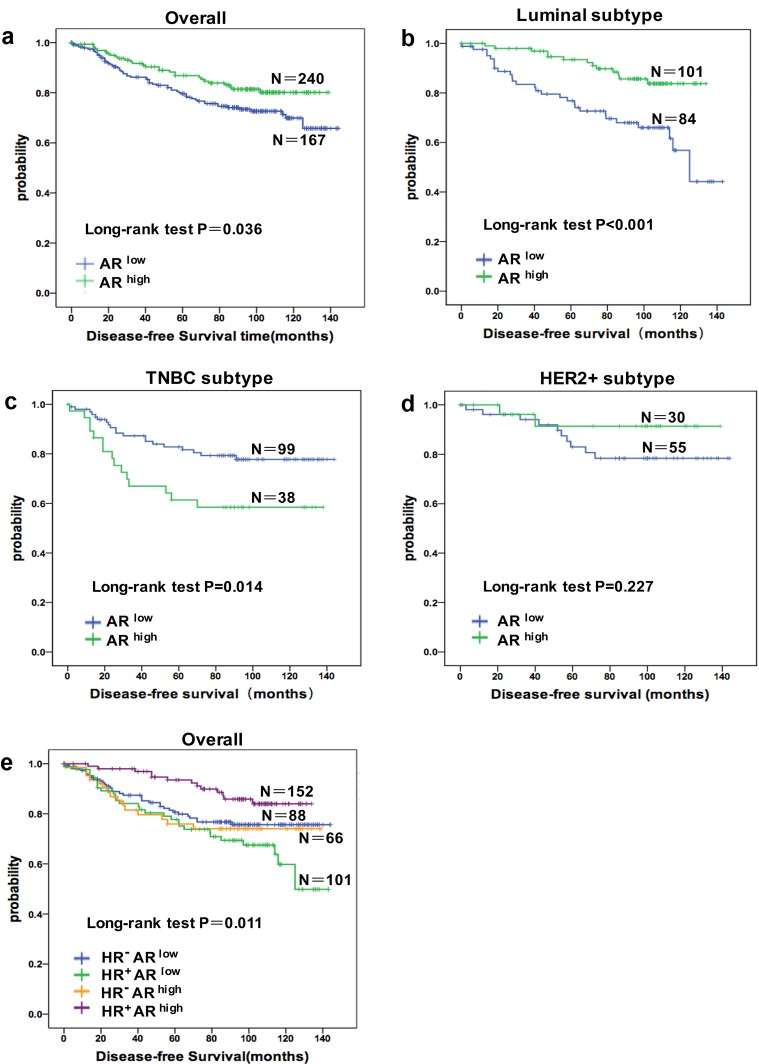
In this study we sought to correlate androgen receptor (AR) expression with tumor progression and disease-free survival (DFS) in breast cancer patients. We investigated AR expression in 450 breast cancer patients. We found that breast cancers expressing the estrogen receptor (ER) are more likely to co-express AR compared to ER-negative cancers (56.0% versus 28.1%, P < 0.001). In addition, we found that AR expression is correlated with increased DFS in patients with luminal breast cancer (P < 0.001), and decreased DFS in TNBC (triple negative breast cancer, P = 0.014). In addition, patients with HR+ tumors (Hormone receptor positive tumors) expressing low levels of AR have the lowest DFS among all receptor combinations. We also propose a novel prognostic model using AR receptor status, BRCA1, and present data showing that our model is more predictive of disease free survival compared to the traditional TMN staging system.
在本研究中,我们试图将雄激素受体(AR)表达与乳腺癌患者的肿瘤进展和无病生存期(DFS)相关联。我们调查了450例乳腺癌患者的AR表达情况。我们发现,与雌激素受体(ER)阴性的癌症相比,表达ER的乳腺癌更有可能共表达AR(56.0%对28.1%,P<0.001)。此外,我们发现AR表达与管腔型乳腺癌患者DFS增加相关(P<0.001),而与三阴性乳腺癌(TNBC)患者DFS降低相关(P = 0.014)。此外,在所有受体组合中,AR表达水平低的HR+肿瘤(激素受体阳性肿瘤)患者的DFS最低。我们还提出了一种使用AR受体状态、BRCA1的新型预后模型,并给出数据表明,与传统的TMN分期系统相比,我们的模型对无病生存期的预测性更强。