Jensen Judd, Salottolo Kristin, Frei Donald, Loy David, McCarthy Kathryn, Wagner Jeffrey, Whaley Michelle, Bellon Richard, Bar-Or David
Department of Neurology, Swedish Medical Center, Englewood, Colorado, USA.
Trauma Research LLC, Swedish Medical Center, Englewood, Colorado, USA.
J Neurointerv Surg. 2017 Jul;9(7):654-658. doi: 10.1136/neurintsurg-2016-012421. Epub 2016 Jun 10.
The safety and efficacy of intra-arterial treatment (IAT) in patients with acute ischemic stroke (AIS) due to cervical artery dissection (CeAD) has not been formally studied. The purpose of this study was twofold: first, describe a large series with CeAD treated with IAT; second, analyze outcomes with CeAD receiving IAT versus (a) CeAD not treated with IAT, (b) CeAD receiving intravenous thrombolysis (IVT) alone, and (c) non-CeAD mechanism of AIS receiving IAT.
Demographics, clinical characteristics, treatment, and outcomes were summarized for all CeAD patients treated with IAT from January 2010 to May 2015. Outcomes included favorable 90 day modified Rankin Scale (mRS) score of 0-2, symptomatic intracerebral hemorrhage (sICH), recanalization (Thrombolysis in Cerebral Infarction 2b-3), procedural complications, and mortality. Outcomes were analyzed with χ tests and multivariate logistic regression.
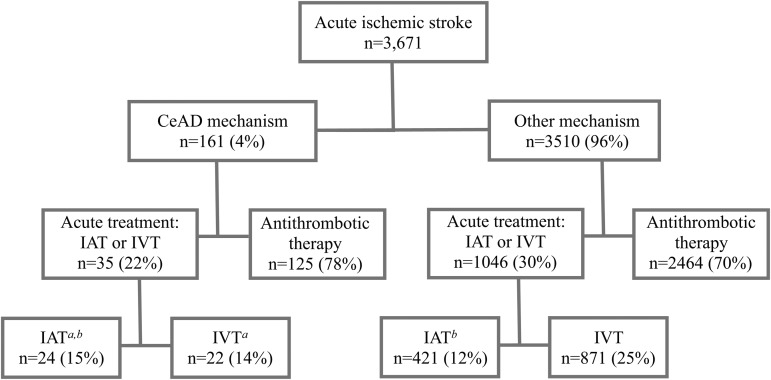
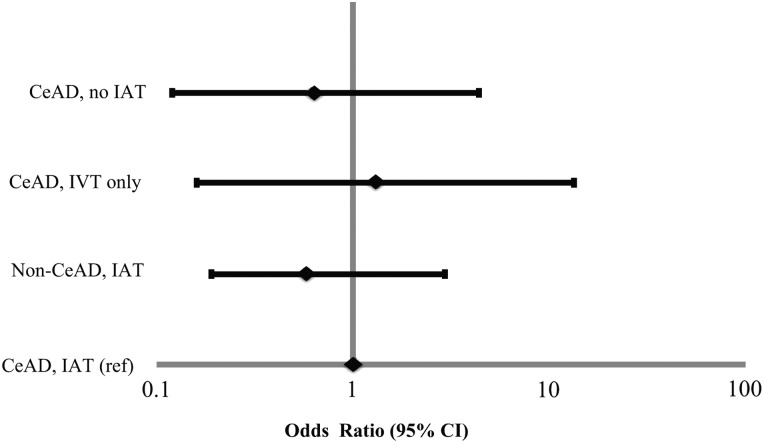
There were 161 patients with CeAD: 24 were treated with IAT and comprised our target population. Dissections were more common in the internal carotid (n=18) than in the vertebral arteries (n=6). All but one patient had intracranial embolus. IAT techniques included thrombectomy (n=19), IA thrombolysis (n=17), stent (n=14), and angioplasty (n=7). Outcomes included favorable 90 day mRS score of 0-2 in 63%, 4 deaths, 1 sICH, and 3 procedural complications. After adjustment, favorable mRS in our target population was similar to comparison populations: (a) in CeAD, IAT versus no IAT (OR 0.62, p=0.56); (b) In CeAD, IAT versus IVT alone (OR 1.32, p=0.79); and (c) IAT in CeAD versus non-CeAD mechanism of AIS (OR 0.58, p=0.34).
IAT is a valid alternative therapeutic option for AIS caused by CeAD due to the low complication rate and excellent outcomes observed in this study.
尚未对颈内动脉夹层(CeAD)所致急性缺血性卒中(AIS)患者进行动脉内治疗(IAT)的安全性和有效性进行正式研究。本研究的目的有两个:第一,描述接受IAT治疗的CeAD的一大系列病例;第二,分析接受IAT治疗的CeAD与(a)未接受IAT治疗的CeAD、(b)仅接受静脉溶栓(IVT)的CeAD以及(c)接受IAT的非CeAD机制的AIS的结局。
总结2010年1月至2015年5月接受IAT治疗的所有CeAD患者的人口统计学、临床特征、治疗及结局。结局包括90天时改良Rankin量表(mRS)评分为0 - 2的良好结局、症状性脑出血(sICH)、再通(脑梗死溶栓2b - 3级)、手术并发症及死亡率。采用χ检验和多因素逻辑回归分析结局。
有161例CeAD患者:24例接受IAT治疗,构成我们的目标人群。夹层在内颈动脉(n = 18)比椎动脉(n = 6)更常见。除1例患者外,所有患者均有颅内栓子。IAT技术包括血栓切除术(n = 19)、动脉内溶栓(n = 17)、支架置入(n = 14)和血管成形术(n = 7)。结局包括63%的患者90天时mRS评分为0 - 2的良好结局、4例死亡、1例sICH和3例手术并发症。调整后,我们目标人群的良好mRS与对照人群相似:(a)在CeAD中,IAT与未接受IAT(比值比[OR] 0.62,p = 0.56);(b)在CeAD中,IAT与仅接受IVT(OR 1.32,p = 0.79);以及(c)CeAD中的IAT与非CeAD机制的AIS(OR 0.58,p = 0.34)。
由于本研究中观察到的低并发症发生率和良好结局,IAT是CeAD所致AIS的一种有效的替代治疗选择。