Asiri Samirah A, Rohrer Wesley W, Al-Surimi Khaled, Da'ar Omar O, Ahmed Anwar
Department of Continuous Quality Management and Patient Safety, Armed Forces Hospital, Dhahran, Saudi Arabia.
Department of Health Policy and Management, Program Graduate School of Public Health, University of Pittsburgh, Pittsburgh, USA.
BMC Nurs. 2016 Jun 9;15:38. doi: 10.1186/s12912-016-0161-7. eCollection 2016.
The current challenges facing healthcare systems, in relation to the shortage of health professionals, necessitates mangers and leaders to learn from different leadership styles and staff empowerment strategies, so as to create a work environment that encourages nursing staff commitment to patients and their organization. This study intends to measure the effects of nurses' overall perception of the leadership style of their managers, and psychological empowerment on their organizational commitment in acute care units, in National Guard Health Affairs, Riyadh City, Saudi Arabia.
This was a cross-sectional survey, where the data was obtained from nurses at King Abdulaziz Medical City. Hard copy questionnaires were distributed to 350 randomly selected nurses. Three hundred and thirty two (332) were completed, representing a response rate of 95 %. Three validated survey instruments were used to obtain the data: (1) The Multifactor Leadership Questionnaire (MLQ), formulated by Bass and Avolio (1997), (2) The Psychological Empowerment Scale developed by Spreitzer (1995) and (3) The Three-Component Model of Employee Commitment developed by Meyer and Allen (1997). A theoretical model that conceptually links leadership, empowerment, and organizational commitment was used. The SPSS program version 19 was employed to perform descriptive and inferential statistics including correlation and stepwise multiple regression analysis.
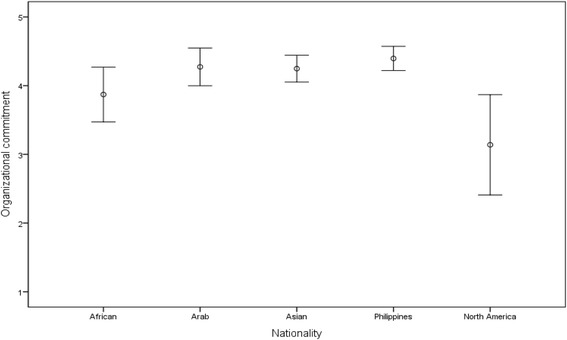
Overall most nurses perceived their immediate nursing managers as not displaying the ideal level of transformational leadership (TFL) behaviors. Nurses' commitment appeared to be negatively correlated with TFL style and perceived psychological empowerment. However, commitment was positively correlated with the Transactional Leadership (TAL) style. Analysis, also, showed that commitment is significantly associated with the nurse's nationality by region: North American (P = 0.001) and Arab (p = 0.027). The other important predictors of commitment include TAL (P = 0.027), Laissez-faire Leadership (LFL (P = 0.012), and autonomy (P = 0.016). The linear combination of these predictors explained 20 % of the variability of the nurses' commitment.
The study findings suggest that leadership styles and employee empowerment could play an instrumental role in promoting organizational commitment of nurses working in acute health care settings, at least in the Saudi Arabian context.
医疗系统目前面临着与卫生专业人员短缺相关的挑战,这就要求管理人员和领导者学习不同的领导风格和员工赋权策略,以便营造一个鼓励护理人员致力于患者及其所在组织的工作环境。本研究旨在衡量沙特阿拉伯利雅得市国民警卫队卫生事务部急症护理病房护士对其管理人员领导风格的总体认知以及心理赋权对其组织承诺的影响。
这是一项横断面调查,数据来自阿卜杜勒阿齐兹国王医疗城的护士。向350名随机挑选的护士发放了纸质问卷。共收回332份问卷,回复率为95%。使用了三种经过验证的调查工具来获取数据:(1)由巴斯和阿沃利奥(1997年)编制的多因素领导问卷(MLQ),(2)由斯普雷itzer(1995年)开发的心理赋权量表,以及(3)由迈耶和艾伦(1997年)开发的员工承诺三成分模型。使用了一个从概念上联系领导、赋权和组织承诺的理论模型。采用SPSS 19版程序进行描述性和推断性统计,包括相关性和逐步多元回归分析。
总体而言,大多数护士认为其直属护理管理人员未展现出理想水平的变革型领导(TFL)行为。护士的组织承诺似乎与变革型领导风格和感知到的心理赋权呈负相关。然而,组织承诺与交易型领导(TAL)风格呈正相关。分析还表明,组织承诺与护士所在地区的国籍显著相关:北美地区(P = 0.001)和阿拉伯地区(P = 0.027)。组织承诺的其他重要预测因素包括交易型领导(P = 0.027)、放任型领导(LFL,P = 0.012)和自主性(P = 0.016)。这些预测因素的线性组合解释了护士组织承诺变异的20%。
研究结果表明,领导风格和员工赋权至少在沙特阿拉伯的背景下,可能在促进急症护理环境中工作的护士的组织承诺方面发挥重要作用。