Alasiry Sharifa M, Alkhaldi Fawzah S
Department of Nursing, Majmaah University, Al Majma'ah, SAU.
Department of Nursing Education, Hafar Al-Batin Central Hospital, Ministry of Health, Hafar Al-Batin, SAU.
Cureus. 2024 Oct 2;16(10):e70676. doi: 10.7759/cureus.70676. eCollection 2024 Oct.
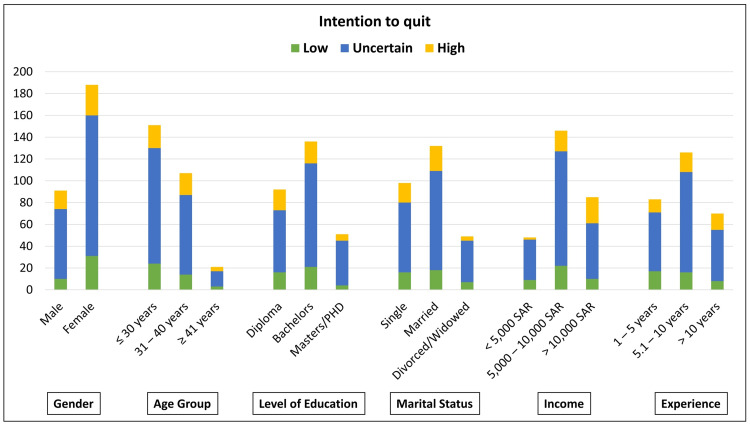
Background and objectives The efficiency of healthcare systems and nursing care depends on appropriate leadership. The purpose of this study was to determine the association between leadership styles of nurse managers and the staff turnover intention in Saudi Arabia. The nurses' intention to quit their jobs was considered as indicative of staff turnover intention. Methods A quantitative cross-sectional questionnaire-based study was conducted among 279 nurses, employed in three hospitals in Hafar Al-Batin City, Saudi Arabia. The questionnaire comprised three parts to determine the association between leadership styles of nurse managers and staff turnover intention, and how they related to participants' demographic variables (gender/age/education/income/marital status/experience). The first part collected demographic data, and the second part was an adapted and validated version of the multifactor leadership questionnaire (MLQ-6S) used to assess the perceived leadership styles of nurse managers, based on 21 items. The third part, comprising seven items, was used to assess nurses' turnover based on intention to quit. The second and third parts of the questionnaire were scored using a five-point Likert scale. Collected data were tabulated and analyzed using a statistical software package for descriptive and inferential statistics (t-test, one-way analysis of variance (ANOVA), and correlation), comparing dependent outcome variables against independent demographic variables. Statistical significance was assumed when p-value was less than 0.05. Results Based on leadership style scores, transactional (13.32 out of a maximum of 24; 55.48%) and transformational (26.58 out of a maximum of 48; 55.37%) leadership were the most frequently perceived leadership styles among nurse managers. Laissez-faire leadership (6.31 out of a maximum of 12; 52.57%) was the least frequently perceived style. Upon comparing perceived leadership styles of nurse managers against demographic variables, no significant differences were observed for transformational leadership. However, income and experience of nurses showed significant relationship with the perceived transactional and laissez-faire leadership style scores, respectively. Based on perceived "intention to quit" scores, majority of the nurses expressed uncertain intention to quit (n = 193; 69.2%) and there was a significant yet weak negative correlation between the perceived leadership styles and intention to quit. The correlation coefficient (Pearson's-r) was lowest for laissez-faire leadership (-0.258) followed by transactional (-0.295) and transformational styles of leadership (-0.348). Conclusions The present study indicated a greater degree of transactional and transformational leadership styles among nurse managers than laissez-faire leadership style. While most of the nurses mentioned an uncertain intention to quit, correlating it with the perceived leadership styles it was found that transformational leadership among nurse managers indicated greater retention of nurses within their present jobs. The present research findings underline the importance of prioritizing and fostering healthy workplace environment by the nurse managers, through inculcation of transformational leadership practices. Furthermore, focused, multi-centric studies from around the world can help understand the leadership practices of nursing leaders and its relationship with the intention of nurses to quit their respective roles.
背景与目的 医疗保健系统和护理工作的效率取决于恰当的领导。本研究的目的是确定沙特阿拉伯护士管理者的领导风格与员工离职意愿之间的关联。护士的离职意愿被视为员工离职意愿的指标。方法 对沙特阿拉伯哈费尔巴廷市三家医院的279名护士进行了一项基于问卷调查的定量横断面研究。问卷包括三个部分,以确定护士管理者的领导风格与员工离职意愿之间的关联,以及它们与参与者的人口统计学变量(性别/年龄/教育程度/收入/婚姻状况/工作经验)之间的关系。第一部分收集人口统计学数据,第二部分是多因素领导问卷(MLQ - 6S)的改编和验证版本,用于根据21个项目评估护士管理者的领导风格认知。第三部分包括7个项目,用于根据离职意愿评估护士的离职情况。问卷的第二部分和第三部分采用五点李克特量表评分。收集的数据进行列表,并使用统计软件包进行描述性和推断性统计分析(t检验、单因素方差分析(ANOVA)和相关性分析),将相关结果变量与独立的人口统计学变量进行比较。当p值小于0.05时,认为具有统计学意义。结果 根据领导风格得分,交易型领导(满分24分,得13.32分;55.48%)和变革型领导(满分48分,得26.58分;55.37%)是护士管理者中最常被感知到的领导风格。放任型领导(满分12分,得6.31分;52.57%)是最不常被感知到的风格。将护士管理者的领导风格认知与人口统计学变量进行比较时,变革型领导未观察到显著差异。然而,护士的收入和工作经验分别与感知到的交易型和放任型领导风格得分显示出显著关系。根据感知到的“离职意愿”得分,大多数护士表示离职意愿不确定(n = 193;69.2%),并且感知到的领导风格与离职意愿之间存在显著但较弱的负相关。放任型领导的相关系数(皮尔逊r)最低(-0.258),其次是交易型(-0.295)和变革型领导风格(-0.348)。结论 本研究表明,护士管理者中交易型和变革型领导风格的程度高于放任型领导风格。虽然大多数护士提到离职意愿不确定,但将其与感知到的领导风格相关联后发现,护士管理者中的变革型领导表明护士在当前工作中的留任意愿更高。本研究结果强调了护士管理者通过灌输变革型领导实践来优先考虑和营造健康工作场所环境的重要性。此外,来自世界各地的有针对性的多中心研究有助于了解护理领导者的领导实践及其与护士离职意愿的关系。
