Masterson Liam, Winder David M, Ball Siolian L R, Vaughan Katie, Lehmann Martin, Scholtz Lars-Uwe, Sterling Jane C, Sudhoff Holger H, Goon Peter K C
Department of Pathology, University of Cambridge, Cambridge, UK.
Department of Otorhinolaryngology, Cambridge University Hospitals NHS Trust, Cambridge, UK.
BMC Cancer. 2016 Jun 13;16:367. doi: 10.1186/s12885-016-2398-7.
Human papillomavirus DNA detection in head and neck squamous cell carcinoma has been linked to improved patient prognosis. The main aims of the study was to test the hypotheses that HPV16 E6/E7 oncogene and p53 function within tumours were associated with the widely reported improved patient survival and prognosis in head and neck cancer.
HPV16 DNA, mRNA and p53 mRNA presence were analysed in a prospective study of 42 unselected HNSCC patients; correlating the data with patient age, tumour staging/grade, treatment response, disease recurrence and survival.
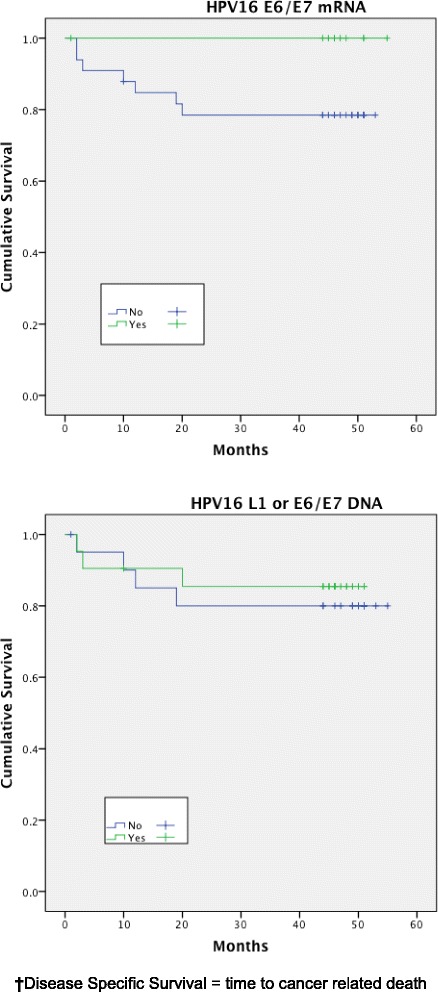
HPV16 DNA and HPV16 mRNA were present in 45.2 % and 21.4 % of patients, respectively. There was a significant positive association between the detection of HPV16 E6/E7 mRNA and p53 mRNA (p = 0.032), but this was not replicated for HPV16 DNA. Five-year disease free survival for the whole cohort was 63 % (CI 52.5-73.5 %). Multivariable analysis revealed only HPV16 E6/E7 mRNA expression to have significant prognostic influence (p = 0.04).
Our study suggests that HPV16 oncogenic transcriptional activity within HNSCC tumours is associated with improved patient survival and better prognosis in a German population. Simple HPV DNA detection alone did not demonstrate this association. The significant association of full-length (wild-type) p53 with HPV16 E6/E7 mRNA is further evidence for a functional relationship, which could contribute to the widely reported improved survival and prognosis. Larger studies are required to validate the frequency of HPV16 mRNA expression in HNSCC.
头颈部鳞状细胞癌中人乳头瘤病毒DNA检测与患者预后改善相关。本研究的主要目的是检验以下假设:肿瘤内的HPV16 E6/E7癌基因和p53功能与头颈部癌患者广泛报道的生存率和预后改善相关。
在一项对42例未经选择的头颈部鳞状细胞癌患者的前瞻性研究中,分析HPV16 DNA、mRNA和p53 mRNA的存在情况;将数据与患者年龄、肿瘤分期/分级、治疗反应、疾病复发和生存情况相关联。
分别有45.2%和21.4%的患者存在HPV16 DNA和HPV16 mRNA。HPV16 E6/E7 mRNA和p53 mRNA的检测之间存在显著正相关(p = 0.032),但HPV16 DNA未出现这种相关性。整个队列的五年无病生存率为63%(可信区间52.5 - 73.5%)。多变量分析显示只有HPV16 E6/E7 mRNA表达具有显著的预后影响(p = 0.04)。
我们的研究表明,在德国人群中,头颈部鳞状细胞癌肿瘤内的HPV16致癌转录活性与患者生存率提高和预后改善相关。单纯的HPV DNA检测未显示这种关联。全长(野生型)p53与HPV16 E6/E7 mRNA的显著关联进一步证明了一种功能关系,这可能有助于解释广泛报道的生存率和预后改善情况。需要更大规模的研究来验证头颈部鳞状细胞癌中HPV16 mRNA表达的频率。