Zhang Yan, Li Lixiang, Guo Chuanguo, Mu Dan, Feng Bingcheng, Zuo Xiuli, Li Yanqing
Department of Gastroenterology, Laboratory of Translational Gastroenterology, Qilu Hospital, Shandong University, 107 Wenhuaxi Road, Jinan, 250012, Shandong Province, China.
BMC Gastroenterol. 2016 Jun 13;16(1):62. doi: 10.1186/s12876-016-0470-z.
Irritable bowel syndrome (IBS) is one of the most common functional gastroenterological diseases, affecting 11.2 % of people worldwide. Previous studies have shown that probiotic treatment may benefit IBS patients. However, the effect of probiotics and the appropriate type, dose, and treatment duration for IBS are still unclear. The aim of the current study was to assess the efficacy of different probiotic types, doses and treatment durations in IBS patients diagnosed by Rome III criteria via a meta-analysis of randomized controlled trials (RCTs).
Medline, EMBASE, and the Cochrane Central Register of Controlled Trials up to October 2015 were searched. RCTs including comparisons between the effects of probiotics and placebo on IBS patients diagnosed by Rome III criteria were eligible. Dichotomous data were pooled to obtain the relative risk (RR) with a 95 % confidence interval (CI), whereas continuous data were pooled using a standardized mean difference (SMD) with a 95 % CI.
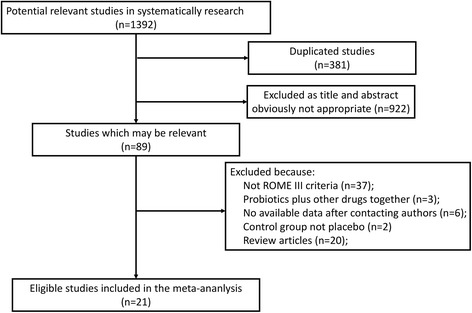
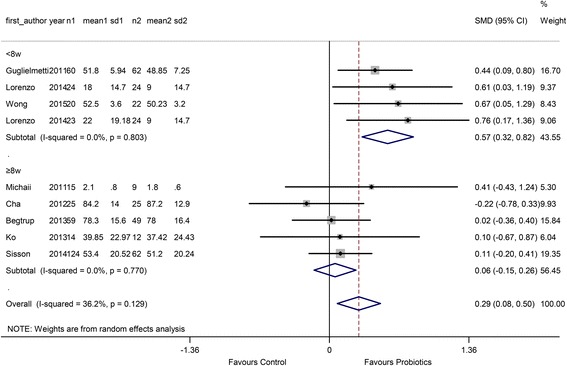
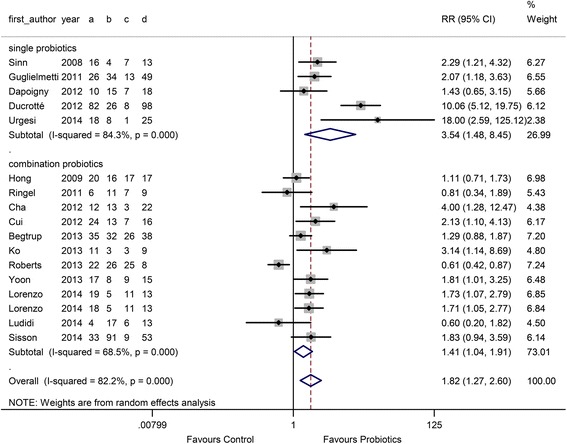
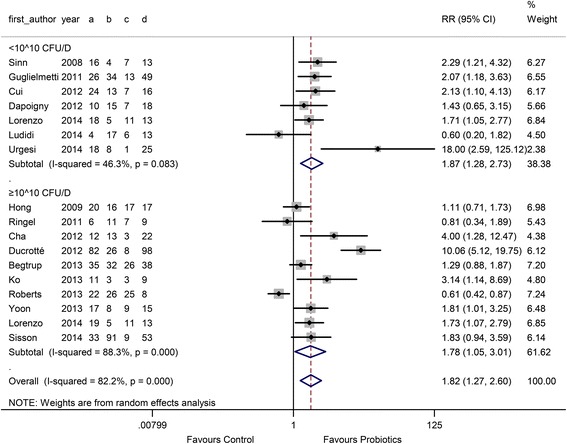
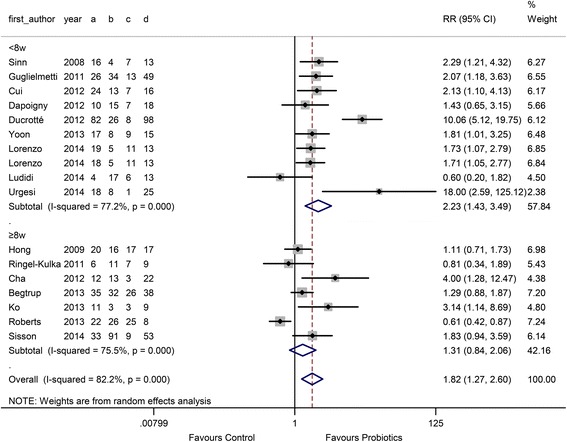
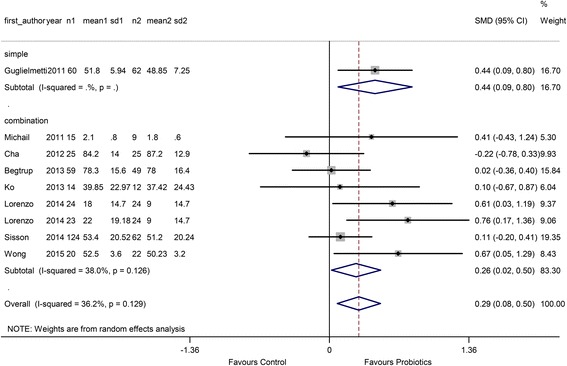
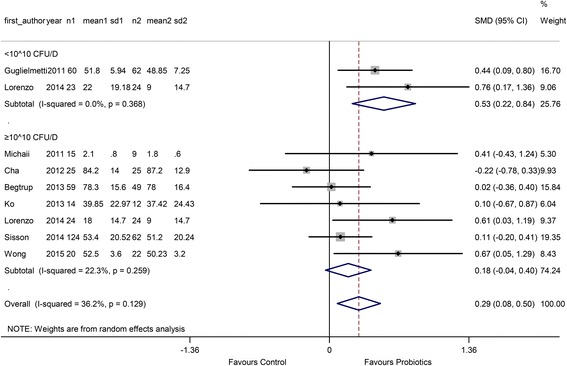
Twenty-one RCTs were included in this meta-analysis. Probiotic therapy was associated with more improvement than placebo administration in overall symptom response (RR: 1.82, 95 % CI 1.27 to 2.60) and quality of life (QoL) (SMD: 0.29, 95 % CI 0.08 to 0.50), but not in individual IBS symptoms. Single probiotics, a low dose, and a short treatment duration were more effective with respect to overall symptom response and QoL. No differences were detected in individual IBS symptoms in the subgroup analyses.
Probiotics are an effective pharmacological therapy in IBS patients. Single probiotics at a low dose and with a short treatment duration appear to be more effective in improving overall symptom response and QoL, but more evidence for these effects is still needed.
肠易激综合征(IBS)是最常见的功能性胃肠疾病之一,全球患病率为11.2%。既往研究表明,益生菌治疗可能使IBS患者获益。然而,益生菌的疗效以及IBS适用的益生菌类型、剂量和疗程仍不明确。本研究旨在通过对随机对照试验(RCT)进行荟萃分析,评估不同类型、剂量和疗程的益生菌对符合罗马III标准的IBS患者的疗效。
检索截至2015年10月的Medline、EMBASE和Cochrane对照试验中心注册库。纳入比较益生菌与安慰剂对符合罗马III标准的IBS患者疗效的RCT。汇总二分数据以获得相对危险度(RR)及95%置信区间(CI),汇总连续数据则采用标准化均数差(SMD)及95%CI。
本荟萃分析纳入21项RCT。在总体症状缓解(RR:1.82,95%CI 1.27至2.60)和生活质量(QoL)(SMD:0.29,95%CI 0.08至0.50)方面,益生菌治疗比安慰剂更有效,但在单个IBS症状方面并非如此。单一益生菌、低剂量和短疗程在总体症状缓解和QoL方面更有效。亚组分析中未发现单个IBS症状有差异。
益生菌是IBS患者有效的药物治疗方法。低剂量、短疗程的单一益生菌似乎在改善总体症状缓解和QoL方面更有效,但仍需更多证据支持这些效果。