Kishida Norihiro, Matsuda Sachiko, Itano Osamu, Shinoda Masahiro, Kitago Minoru, Yagi Hiroshi, Abe Yuta, Hibi Taizo, Masugi Yohei, Aiura Koichi, Sakamoto Michiie, Kitagawa Yuko
Department of Surgery, School of Medicine, Keio University, 35 Shinanomachi, Shinjuku-ku, Tokyo, 160-8582, Japan.
Chugai Pharmaceutical Endowed Research Chair in Molecular Targeted Therapy of Gastrointestinal Cancer, School of Medicine, Keio University, Tokyo, Japan.
BMC Gastroenterol. 2016 Jun 13;16(1):61. doi: 10.1186/s12876-016-0477-5.
The incidence of hepatocellular carcinoma with nonalcoholic steatohepatitis is increasing, and its clinicopathological features are well established. Several animal models of nonalcoholic steatohepatitis have been developed to facilitate its study; however, few fully recapitulate all its clinical features, which include insulin resistance, inflammation, fibrosis, and carcinogenesis. Moreover, these models require a relatively long time to produce hepatocellular carcinoma reliably. The aim of this study was to develop a mouse model of hepatocellular carcinoma with nonalcoholic steatohepatitis that develops quickly and reflects all clinically relevant features.
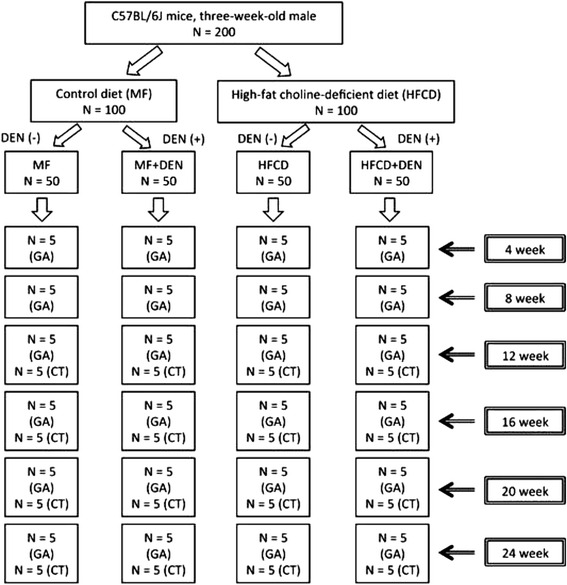
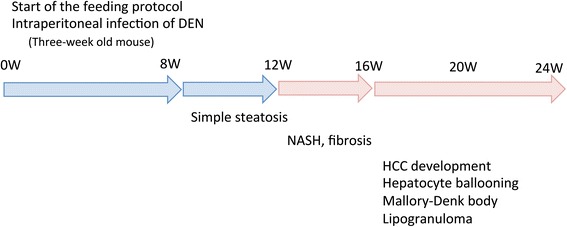
Three-week-old C57BL/6J male mice were fed either a standard diet (MF) or a choline-deficient, high-fat diet (HFCD). The mice in the MF + diethylnitrosamine (DEN) and HFCD + DEN groups received a one-time intraperitoneal injection of DEN at the start of the respective feeding protocols.
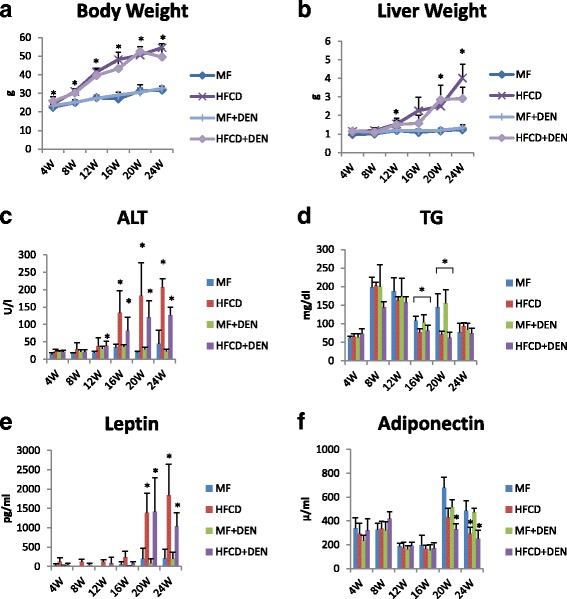
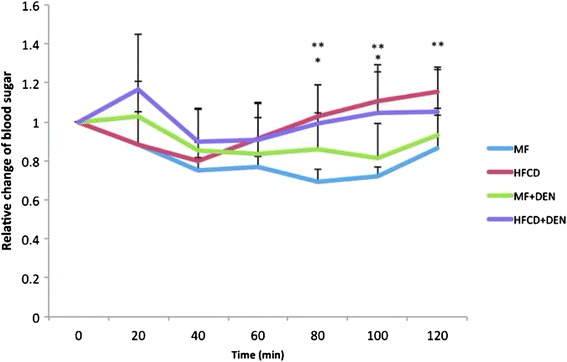
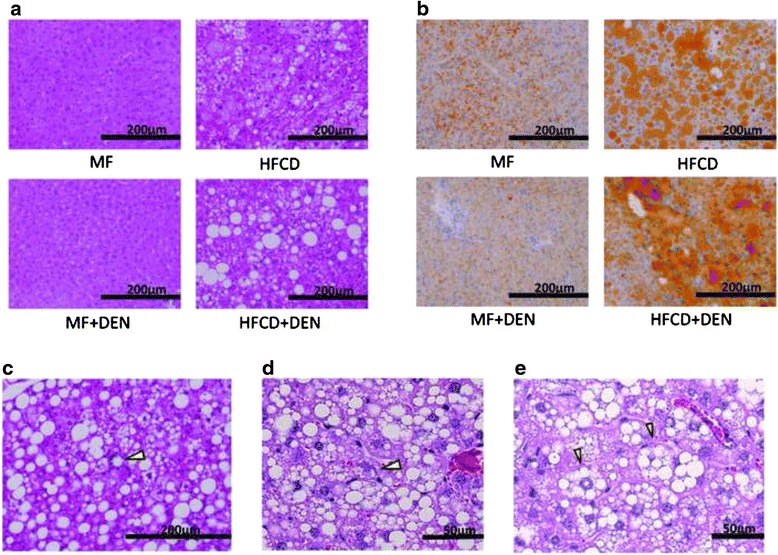
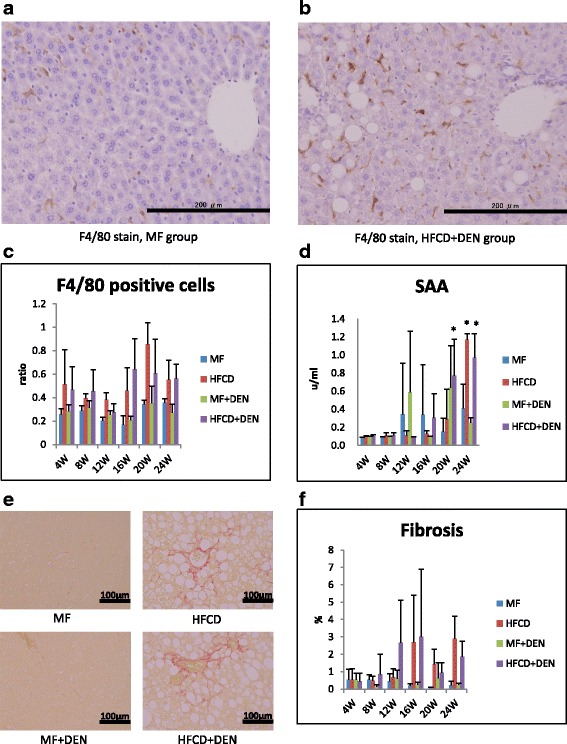
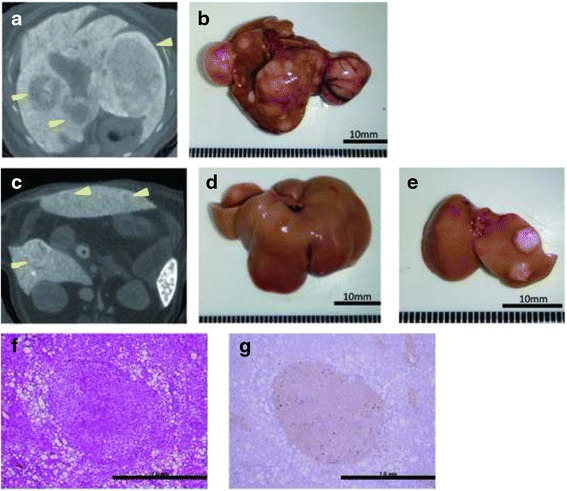
The mice in the HFCD and HFCD + DEN groups developed obesity early in the experiment and insulin resistance after 12 weeks. Triglyceride levels peaked at 8 weeks for all four groups and decreased thereafter. Alanine aminotransferase levels increased every 4 weeks, with the HFCD and HFCD + DEN groups showing remarkably high levels; the HFCD + DEN group presented the highest incidence of nonalcoholic steatohepatitis. The levels of fibrosis and steatosis varied, but they tended to increase every 4 weeks in the HFCD and HFCD + DEN groups. Computed tomography scans indicated that all the HFCD + DEN mice developed hepatic tumors from 20 weeks, some of which were glutamine synthetase-positive.
The nonalcoholic steatohepatitis-hepatocellular carcinoma model we describe here is simple to establish, results in rapid tumor formation, and recapitulates most of the key features of nonalcoholic steatohepatitis. It could therefore facilitate further studies of the development, oncogenic potential, diagnosis, and treatment of this condition.
非酒精性脂肪性肝炎相关肝细胞癌的发病率正在上升,其临床病理特征已得到充分认识。为便于研究,已建立了几种非酒精性脂肪性肝炎动物模型;然而,很少有模型能完全重现其所有临床特征,这些特征包括胰岛素抵抗、炎症、纤维化和致癌作用。此外,这些模型需要相对较长时间才能可靠地产生肝细胞癌。本研究的目的是建立一种快速发展且能反映所有临床相关特征的非酒精性脂肪性肝炎相关肝细胞癌小鼠模型。
给3周龄的C57BL/6J雄性小鼠喂食标准饮食(MF)或胆碱缺乏的高脂肪饮食(HFCD)。MF+二乙基亚硝胺(DEN)组和HFCD+DEN组的小鼠在各自喂养方案开始时一次性腹腔注射DEN。
HFCD组和HFCD+DEN组的小鼠在实验早期出现肥胖,12周后出现胰岛素抵抗。所有四组的甘油三酯水平在8周时达到峰值,此后下降。丙氨酸转氨酶水平每4周升高一次,HFCD组和HFCD+DEN组水平显著升高;HFCD+DEN组非酒精性脂肪性肝炎的发病率最高。纤维化和脂肪变性水平各不相同,但在HFCD组和HFCD+DEN组中它们往往每4周增加一次。计算机断层扫描显示,所有HFCD+DEN小鼠从20周起出现肝肿瘤,其中一些是谷氨酰胺合成酶阳性。
我们在此描述的非酒精性脂肪性肝炎-肝细胞癌模型易于建立,能快速形成肿瘤,并重现了非酒精性脂肪性肝炎的大部分关键特征。因此,它有助于对这种疾病的发生发展、致癌潜力、诊断和治疗进行进一步研究。