Kim Jeong-Geun, Ahn Chun-Seob, Kim Seon-Hee, Bae Young-An, Kwon Na-Young, Kang Insug, Yang Hyun-Jong, Sohn Woon-Mok, Kong Yoon
Department of Molecular Parasitology, Sungkyunkwan University School of Medicine, 2066 Seobu-ro, Jangan-gu, Suwon, 16419, Korea.
Department of Microbiology, Graduate School of Medicine, Gachon University, Incheon, Korea.
Parasit Vectors. 2016 Jun 13;9(1):337. doi: 10.1186/s13071-016-1622-2.
Clonorchis sinensis causes a major food-borne helminthic infection. This species locates in mammalian hepatobiliary ducts, where oxidative stressors and hydrophobic substances are profuse. To adapt to the hostile micromilieu and to ensure its long-term survival, the parasite continuously produces a diverse repertoire of antioxidant enzymes including several species of glutathione transferases (GSTs). Helminth GSTs play pertinent roles during sequestration of harmful xenobiotics since most helminths lack the cytochrome P-450 detoxifying enzyme.
We isolated and analyzed the biochemical properties of two omega-class GSTs of C. sinensis (CsGSTo1 and CsGSTo2). We observed spatiotemporal expression patterns in accordance with the maturation of the worm's reproductive system. Possible biological protective roles of CsGSTos in these organs under oxidative stress were investigated.
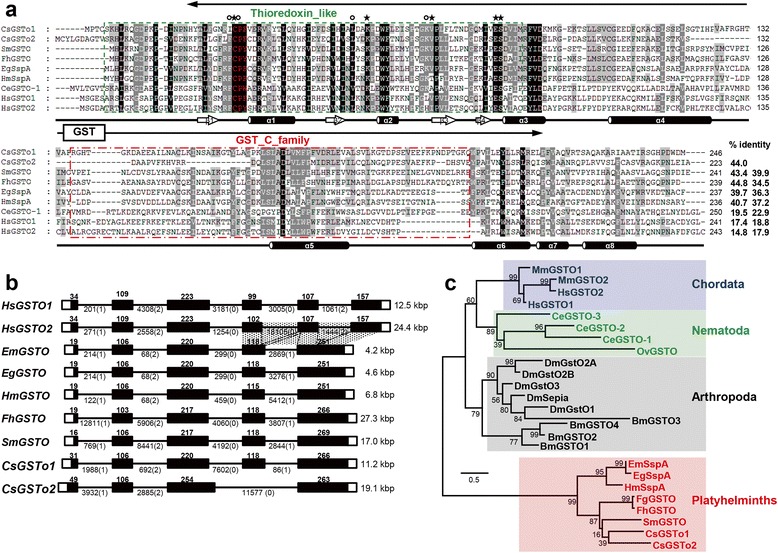
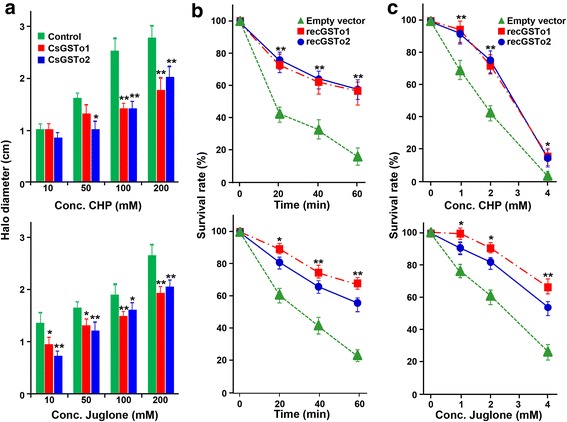
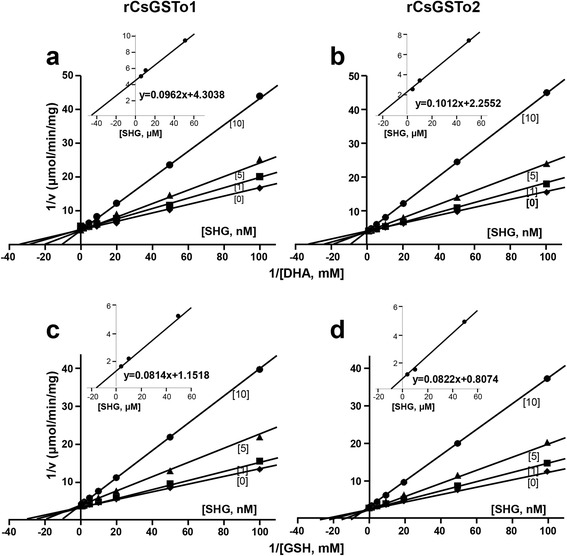
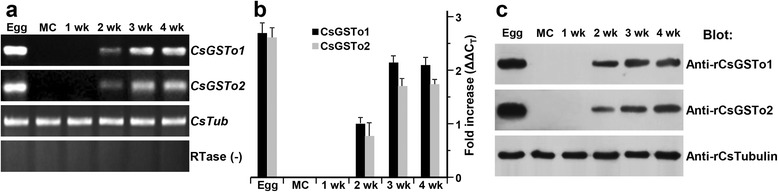
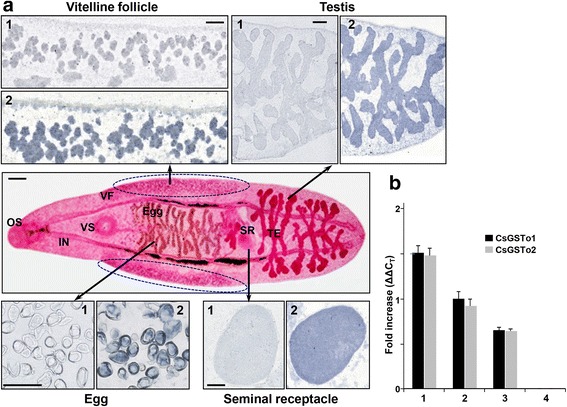
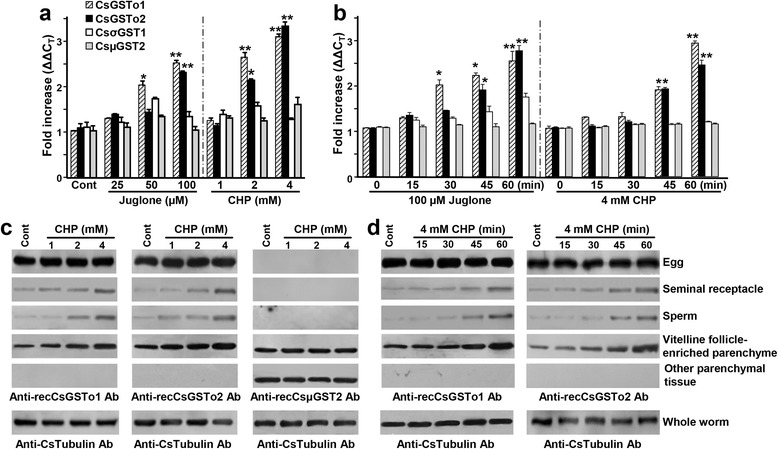
The full-length cDNAs of CsGSTo1 and 2 constituted 965 bp and 1,061 bp with open reading frames of 737 bp (246 amino acids) and 669 bp (223 amino acids). They harbored characteristic N-terminal thioredoxin-like and C-terminal α-helical domains. A cysteine residue, which constituted omega-class specific active site, and the glutathione-binding amino acids, were recognized in appropriate positions. They shared 44 % sequence identity with each other and 14.8-44.8 % with orthologues/homologues from other organisms. Bacterially expressed recombinant proteins (rCsGSTo1 and 2) exhibited dehydroascorbate reductase (DHAR) and thioltransferase activities. DHAR activity was higher than thioltransferase activity. They showed weak canonical GST activity toward 1-chloro-2,4-dinitrobenzene. S-hexylglutathione potently and competitively inhibited the active-site at nanomolar concentrations (0.63 and 0.58 nM for rCsGSTo1 and 2). Interestingly, rCsGSTos exhibited high enzyme activity toward mu- and theta-class GST specific substrate, 4-nitrobenzyl chloride. Expression of CsGSTo transcripts and proteins increased beginning in 2-week-old juveniles and reached their highest levels in 4-week-old adults. The proteins were mainly expressed in the elements of the reproductive system, such as vitelline follicles, testes, seminal receptacle, sperm and eggs. Oxidative stressors induced upregulated expression of CsGSTos in these organs. Regardless of oxidative stresses, CsGSTos continued to be highly expressed in eggs. CsGSTo1 or 2 overexpressing bacteria demonstrated high resistance under oxidative killing.
CsGSTos might be critically involved in protection of the reproductive system during maturation of C. sinensis worms and in response to oxidative conditions, thereby contributing to maintenance of parasite fecundity.
华支睾吸虫引起一种主要的食源性蠕虫感染。该物种寄生于哺乳动物的肝胆管内,那里存在大量氧化应激源和疏水性物质。为了适应这种恶劣的微环境并确保其长期存活,该寄生虫持续产生多种抗氧化酶,包括几种谷胱甘肽转移酶(GSTs)。由于大多数蠕虫缺乏细胞色素P - 450解毒酶,蠕虫GSTs在隔离有害外源性物质过程中发挥相关作用。
我们分离并分析了华支睾吸虫的两种ω - 类GST(CsGSTo1和CsGSTo2)的生化特性。我们观察了其随蠕虫生殖系统成熟的时空表达模式。研究了CsGSTos在氧化应激下这些器官中可能的生物保护作用。
CsGSTo1和2的全长cDNA分别为965 bp和1,061 bp,开放阅读框分别为737 bp(246个氨基酸)和669 bp(223个氨基酸)。它们具有特征性的N端硫氧还蛋白样结构域和C端α - 螺旋结构域。在适当位置识别出构成ω - 类特异性活性位点的半胱氨酸残基以及与谷胱甘肽结合的氨基酸。它们彼此之间具有44%的序列同一性,与其他生物的直系同源物/同源物具有14.8 - 44.8%的序列同一性。细菌表达的重组蛋白(rCsGSTo1和2)表现出脱氢抗坏血酸还原酶(DHAR)和硫醇转移酶活性。DHAR活性高于硫醇转移酶活性。它们对1 - 氯 - 2,4 - 二硝基苯表现出较弱的典型GST活性。S - 己基谷胱甘肽在纳摩尔浓度(rCsGSTo1和2分别为0.63和0.58 nM)下能有效且竞争性地抑制活性位点。有趣的是,rCsGSTos对μ - 类和θ - 类GST特异性底物4 - 硝基苄氯表现出高酶活性。CsGSTo转录本和蛋白的表达从2周龄幼虫开始增加,并在4周龄成虫时达到最高水平。这些蛋白主要在生殖系统的成分中表达,如卵黄滤泡、睾丸、受精囊、精子和卵子。氧化应激源诱导这些器官中CsGSTos的表达上调。无论有无氧化应激,CsGSTos在卵中持续高表达。过表达CsGSTo1或2的细菌在氧化杀伤下表现出高抗性。
CsGSTos可能在华支睾吸虫成熟过程中对生殖系统的保护以及对氧化条件的应答中起关键作用,从而有助于维持寄生虫的繁殖力。