Gardner Adrian, Price Anna, Berryman Fiona, Pynsent Paul
The Royal Orthopaedic Hospital NHS Foundation Trust, Bristol Road South, Northfield, Birmingham, B31 2AP UK.
School of Clinical and Experimental Medicine, University of Birmingham, Edgbaston, Birmingham, B15 2TT UK.
Scoliosis Spinal Disord. 2016 Feb 26;11:6. doi: 10.1186/s13013-016-0068-9. eCollection 2016.
Loss of trunk height caused by scoliosis has been previously assessed using different mathematical formulae. However, these are of differing algebraic construction and will give a range of values for the same size of scoliosis curve. As such, the following study attempted to determine the most valid published formulae for calculating height loss caused by idiopathic scoliosis based on reported growth charts.
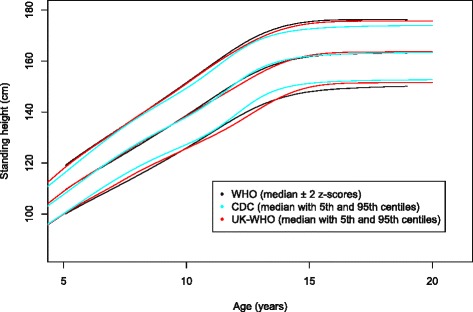
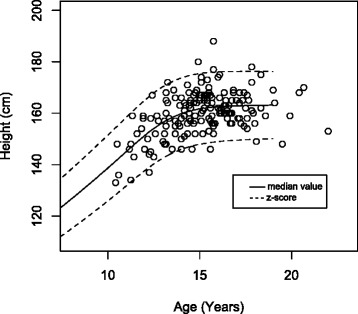
The height and sitting height for a group with idiopathic scoliosis were measured. These were plotted on published growth standards. The size of the coronal curves and the thoracic kyphosis was measured. Height was corrected for the size of the scoliosis using the formulae and replotted on the growth standards. The data spread on the standard was analysed for significant differences between the median and the 5th or 95th centile, and between data outside the 5th and 95th centile.
The sitting to standing height ratio growth standard was used in the analysis as it minimised errors across the different growth standards, given that these standards come from different original populations. In the female group significant differences in the data spread were seen using the formulae of Bjure, Ylikoski and Hwang. Non-significant results were seen for the Kono and Stokes formulae. All formulae caused no significant differences in data spread across the growth standard in the males group.
When assessing against growth standards, the formulae of Kono and Stokes are the most valid at determining height loss caused by idiopathic scoliosis.
先前已使用不同的数学公式评估脊柱侧弯导致的躯干高度损失。然而,这些公式的代数结构不同,对于相同大小的脊柱侧弯曲线会给出一系列不同的值。因此,以下研究试图根据已发表的生长图表确定计算特发性脊柱侧弯导致的身高损失的最有效公式。
测量一组特发性脊柱侧弯患者的身高和坐高。将这些数据绘制在已发表的生长标准图表上。测量冠状曲线的大小和胸椎后凸角度。使用公式根据脊柱侧弯的大小对身高进行校正,并重新绘制在生长标准图表上。分析标准图表上的数据分布,以确定中位数与第5或第95百分位数之间以及第5和第95百分位数之外的数据之间是否存在显著差异。
在分析中使用了坐高与身高比生长标准,因为考虑到这些标准来自不同的原始人群,该标准可将不同生长标准之间的误差降至最低。在女性组中,使用比尤勒(Bjure)、伊利科斯(Ylikoski)和黄(Hwang)的公式时,数据分布存在显著差异。使用河野(Kono)和斯托克斯(Stokes)公式时结果无显著差异。在男性组中,所有公式在生长标准上的数据分布均无显著差异。
在对照生长标准进行评估时,河野和斯托克斯的公式在确定特发性脊柱侧弯导致的身高损失方面最为有效。