Kesteman Thomas, Randrianarivelojosia Milijaona, Piola Patrice, Rogier Christophe
Malaria Research Unit, Institut Pasteur de Madagascar, BP 1274, 101, Avaradoha, Antananarivo, Madagascar.
Unité de recherche sur les maladies infectieuses et tropicales émergentes (URMITE)-UMR 6236, 27 boulevard Jean Moulin, 13385, Marseille, Cedex 05, France.
Malar J. 2016 Jun 16;15:322. doi: 10.1186/s12936-016-1376-5.
Because international funding for malaria control is plateauing, affected countries that receive foreign funding are expected to maintain a constant budget while continuing to reduce Plasmodium transmission. To investigate the appropriateness of a malaria control policy in Madagascar, the effectiveness of all currently deployed malaria control interventions (MCIs) was measured.
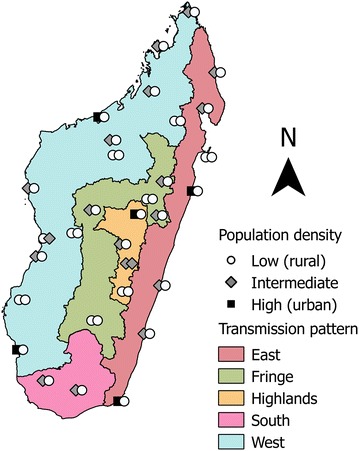
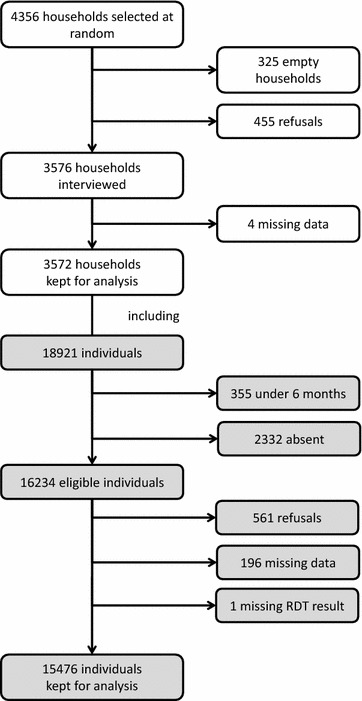
A nationwide cross-sectional survey was conducted in 2012-2013 at 62 sites throughout Madagascar. A total of 15,746 individuals of all ages were tested for Plasmodium infection using rapid diagnostic tests and were interviewed about their use of long-lasting insecticidal nets (LLINs), indoor residual spraying (IRS), intermittent preventive treatment of pregnant women (IPTp), and exposure to information, education and communication (IEC) campaigns. The association between Plasmodium infection and MCI exposure was calculated using multivariate multilevel models, and the protective effectiveness (PE) of an intervention was defined as one minus the odds ratio of this association.
The individual PE of regular LLIN use was high and significant (41 %, 95 % confidence interval [CI] 23-54), whereas its community PE was not. The PE of IRS at the household level was significant in one transmission pattern only (44 %, 95 % CI 11-65), and the community PE with high IRS coverage (>75 %) was high and significant overall (78 %, 95 % CI 44-91). Using LLINs after IRS increased the PE, and the reciprocal was also true. The maternal PE of IPTp was high but non-significant (65 %, 95 % CI -32 to 91). The PE of IEC was low, non-significant and restricted to certain areas (24 %, 95 % CI -34 to 57).
This snapshot of the effectiveness of MCIs confirms that integrated vector control is required in malaria control policies in Madagascar and suggests combining MCIs when one is questionable. Policymakers should consider the local effectiveness of all deployed MCIs through a similar phase IV assessment.
由于国际疟疾控制资金趋于平稳,接受外国资金的受影响国家预计在持续减少疟原虫传播的同时维持预算不变。为调查马达加斯加疟疾控制政策的适宜性,对目前所有已部署的疟疾控制干预措施(MCI)的有效性进行了评估。
2012年至2013年在马达加斯加全国62个地点开展了一项横断面调查。使用快速诊断检测对总共15746名各年龄段个体进行疟原虫感染检测,并就其长效驱虫蚊帐(LLIN)的使用、室内滞留喷洒(IRS)、孕妇间歇性预防治疗(IPTp)以及信息、教育和宣传(IEC)活动的接触情况进行访谈。使用多变量多层次模型计算疟原虫感染与MCI接触之间的关联,干预措施的保护效果(PE)定义为1减去该关联的比值比。
定期使用LLIN的个体保护效果高且显著(41%,95%置信区间[CI] 23 - 54),而其社区保护效果则不然。IRS在家庭层面的保护效果仅在一种传播模式下显著(44%,95% CI 11 - 65),且IRS高覆盖率(>75%)的社区保护效果总体上高且显著(78%,95% CI 44 - 91)。IRS后使用LLIN可提高保护效果,反之亦然。IPTp的产妇保护效果高但不显著(65%,95% CI -32至91)。IEC的保护效果低,不显著且仅限于某些地区(24%,95% CI -34至57)。
MCI有效性的这一简要情况证实,马达加斯加疟疾控制政策需要综合病媒控制,并建议在某项干预措施存疑时将多种MCI联合使用。政策制定者应通过类似的IV期评估考虑所有已部署MCI的当地有效性。