
CpG岛甲基化表型对转移性结直肠癌的不良预后影响。
Adverse prognostic impact of the CpG island methylator phenotype in metastatic colorectal cancer.
作者信息
Cha Yongjun, Kim Kyung-Ju, Han Sae-Won, Rhee Ye Young, Bae Jeong Mo, Wen Xianyu, Cho Nam-Yun, Lee Dae-Won, Lee Kyung-Hun, Kim Tae-Yong, Oh Do-Youn, Im Seock-Ah, Bang Yung-Jue, Jeong Seung-Yong, Park Kyu Joo, Kang Gyeong Hoon, Kim Tae-You
机构信息
Department of Internal Medicine, Seoul National University Hospital, Seoul, South Korea.
Department of Pathology, Seoul National University College of Medicine, Seoul, South Korea.
出版信息
Br J Cancer. 2016 Jul 12;115(2):164-71. doi: 10.1038/bjc.2016.176. Epub 2016 Jun 16.
BACKGROUND
The association between the CpG island methylator phenotype (CIMP) and clinical outcomes in metastatic colorectal cancer remains unclear. We investigated the prognostic impact of CIMP in patients with metastatic colorectal cancer treated with systemic chemotherapy.
METHODS
Eight CIMP-specific promoters (CACNA1G, IGF2, NEUROG1, RUNX3, SOCS1, CDKN2A, CRABP1, and MLH1) were examined. The CIMP status was determined by the number of methylated promoters as high (⩾5), low (1-4), and negative (0).
RESULTS
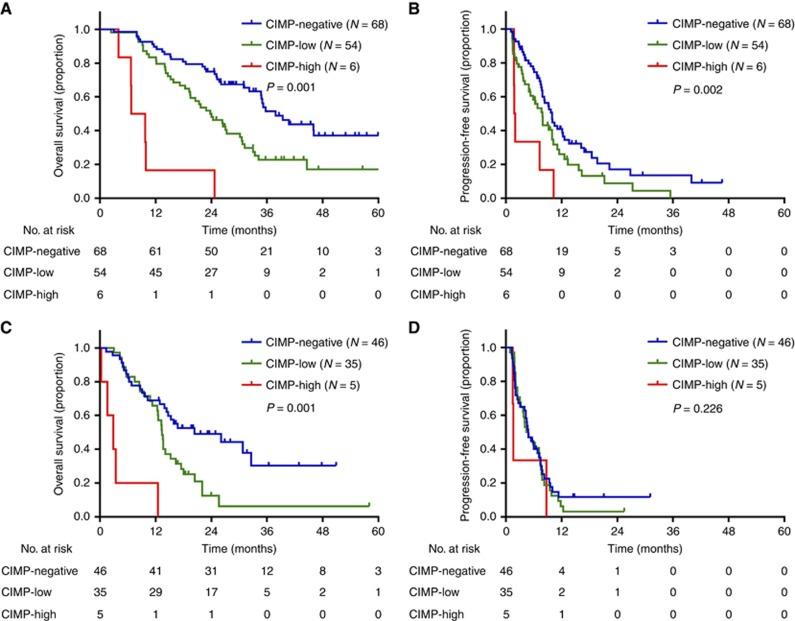
A total of 153 patients were included (men/women, 103/50; median age, 61 years; range, 22-80 years). The CIMP status was negative/low/high in 77/ 69/7 patients, respectively. Overall survival (OS) was significantly different among the three CIMP groups, with median values of 35.7, 22.2, and 9.77 months for the negative, low, and high groups, respectively (P<0.001). For patients treated with fluoropyrimidine and oxaliplatin first-line chemotherapy (N=128), OS and progression-free survival (PFS) were significantly different among the three CIMP groups; the median OS was 37.9, 23.8, and 6.77 months for the negative, low, and high groups, respectively (P<0.001), while the median PFS was 9.97, 7.87, and 1.83 months, respectively (P=0.002). Response rates were marginally different among the three CIMP groups (53.4% vs 45.1% vs 16.7%, respectively; P=0.107). For patients treated with fluoropyrimidine and irinotecan second-line chemotherapy (N=86), only OS showed a difference according to the CIMP status, with median values of 20.4, 13.4, and 2.90 months for the negative, low, and high groups, respectively (P<0.001).
CONCLUSIONS
The CIMP status is a negative prognostic factor for patients with metastatic colorectal cancer treated with chemotherapy.
背景
CpG岛甲基化表型(CIMP)与转移性结直肠癌临床结局之间的关联尚不清楚。我们研究了CIMP对接受全身化疗的转移性结直肠癌患者的预后影响。
方法
检测了8个CIMP特异性启动子(CACNA1G、IGF2、NEUROG1、RUNX3、SOCS1、CDKN2A、CRABP1和MLH1)。根据甲基化启动子的数量将CIMP状态分为高(⩾5个)、低(1 - 4个)和阴性(0个)。
结果
共纳入153例患者(男/女,103/50;中位年龄61岁;范围22 - 80岁)。CIMP状态为阴性/低/高的患者分别有77/69/7例。三组CIMP患者的总生存期(OS)有显著差异,阴性、低和高组的中位生存期分别为35.7、22.2和9.77个月(P<0.001)。对于接受氟嘧啶和奥沙利铂一线化疗的患者(N = 128),三组CIMP患者的OS和无进展生存期(PFS)有显著差异;阴性、低和高组的中位OS分别为37.9、23.8和6.77个月(P<0.001),而中位PFS分别为9.97、7.87和1.83个月(P = 0.002)。三组CIMP患者的缓解率略有差异(分别为53.4%、45.1%和16.7%;P = 0.107)。对于接受氟嘧啶和伊立替康二线化疗的患者(N = 86),仅OS根据CIMP状态显示出差异,阴性、低和高组的中位生存期分别为20.4、13.4和2.90个月(P<0.001)。
结论
CIMP状态是接受化疗的转移性结直肠癌患者的不良预后因素。


 Zotero 插件