Duan T, Chapman S C, Holland E, Rebetzke G J, Guo Y, Zheng B
College of Resources and Environmental Sciences, China Agricultural University, Beijing 100193, China CSIRO Agriculture, Queensland Biosciences Precinct, 306 Carmody Road, St Lucia, QLD 4067, Australia.
CSIRO Agriculture, Queensland Biosciences Precinct, 306 Carmody Road, St Lucia, QLD 4067, Australia.
J Exp Bot. 2016 Aug;67(15):4523-34. doi: 10.1093/jxb/erw227. Epub 2016 Jun 15.
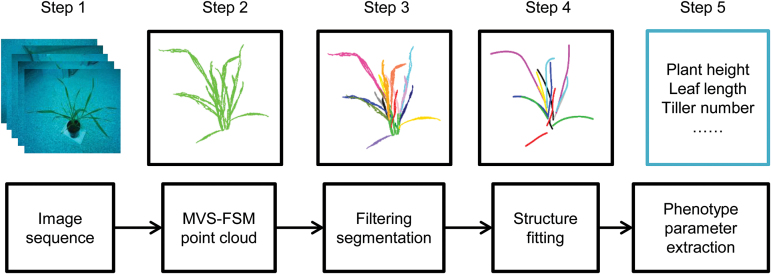
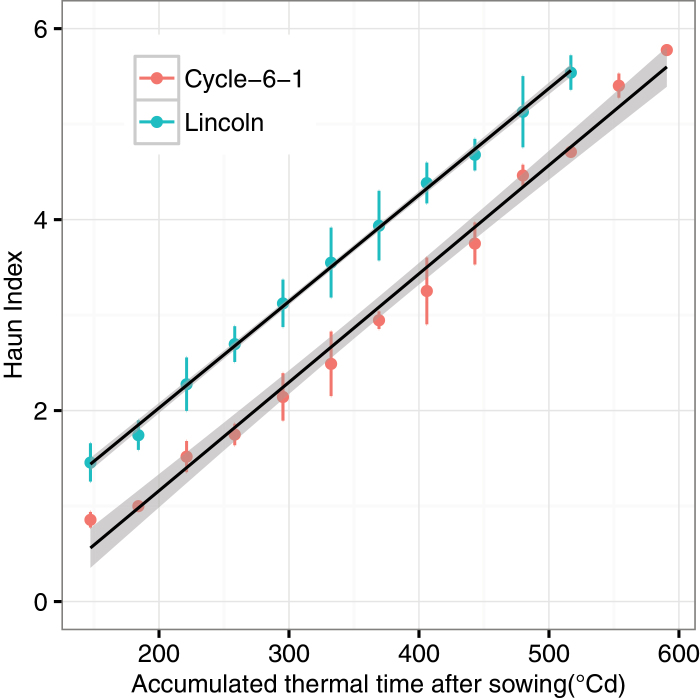
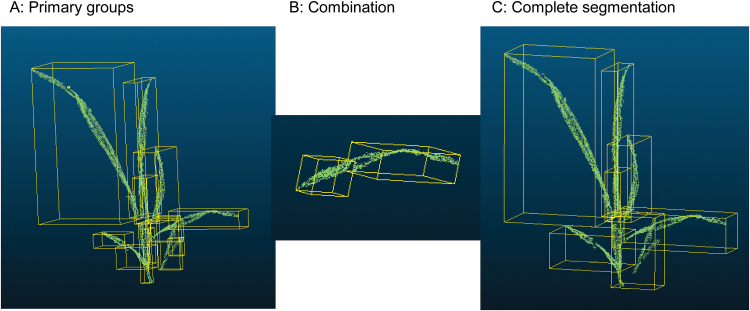
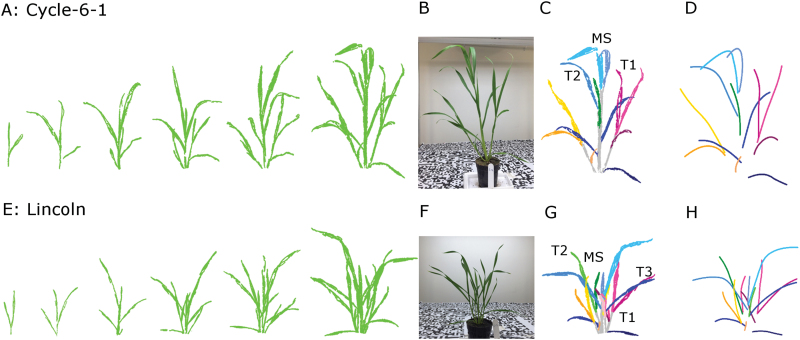
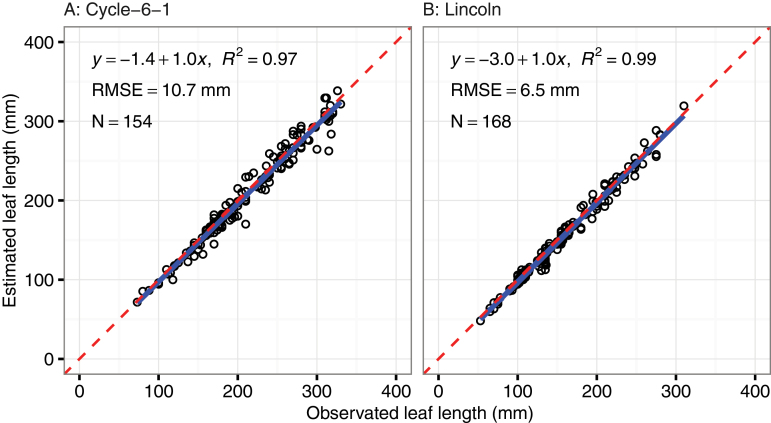
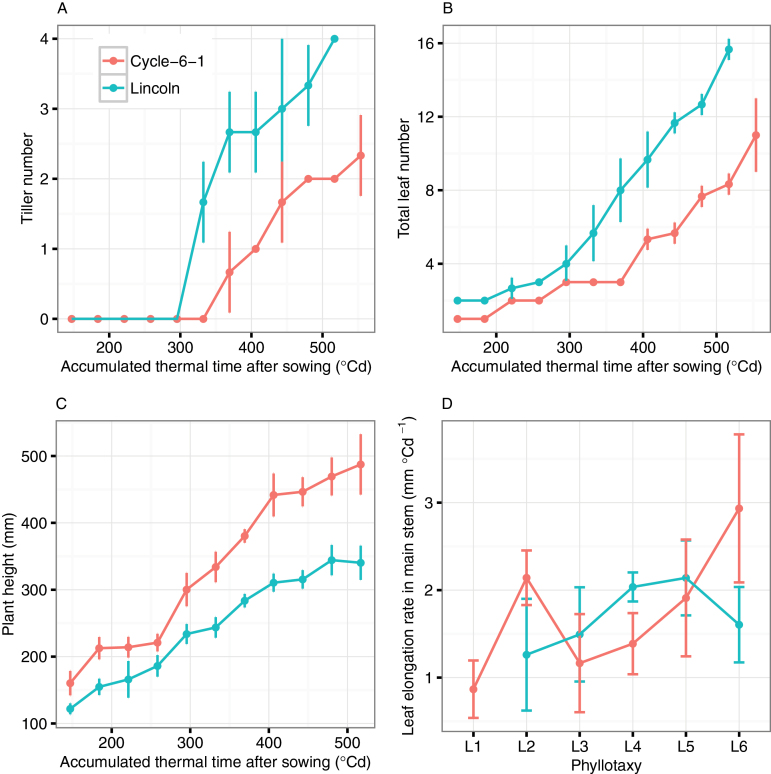
Early vigour is an important physiological trait to improve establishment, water-use efficiency, and grain yield for wheat. Phenotyping large numbers of lines is challenging due to the fast growth and development of wheat seedlings. Here we developed a new photo-based workflow to monitor dynamically the growth and development of the wheat canopy of two wheat lines with a contrasting early vigour trait. Multiview images were taken using a 'vegetation stress' camera at 2 d intervals from emergence to the sixth leaf stage. Point clouds were extracted using the Multi-View Stereo and Structure From Motion (MVS-SFM) algorithm, and segmented into individual organs using the Octree method, with leaf midribs fitted using local polynomial function. Finally, phenotypic parameters were calculated from the reconstructed point cloud including: tiller and leaf number, plant height, Haun index, phyllochron, leaf length, angle, and leaf elongation rate. There was good agreement between the observed and estimated leaf length (RMSE=8.6mm, R (2)=0.98, n=322) across both lines. Significant contrasts of phenotyping parameters were observed between the two lines and were consistent with manual observations. The early vigour line had fewer tillers (2.4±0.6) and larger leaves (308.0±38.4mm and 17.1±2.7mm for leaf length and width, respectively). While the phyllochron of both lines was quite similar, the non-vigorous line had a greater Haun index (more leaves on the main stem) on any date, as the vigorous line had slower development of its first two leaves. The workflow presented in this study provides an efficient method to phenotype individual plants using a low-cost camera (an RGB camera is also suitable) and could be applied in phenotyping for applications in both simulation modelling and breeding. The rapidity and accuracy of this novel method can characterize the results of specific selection criteria (e.g. width of leaf three, number of tillers, rate of leaf appearance) that have been or can now be utilized to breed for early leaf growth and tillering in wheat.
早期活力是提高小麦的出苗率、水分利用效率和籽粒产量的重要生理性状。由于小麦幼苗生长发育迅速,对大量品系进行表型分析具有挑战性。在此,我们开发了一种基于图像的新工作流程,以动态监测具有不同早期活力性状的两个小麦品系的冠层生长发育情况。从出苗到第六叶期,每隔2天使用一台“植被胁迫”相机拍摄多视图图像。使用多视图立体和运动结构(MVS-SFM)算法提取点云,并使用八叉树方法将其分割为单个器官,用局部多项式函数拟合叶片中脉。最后,根据重建的点云计算表型参数,包括:分蘖数和叶片数、株高、豪恩指数、出叶间隔、叶长、叶角和叶片伸长率。两个品系的观测叶长和估计叶长之间具有良好的一致性(均方根误差=8.6毫米,R²=0.98,n=322)。两个品系之间在表型参数上存在显著差异,且与人工观测结果一致。早期活力较强的品系分蘖较少(2.4±0.6个),叶片较大(叶长和叶宽分别为308.0±38.4毫米和17.1±2.7毫米)。虽然两个品系的出叶间隔非常相似,但在任何日期,非活力品系的豪恩指数都更高(主茎上的叶片更多),因为活力品系的前两片叶子发育较慢。本研究中提出的工作流程提供了一种使用低成本相机(RGB相机也适用)对单株进行表型分析的有效方法,可应用于模拟建模和育种中的表型分析。这种新方法的快速性和准确性能够表征已被或现在可用于培育小麦早期叶片生长和分蘖的特定选择标准(如第三片叶的宽度、分蘖数、出叶速率)的结果。