Yeung M, Kowalczuk M, Simunovic N, Ayeni O R
McMaster University, 1200 Main St W, Room 4E15, Hamilton, Ontario L8N 3Z5, Canada.
McMaster University, 293 Wellington St. N., Suite 110, Hamilton, Ontario L8L 8E7, Canada.
Bone Joint Res. 2016 Jun;5(6):225-31. doi: 10.1302/2046-3758.56.2000533.
Hip arthroscopy in the setting of hip dysplasia is controversial in the orthopaedic community, as the outcome literature has been variable and inconclusive. We hypothesise that outcomes of hip arthroscopy may be diminished in the setting of hip dysplasia, but outcomes may be acceptable in milder or borderline cases of hip dysplasia.
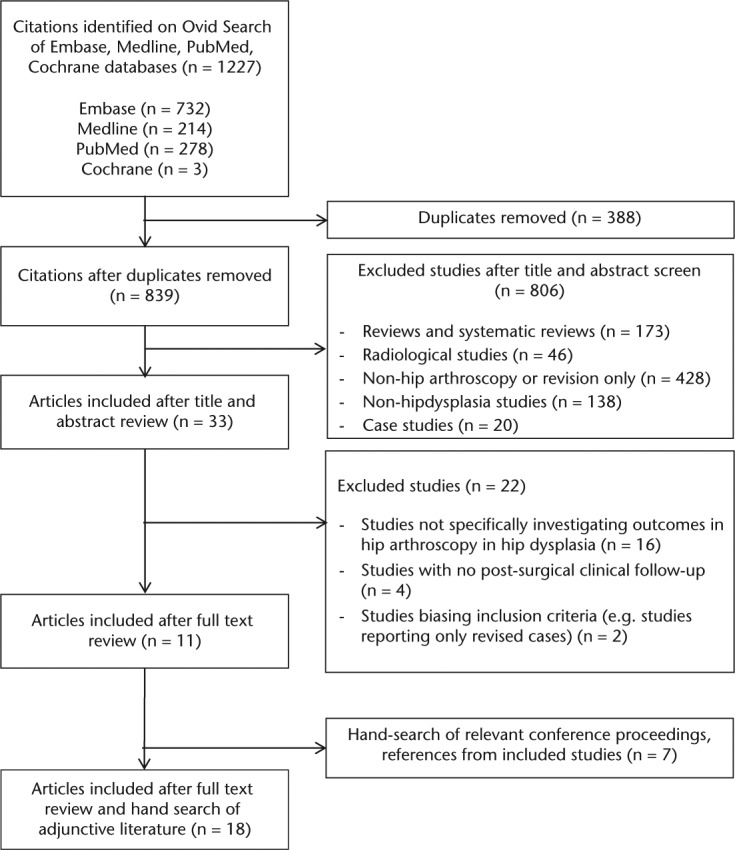
A systematic search was performed in duplicate for studies investigating the outcome of hip arthroscopy in the setting of hip dysplasia up to July 2015. Study parameters including sample size, definition of dysplasia, outcomes measures, and re-operation rates were obtained. Furthermore, the levels of evidence of studies were collected and quality assessment was performed.
The systematic review identified 18 studies investigating hip arthroscopy in the setting of hip dysplasia, with 889 included patients. Criteria used by the studies to diagnose hip dysplasia and borderline hip dysplasia included centre edge angle in 72% of studies but the range of angles were quite variable. Although 89% of studies reported improved post-operative outcome scores in the setting of hip dysplasia, revision rates were considerable (14.1%), with 9.6% requiring conversion to total hip arthroplasty.
The available orthopaedic literature suggests that although improved outcomes are seen in hip arthroscopy in the setting of hip dysplasia, there is a high rate of re-operation and conversion to total hip arthroplasty. Furthermore, the criteria used to define hip dysplasia vary considerably among published studies.Cite this article: M. Yeung, M. Kowalczuk, N. Simunovic, O. R. Ayeni. Hip arthroscopy in the setting of hip dysplasia: A systematic review. Bone Joint Res 2016;5:225-231. DOI: 10.1302/2046-3758.56.2000533.
在骨科领域,髋关节发育不良情况下的髋关节镜检查存在争议,因为相关结果的文献报道不一且尚无定论。我们推测,在髋关节发育不良的情况下,髋关节镜检查的效果可能会降低,但在轻度或临界髋关节发育不良病例中,效果可能是可以接受的。
对截至2015年7月研究髋关节发育不良情况下髋关节镜检查结果的研究进行了重复的系统检索。获取了包括样本量、发育不良的定义、结果测量和再次手术率等研究参数。此外,收集了研究的证据水平并进行了质量评估。
系统评价确定了18项研究髋关节发育不良情况下髋关节镜检查的研究,共纳入889例患者。这些研究用于诊断髋关节发育不良和临界髋关节发育不良的标准中,72%的研究包括中心边缘角,但角度范围差异很大。尽管89%的研究报告在髋关节发育不良的情况下术后结果评分有所改善,但翻修率相当高(14.1%),其中9.6%需要转换为全髋关节置换术。
现有的骨科文献表明,尽管在髋关节发育不良的情况下髋关节镜检查有改善的结果,但再次手术和转换为全髋关节置换术的发生率很高。此外,已发表的研究中用于定义髋关节发育不良的标准差异很大。引用本文:M. 杨,M. 科瓦尔楚克,N. 西穆诺维奇,O. R. 阿耶尼。髋关节发育不良情况下的髋关节镜检查:系统评价。《骨与关节研究》2016;5:225 - 231。DOI:10.1302/2046 - 3758.56.2000533。