Aziz Hamiza, Hatah Ernieda, Makmor Bakry Mohd, Islahudin Farida
Faculty of Pharmacy, Universiti Kebangsaan Malaysia, Jalan Raja Muda Abdul Aziz, Kuala Lumpur, Malaysia; Pharmacy Division, Ministry of Health, Jalan Universiti, Petaling Jaya, Malaysia.
Faculty of Pharmacy, Universiti Kebangsaan Malaysia, Jalan Raja Muda Abdul Aziz, Kuala Lumpur, Malaysia.
Patient Prefer Adherence. 2016 May 13;10:837-50. doi: 10.2147/PPA.S103057. eCollection 2016.
A previous systematic review reported that increase in patients' medication cost-sharing reduced patients' adherence to medication. However, a study among patients with medication subsidies who received medication at no cost found that medication nonadherence was also high. To our knowledge, no study has evaluated the influence of different medication payment schemes on patients' medication adherence.
This study aims to review research reporting the influence of payment schemes and their association with patients' medication adherence behavior.
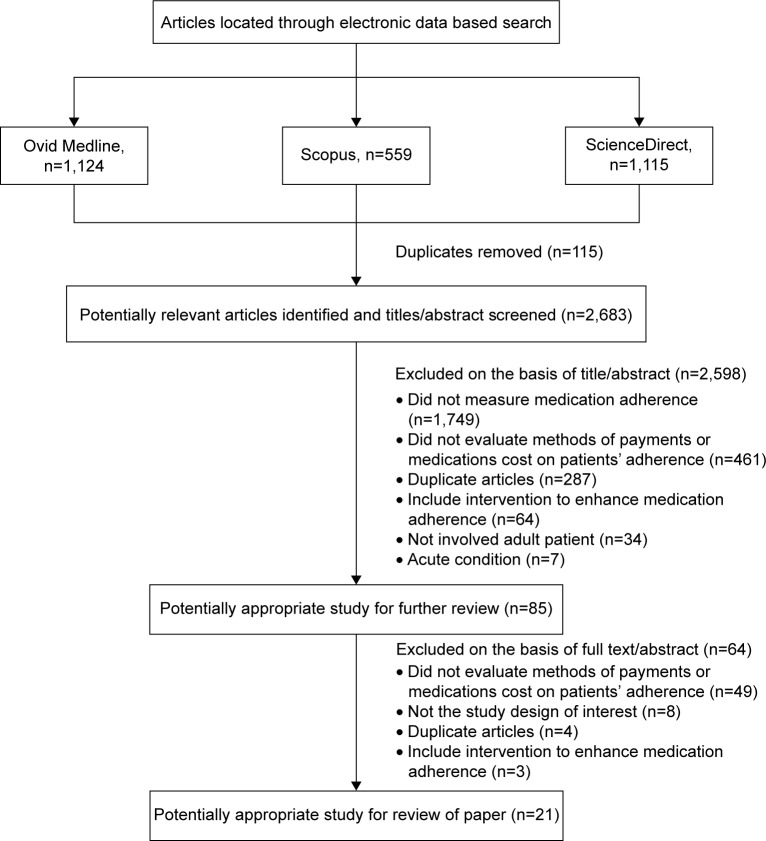
This study was conducted using systematic review of published articles. Relevant published articles were located through three electronic databases Medline, ProQuest Medical Library, and ScienceDirect since inception to February 2015. Included articles were then reviewed and summarized narratively.
Of the total of 2,683 articles located, 21 were included in the final analysis. There were four types of medication payment schemes reported in the included studies: 1) out-of-pocket expenditure or copayments; 2) drug coverage or insurance benefit; 3) prescription cap; and 4) medication subsidies. Our review found that patients with "lower self-paying constraint" were more likely to adhere to their medication (adherence rate ranged between 28.5% and 94.3%). Surprisingly, the adherence rate among patients who received medication as fully subsidized was similar (rate between 34% and 84.6%) as that of other payment schemes. The studies that evaluated patients with fully subsidized payment scheme found that the medication adherence was poor among patients with nonsevere illness.
Although medication adherence was improved with the reduction of cost-sharing such as lower copayment, higher drug coverage, and prescription cap, patients with full-medication subsidies payment scheme (received medication at no cost) were also found to have poor adherence to their medication. Future studies comparing factors that may influence patients' adherence to medication among patients who received medication subsidies should be done to develop strategies to overcome medication nonadherence.
先前的一项系统评价报告称,患者药物费用分担的增加会降低患者的用药依从性。然而,一项针对享受药物补贴且免费获得药物的患者的研究发现,用药不依从的情况也很普遍。据我们所知,尚无研究评估不同药物支付方案对患者用药依从性的影响。
本研究旨在综述报告支付方案的影响及其与患者用药依从性行为之间关联的研究。
本研究采用对已发表文章进行系统评价的方法。自数据库建立至2015年2月,通过三个电子数据库(Medline、ProQuest医学图书馆和ScienceDirect)检索相关已发表文章。然后对纳入的文章进行综述并进行叙述性总结。
在检索到的总共2683篇文章中,最终分析纳入了21篇。纳入研究中报告了四种药物支付方案:1)自付费用或共付费用;2)药物覆盖或保险福利;3)处方限额;4)药物补贴。我们的综述发现,“自付限制较低”的患者更有可能坚持用药(依从率在28.5%至94.3%之间)。令人惊讶的是,完全补贴用药患者的依从率(34%至84.6%之间)与其他支付方案相似。评估完全补贴支付方案患者的研究发现,病情不严重的患者用药依从性较差。
虽然降低共付费用、提高药物覆盖范围和处方限额等费用分担措施可改善用药依从性,但完全药物补贴支付方案(免费获得药物)的患者用药依从性也较差。未来应开展研究,比较可能影响享受药物补贴患者用药依从性的因素,以制定克服用药不依从的策略。