Wang Ledan, Hu Yue, Li Wenju, Wang Fan, Lu Xiaosheng, Han Xueying, Lv Jieqiang, Chen Jie
Department of Gynecology and Obstetrics, The Second Affiliated Hospital and Yuying Children's Hospital of Wenzhou Medical University, Wenzhou, Zhejiang 325000, P.R. China.
Department of Children's Infectious Disease, The Second Affiliated Hospital and Yuying Children's Hospital of Wenzhou Medical University, Wenzhou, Zhejiang 325000, P.R. China.
Oncol Lett. 2016 Jun;11(6):4022-4026. doi: 10.3892/ol.2016.4549. Epub 2016 May 9.
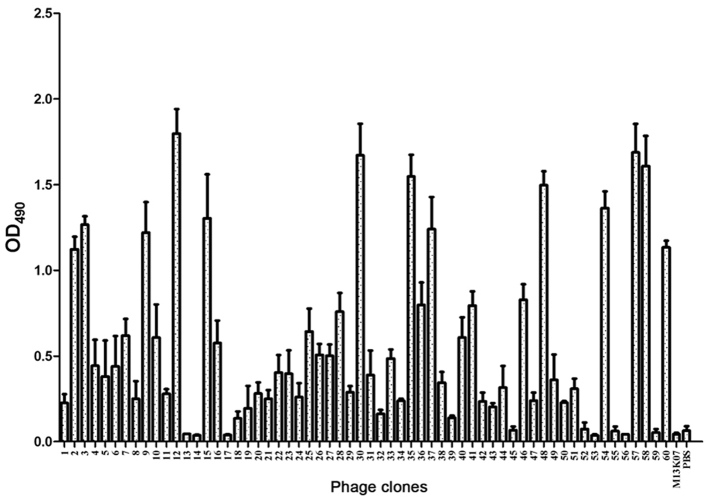
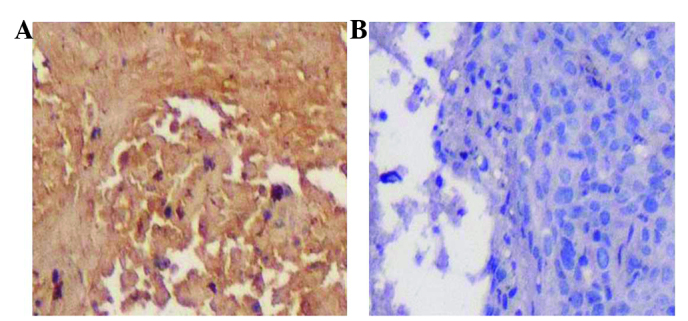
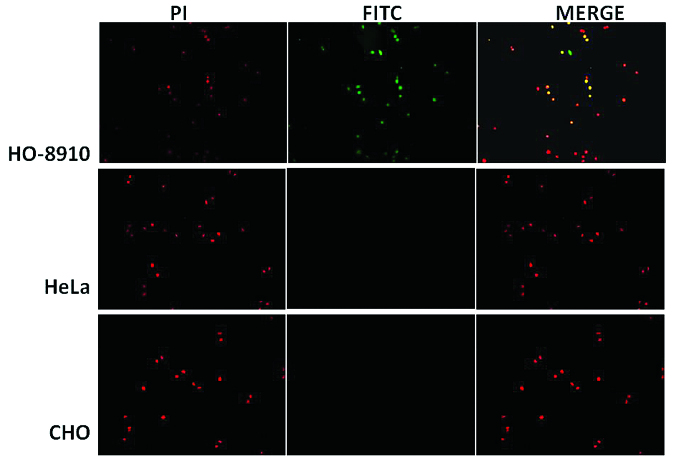
Ovarian cancer is the most common cause of cancer-associated mortality in terms of gynecological malignancies, and is difficult to diagnose due to the absence of reliable biomarkers. To identify ovarian cancer-specific biomarkers, the present study used a Ph.D.-7™ Phage Display Peptide Library to screen for ligands that selectively target HO-8910 ovarian cancer cells. Following 5 rounds of biopanning, the phage clone P2 was selected by enzyme-linked immunosorbent assay and DNA sequencing, and its characteristics were additionally validated by immunofluorescence and immunohistochemical assays. The results revealed the positive phage were enriched 92-fold following 5 rounds of biopanning, and the DNA sequence AAC CCG ATG ATT CGC CGC CAG (amino acid sequence, NPMIRRQ) was repeated most frequently (phage clones, P2, P3, P15, P30 and P54). Immunofluorescence and immunohistochemical assays revealed that the phage clone P2 was able to bind to ovarian cancer cells and tissues, and not those of cervical cancer. In conclusion, the peptide NPMIRRQ may be a potential agent for the diagnosis of ovarian cancer.
在妇科恶性肿瘤中,卵巢癌是癌症相关死亡率的最常见原因,并且由于缺乏可靠的生物标志物而难以诊断。为了鉴定卵巢癌特异性生物标志物,本研究使用了Ph.D.-7™噬菌体展示肽库来筛选选择性靶向HO-8910卵巢癌细胞的配体。经过5轮生物淘选后,通过酶联免疫吸附测定和DNA测序选择噬菌体克隆P2,并通过免疫荧光和免疫组织化学测定进一步验证其特性。结果显示,经过5轮生物淘选后,阳性噬菌体富集了92倍,DNA序列AAC CCG ATG ATT CGC CGC CAG(氨基酸序列,NPMIRRQ)重复出现的频率最高(噬菌体克隆P2、P3、P15、P30和P54)。免疫荧光和免疫组织化学测定显示,噬菌体克隆P2能够与卵巢癌细胞和组织结合,而不与宫颈癌细胞和组织结合。总之,肽NPMIRRQ可能是诊断卵巢癌的潜在试剂。