Rojo de la Vega Montserrat, Dodson Matthew, Gross Christine, Mansour Heidi M, Lantz R Clark, Chapman Eli, Wang Ting, Black Stephen M, Garcia Joe G N, Zhang Donna D
Department of Pharmacology and Toxicology, University of Arizona, Tucson, AZ, USA.
Department of Medicine, Division of Translational and Regenerative Medicine, University of Arizona, Tucson, AZ, USA.
Curr Pharmacol Rep. 2016 Apr;2(2):91-101. doi: 10.1007/s40495-016-0053-2. Epub 2016 Feb 6.
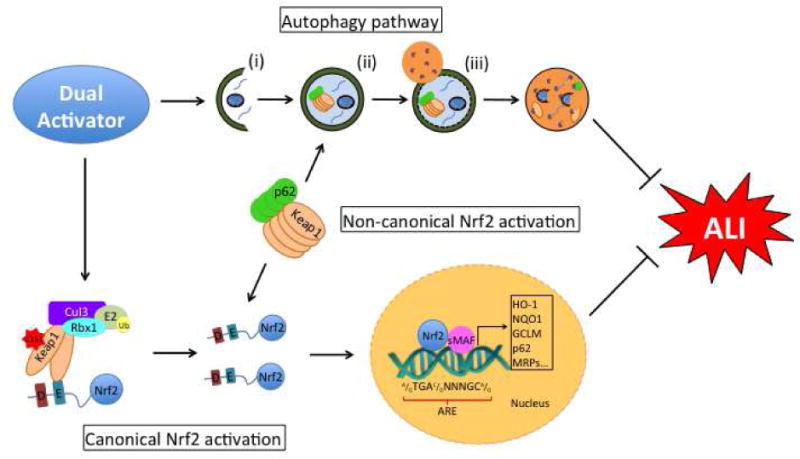
Acute lung injury (ALI) and acute respiratory distress syndrome (ARDS) are the clinical manifestations of severe lung damage and respiratory failure. Characterized by severe inflammation and compromised lung function, ALI/ARDS result in very high mortality of affected individuals. Currently, there are no effective treatments for ALI/ARDS, and ironically, therapies intended to aid patients (specifically mechanical ventilation, MV) may aggravate the symptoms. Key events contributing to the development of ALI/ARDS are: increased oxidative and proteotoxic stresses, unresolved inflammation, and compromised alveolar-capillary barrier function. Since the airways and lung tissues are constantly exposed to gaseous oxygen and airborne toxicants, the bronchial and alveolar epithelial cells are under higher oxidative stress than other tissues. Cellular protection against oxidative stress and xenobiotics is mainly conferred by Nrf2, a transcription factor that promotes the expression of genes that regulate oxidative stress, xenobiotic metabolism and excretion, inflammation, apoptosis, autophagy, and cellular bioenergetics. Numerous studies have demonstrated the importance of Nrf2 activation in the protection against ALI/ARDS, as pharmacological activation of Nrf2 prevents the occurrence or mitigates the severity of ALI/ARDS. Another promising new therapeutic strategy in the prevention and treatment of ALI/ARDS is the activation of autophagy, a bulk protein and organelle degradation pathway. In this review, we will discuss the strategy of concerted activation of Nrf2 and autophagy as a preventive and therapeutic intervention to ameliorate ALI/ARDS.
急性肺损伤(ALI)和急性呼吸窘迫综合征(ARDS)是严重肺损伤和呼吸衰竭的临床表现。ALI/ARDS以严重炎症和肺功能受损为特征,导致受影响个体的死亡率非常高。目前,尚无针对ALI/ARDS的有效治疗方法,具有讽刺意味的是,旨在帮助患者的治疗方法(特别是机械通气,MV)可能会加重症状。促成ALI/ARDS发生发展的关键事件包括:氧化应激和蛋白毒性应激增加、炎症未消退以及肺泡-毛细血管屏障功能受损。由于气道和肺组织不断暴露于气态氧和空气传播的毒物中,支气管和肺泡上皮细胞比其他组织承受更高的氧化应激。细胞对氧化应激和外源性物质的保护主要由Nrf2提供,Nrf2是一种转录因子,可促进调节氧化应激、外源性物质代谢与排泄、炎症、细胞凋亡、自噬和细胞生物能学的基因的表达。大量研究已证明Nrf2激活在预防ALI/ARDS中的重要性,因为Nrf2的药理学激活可预防ALI/ARDS的发生或减轻其严重程度。预防和治疗ALI/ARDS的另一种有前景的新治疗策略是激活自噬,自噬是一种大量蛋白质和细胞器降解途径。在本综述中,我们将讨论协同激活Nrf2和自噬作为改善ALI/ARDS的预防和治疗干预措施的策略。