Brellenthin Angelique G, Koltyn Kelli F
a Department of Kinesiology , University of Wisconsin-Madison , Madison , WI , USA.
Am J Drug Alcohol Abuse. 2016 Sep;42(5):481-489. doi: 10.1080/00952990.2016.1185434. Epub 2016 Jun 17.
Despite cannabis being the most widely used illicit substance in the United States, individuals diagnosed with cannabis use disorder (CUD) have few well-researched, affordable treatment options available to them. Although found to be effective for improving treatment outcomes in other drug populations, exercise is an affordable and highly accessible treatment approach that has not been routinely investigated in cannabis users.
The aim of this paper is to inform the topic regarding exercise's potential as an adjunctive treatment for individuals with CUD.
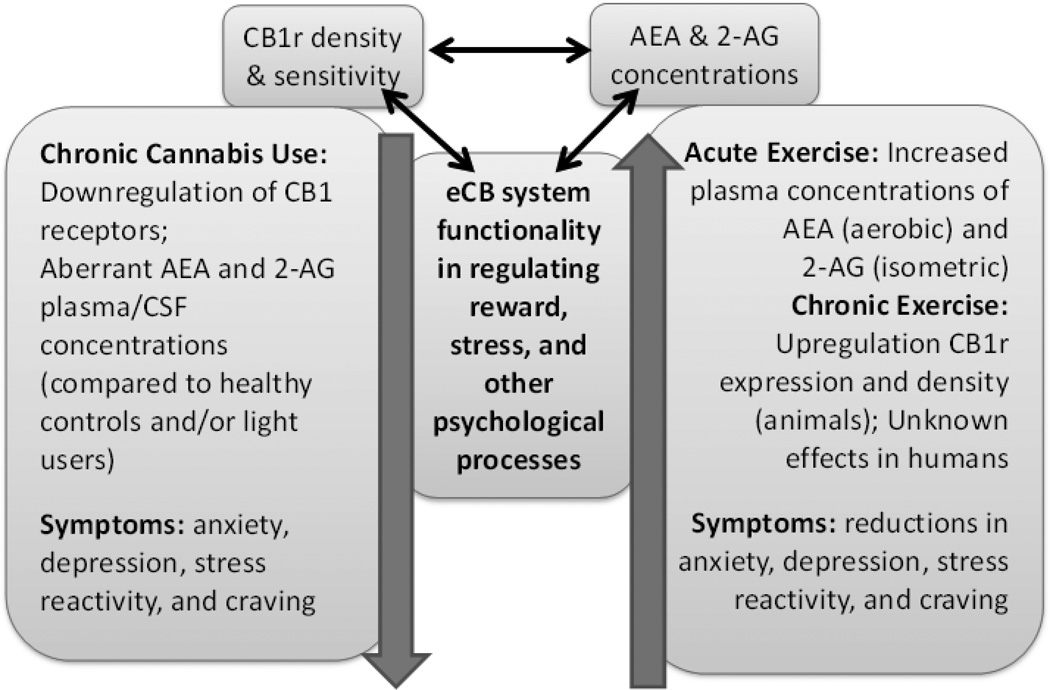
We reviewed the evidence surrounding cannabis use and its current treatment in the United States, explored the rationale for including exercise in the treatment of substance use disorders (SUDs), and in particular, proposed a biological mechanism (i.e., endocannabinoids (eCBs)) that should be examined when utilizing exercise for the treatment of CUD.
Cannabis use is widespread and increasing in the United States. Chronic, heavy cannabis use may dysregulate the endogenous cannabinoid system, which has implications for several psychobiological processes that interact with the eCB system such as reward processing and the stress response. Given that exercise is a potent activator of the eCB system, it is mechanistically plausible that exercise could be an optimal method to supplement cessation efforts by reducing psychophysical withdrawal, managing stress, and attenuating drug cravings.
We suggest there is a strong behavioral and physiological rationale to design studies which specifically assess the efficacy of exercise, in combination with other therapies, in treating CUD. Moreover, it will be especially important to include the investigation of psychobiological mechanisms (e.g., eCBs, hippocampal volume), which have been associated with both exercise and SUDs, to examine the broader impact of exercise on behavioral and physiological responses to treatment.
尽管大麻是美国使用最广泛的非法物质,但被诊断患有大麻使用障碍(CUD)的个体可获得的经过充分研究且价格合理的治疗选择很少。尽管运动已被证明对改善其他药物成瘾人群的治疗效果有效,但它是一种价格合理且极易获得的治疗方法,尚未在大麻使用者中进行常规研究。
本文旨在探讨运动作为CUD个体辅助治疗方法的潜力。
我们回顾了美国围绕大麻使用及其当前治疗的证据,探讨了将运动纳入物质使用障碍(SUD)治疗的理论依据,特别是提出了一种在利用运动治疗CUD时应加以研究的生物学机制(即内源性大麻素(eCBs))。
大麻使用在美国广泛且呈上升趋势。长期大量使用大麻可能会使内源性大麻素系统失调,这会影响与eCB系统相互作用的几个心理生物学过程,如奖赏处理和应激反应。鉴于运动是eCB系统的有效激活剂,从机制上讲,运动可能是通过减轻身心戒断反应、管理压力和减轻药物渴望来辅助戒烟努力的最佳方法。
我们认为,有充分的行为和生理依据来设计专门评估运动与其他疗法联合治疗CUD疗效的研究。此外,特别重要的是要研究与运动和SUD都相关的心理生物学机制(如eCBs、海马体积),以检验运动对治疗行为和生理反应的更广泛影响。