Goldstick Jason E, Stoddard Sarah A, Carter Patrick M, Zimmerman Marc A, Walton Maureen A, Cunningham Rebecca M
a Department of Emergency Medicine , University of Michigan , Ann Arbor , MI , USA.
b Injury Research Center , University of Michigan , Ann Arbor , MI , USA.
Am J Drug Alcohol Abuse. 2016 Nov;42(6):671-681. doi: 10.1080/00952990.2016.1174707. Epub 2016 Jun 17.
Little is known about characteristic profiles of substance use - and their individual- and neighborhood-level correlates - among high-risk youth.
To identify characteristic substance misuse profiles among youth entering an urban emergency department (ED) and explore how those profiles relate to individual- and community-level factors.
Individual-level measures came from screening surveys administered to youth aged 14-24 at an ED in Flint, Michigan (n = 878); alcohol outlet and crime data came from public sources. Binary misuse indicators were generated by using previously established cut-points on scores of alcohol and drug use severity. Latent class analysis (LCA) identified classes of substance use; univariate tests and multinomial models identified correlates of class membership.
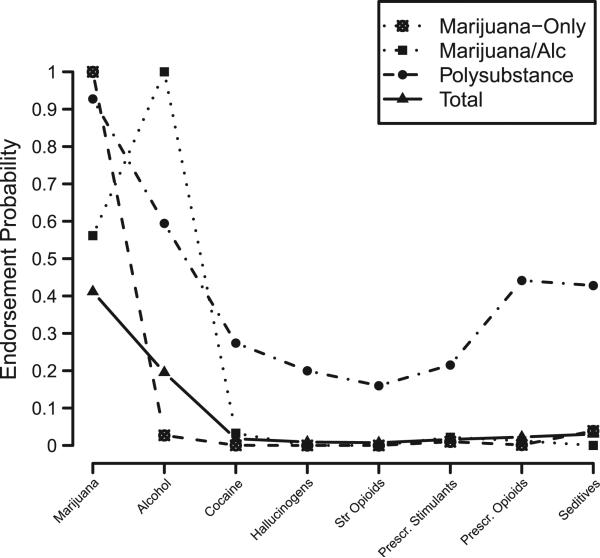
Excluding non-misusers (51.5%), LCA identified three classes: marijuana-only (27.9%), alcohol/marijuana (16.1%), and multiple substances (polysubstance) (4.6%). Moving from non-misusers to polysubstance misusers, there was an increasing trend in rates of: unprotected sex, motor vehicle crash, serious violence, weapon aggression, and victimization (all p < .001). Controlling for individual-level variables, polysubstance misusers lived near more on-premises alcohol outlets than non-misusers (RRR = 1.42, p = .01) and marijuana-only misusers (RRR = 1.31, p = .03). Alcohol/marijuana misusers were more likely to live near high violent crime density areas than non-misusers (RRR = 1.83, p = .01), and were also more likely than marijuana-only misusers to live in areas of high drug crime density (RRR = 1.98, p = .03). No other relationships were significant.
Substance-misusing youth seeking ED care have higher risk for other problem behaviors and neighborhood-level features display potential for distinguishing between use classes. Additional research to elucidate at-risk sub-populations/locales has potential to improve interventions for substance misuse by incorporating geographic information.
对于高危青少年的物质使用特征概况及其个体和社区层面的相关因素,人们了解甚少。
确定进入城市急诊科(ED)的青少年中的物质滥用特征概况,并探讨这些概况与个体和社区层面因素的关系。
个体层面的测量数据来自对密歇根州弗林特市一家急诊科中14至24岁青少年进行的筛查调查(n = 878);酒精销售点和犯罪数据来自公共来源。通过使用先前确定的酒精和药物使用严重程度评分切点生成二元滥用指标。潜在类别分析(LCA)确定物质使用类别;单变量测试和多项模型确定类别成员的相关因素。
排除未滥用者(51.5%)后,LCA确定了三类:仅使用大麻类(27.9%)、酒精/大麻类(16.1%)和多种物质(多物质)类(4.6%)。从未滥用者到多物质滥用者,以下发生率呈上升趋势:无保护性行为、机动车碰撞、严重暴力、武器攻击和受害(所有p <.001)。在控制个体层面变量后,多物质滥用者居住的地方附近的店内酒精销售点比未滥用者更多(相对风险率RRR = 1.42,p =.01),也比仅使用大麻类滥用者更多(RRR = 1.31,p =.03)。酒精/大麻类滥用者比未滥用者更有可能居住在暴力犯罪密度高的地区附近(RRR = 1.83,p =.01),并且也比仅使用大麻类滥用者更有可能居住在毒品犯罪密度高的地区(RRR = 1.98,p =.03)。没有其他关系具有显著性。
寻求急诊科护理的物质滥用青少年出现其他问题行为的风险更高,社区层面的特征显示出区分使用类别的潜力。通过纳入地理信息来阐明高危亚人群/地点的进一步研究有可能改善对物质滥用的干预措施。