National Institute on Drug Abuse, National Institutes of Health, Bethesda, MD, USA.
Kelly Government Solutions, Rockville, MD, USA.
Addiction. 2019 May;114(5):907-916. doi: 10.1111/add.14547. Epub 2019 Feb 1.
Youth aged 15-17 years are at high risk of tobacco, alcohol and drug use. Given the changing landscape with respect to availability, use of emerging products and regulatory environments, we examined patterns and correlates of polysubstance use among US youth aged 15-17 years.
Cross-sectional self-reported data.
United States.
A total of 6127 US youth aged 15-17 years from wave 1 (2013-14) of the nationally representative Population Assessment of Tobacco and Health (PATH) Study.
Latent class analysis was used to identify subgroups of polysubstance use, including 12 tobacco products, alcohol, marijuana, prescription drugs and other drugs. Socio-demographic characteristics, residence in urban area, sensation-seeking, sexual orientation and internalizing and externalizing problems were examined as correlates.
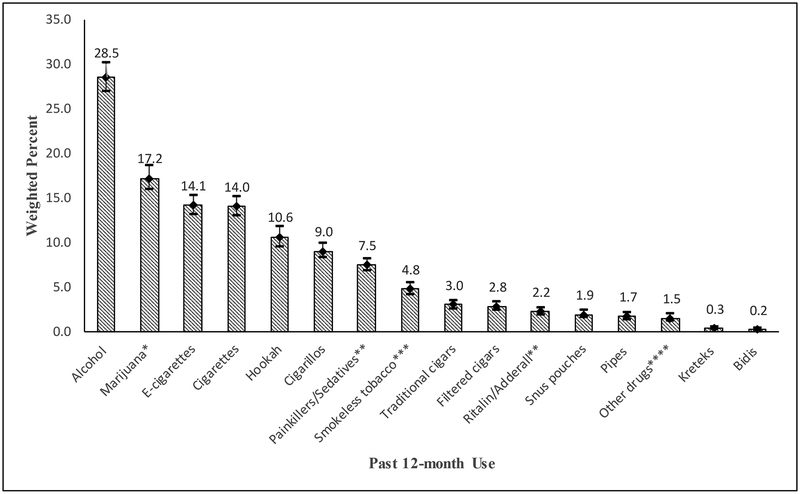
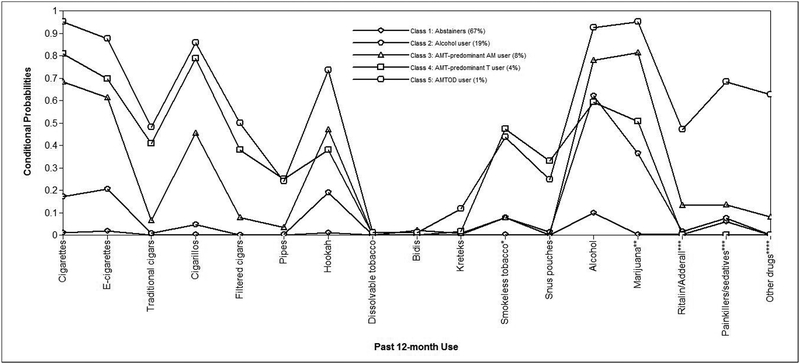
Approximately 43.5% of 15-17-year-olds had used at least one substance in the past 12 months. A 5-class model was identified: class 1 'abstainers' (67.3%), class 2 'alcohol users' (19.2%), class 3 'alcohol, marijuana and tobacco (AMT ) users' (8.2%), class 4 'alcohol, marijuana and tobacco (AMT ) users' (3.9%) and class 5 'alcohol, marijuana, tobacco and other drug (AMTOD) users' (1.4%). Abstainers were considered the reference class. Higher sensation-seeking scores, higher age and lower academic grades were each associated with greater likelihood of membership in all user classes. Gender, race/ethnicity, parents/guardians' education, residence in non-urban areas and sexual minority groups were associated with membership in some, but not all, user classes. Compared with no/low/moderate severity, high severity internalizing problems were associated with membership in classes 2, 3 and 5, whereas high severity externalizing problems were associated with membership in classes 3 and 5 only.
There appear to be three heterogeneous polysubstance use classes among US youth aged 15-17 years. Correlates of substance use among US youth include higher sensation-seeking, poor academic performance, non-urban residence, minority sexual orientation and mental health problems.
15-17 岁的青少年有较高的烟草、酒精和药物使用风险。鉴于可用性、新兴产品使用和监管环境方面的变化,我们调查了美国 15-17 岁青少年多物质使用的模式和相关因素。
横断面自我报告数据。
美国。
共有 6127 名来自具有全国代表性的人口烟草和健康评估 (PATH) 研究波 1(2013-14 年)的 15-17 岁美国青少年。
使用潜在类别分析确定多物质使用的亚组,包括 12 种烟草制品、酒精、大麻、处方药物和其他药物。检查了社会人口统计学特征、居住在城市地区、寻求刺激、性取向以及内化和外化问题等因素。
大约 43.5%的 15-17 岁青少年在过去 12 个月内至少使用过一种物质。确定了一个 5 类模型:第 1 类“禁欲者”(67.3%),第 2 类“酒精使用者”(19.2%),第 3 类“酒精、大麻和烟草(AMT)使用者”(8.2%),第 4 类“酒精、大麻和烟草(AMT)使用者”(3.9%)和第 5 类“酒精、大麻、烟草和其他药物(AMTOD)使用者”(1.4%)。禁欲者被视为参考类。更高的寻求刺激得分、更高的年龄和更低的学业成绩与所有使用者类别的更大可能性相关。性别、种族/民族、父母/监护人的教育程度、居住在非城市地区和性少数群体与某些但不是所有使用者类别相关。与无/低/中度严重程度相比,高严重程度的内化问题与第 2、3 和 5 类有关,而高严重程度的外化问题仅与第 3 和 5 类有关。
美国 15-17 岁青少年似乎有三个异质的多物质使用类别。美国青少年物质使用的相关因素包括更高的寻求刺激、学业成绩不佳、非城市居住、少数性取向和心理健康问题。