Department of Biomedical and Dental Sciences and Morphofunctional Imaging, University of Messina, Messina, Italy.
Department of Psychiatry, University of Florida, Gainesville, FL, USA.
Sci Rep. 2016 Jun 20;6:28203. doi: 10.1038/srep28203.
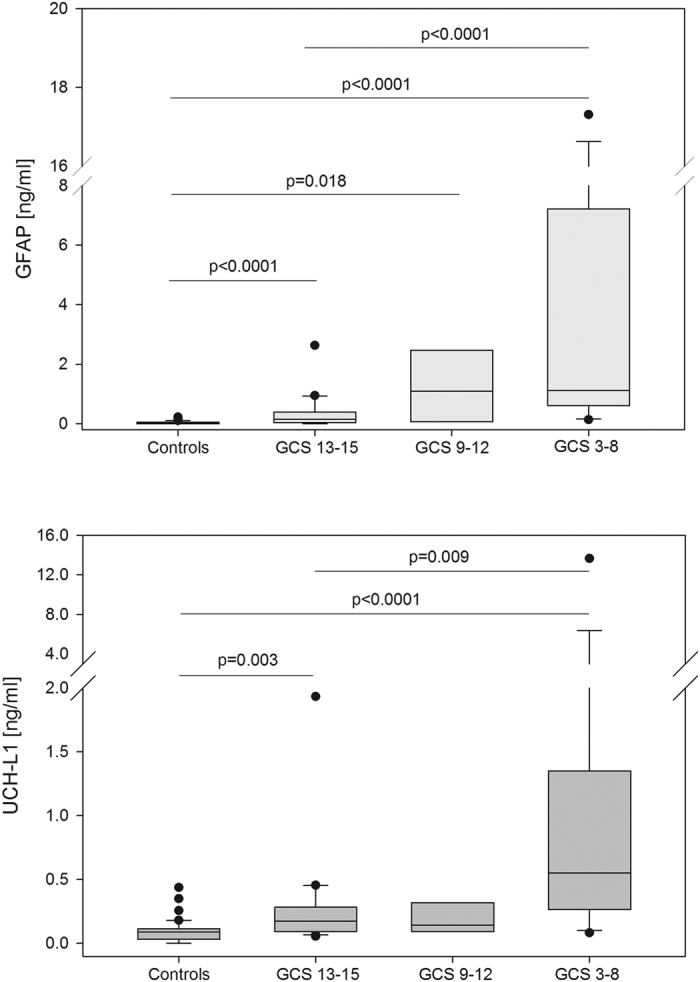
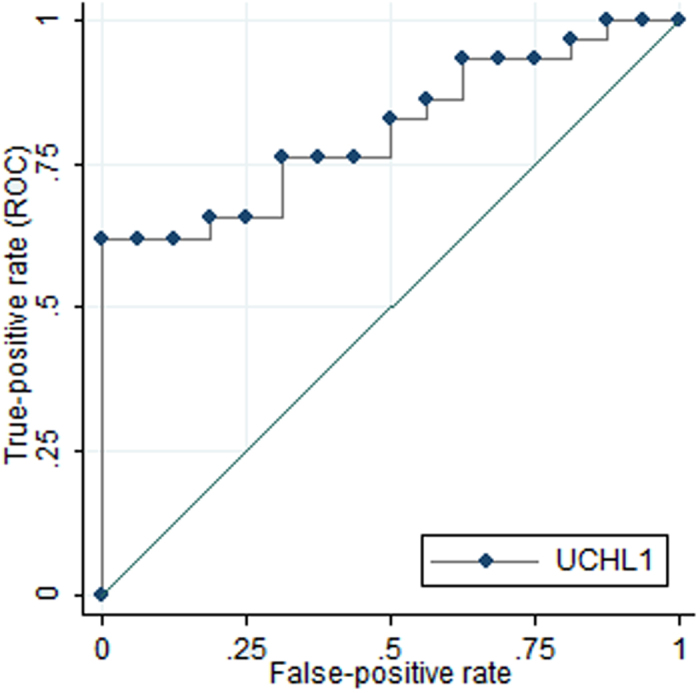
Objective reliable markers to assess traumatic brain injury (TBI) and predict outcome soon after injury are a highly needed tool for optimizing management of pediatric TBI. We assessed serum concentrations of Glial Fibrillary Acidic Protein (GFAP) and Ubiquitin C-Terminal Hydrolase-L1 (UCH-L1) in a cohort of 45 children with clinical diagnosis of TBI (Glasgow Coma Scale [GCS] 3-15) and 40 healthy subjects, evaluated their associations with clinical characteristics and outcomes, and compared their performance to previously published data on two well-studied blood biomarkers, S100B and MBP. We observed higher serum levels of GFAP and UCH-L1 in brain-injured children compared with controls and also demonstrated a step-wise increase of biomarker concentrations over the continuum of severity from mild to severe TBI. Furthermore, while we found that only the neuronal biomarker UCH-L1 holds potential to detect acute intracranial lesions as assessed by computed tomography (CT), both markers were substantially increased in TBI patients even with a normal CT suggesting the presence of undetected microstructural injuries. Serum UCH-L1 and GFAP concentrations also strongly predicted poor outcome and performed better than S100B and MBP. Our results point to a role of GFAP and UCH-L1 as candidate biomarkers for pediatric TBI. Further studies are warranted.
目的
可靠的标志物来评估创伤性脑损伤(TBI)并预测受伤后不久的结果是优化小儿 TBI 管理的高度需要的工具。我们评估了 45 名临床诊断为 TBI(格拉斯哥昏迷量表[GCS] 3-15)的儿童和 40 名健康受试者的血清胶质纤维酸性蛋白(GFAP)和泛素 C 端水解酶-L1(UCH-L1)浓度,评估了它们与临床特征和结果的关系,并将其与先前发表的两种研究充分的血液生物标志物 S100B 和 MBP 的数据进行了比较。
我们观察到脑损伤儿童的血清 GFAP 和 UCH-L1 水平高于对照组,并且还证明了生物标志物浓度在从轻度到重度 TBI 的严重程度连续体上呈逐步增加。此外,虽然我们发现只有神经元生物标志物 UCH-L1 有潜力通过计算机断层扫描(CT)检测急性颅内病变,但即使 CT 正常,两种标志物在 TBI 患者中均显著增加,表明存在未检测到的微结构损伤。
血清 UCH-L1 和 GFAP 浓度也强烈预测不良结局,并且比 S100B 和 MBP 表现更好。
我们的结果表明 GFAP 和 UCH-L1 可作为小儿 TBI 的候选生物标志物。需要进一步的研究。