Ramírez Juan David, Hernández Carolina, León Cielo M, Ayala Martha S, Flórez Carolina, González Camila
Grupo de Investigaciones Microbiológicas-UR (GIMUR), Programa de Biología, Facultad de Ciencias Naturales y Matemáticas, Universidad del Rosario, Bogotá-Colombia.
Grupo de Parasitología, Instituto Nacional de Salud, Bogotá-Colombia.
Sci Rep. 2016 Jun 22;6:28266. doi: 10.1038/srep28266.
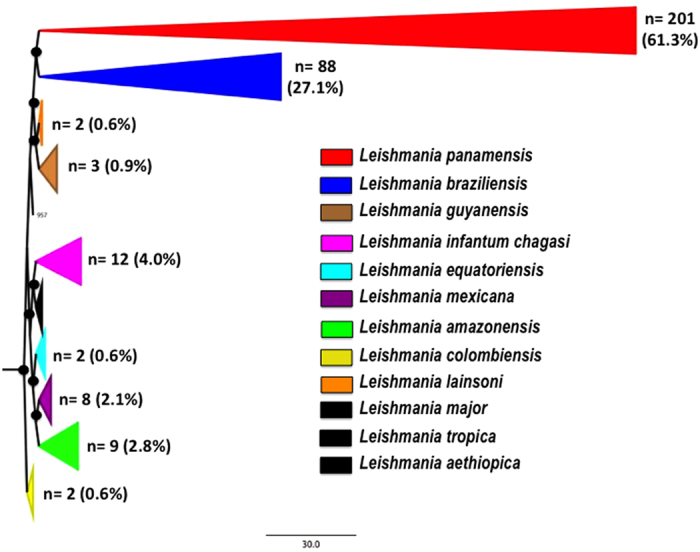
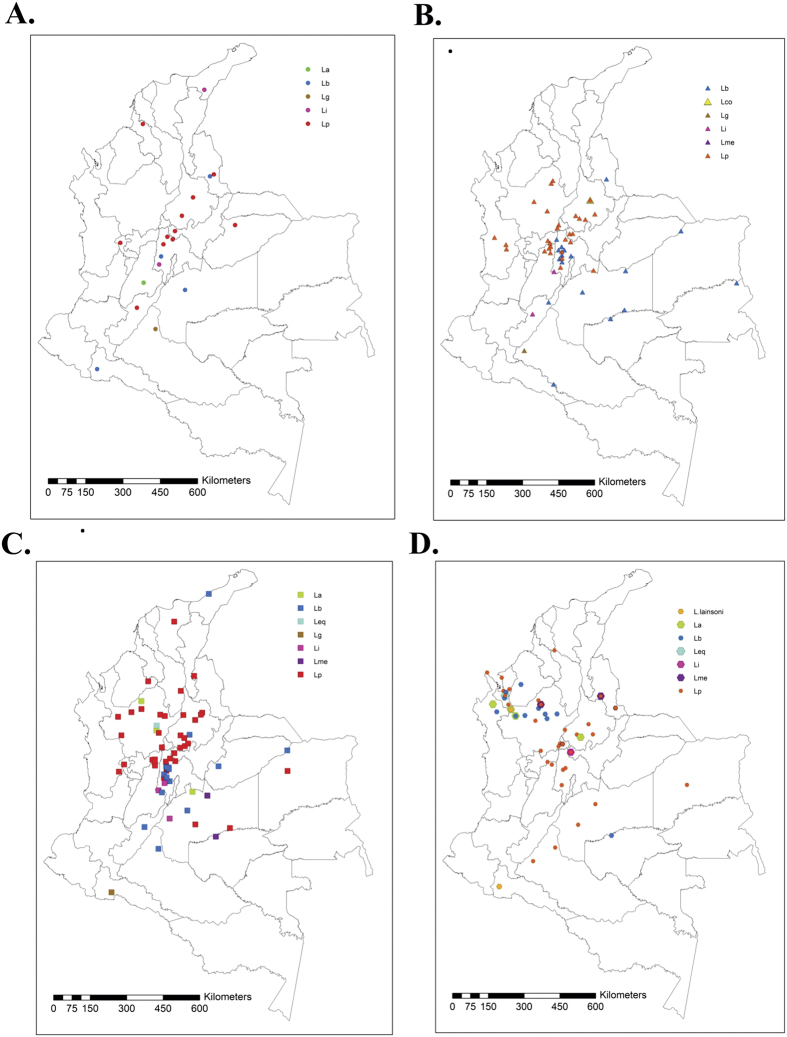
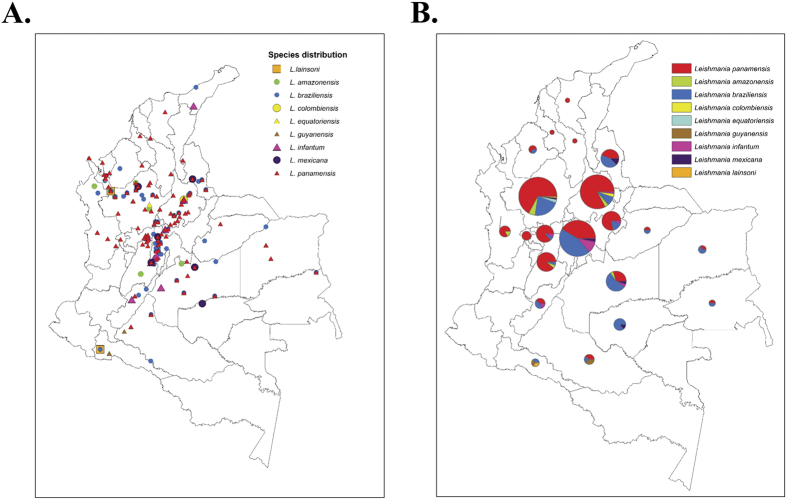
Leishmaniases are tropical zoonotic diseases, caused by kinetoplastid parasites from the genus Leishmania. New World (NW) species are related to sylvatic cycles although urbanization processes have been reported in some South American Countries such as Colombia. Currently, few studies show the relative distribution of Leishmania species related to cutaneous Leishmaniasis (CL) in South America due to the lack of accurate surveillance and public health systems. Herein, we conducted a systematic estimation of the Leishmania species causing CL in Colombia from 1980 to 2001 via molecular typing and isoenzymes. A total of 327 Leishmania isolates from humans, sandflies and reservoirs were typed as L. panamensis 61.3% (201), L. braziliensis 27.1% (88), L. lainsoni 0.6% (2), L. guyanensis 0.9% (3), L. infantum chagasi 4% (12), L. equatoriensis 0.6% (2), L. mexicana 2.1% (8), L. amazonensis 2.8% (9) and L. colombiensis 0.6% (2). This is the first report of two new Leishmania species circulating in Colombia and suggests the need to convince the Colombian government about the need to deploy and standardize tools for the species identification to provide adequate management to individuals suffering this pathology.
利什曼病是热带人畜共患病,由利什曼原虫属的动基体寄生虫引起。新大陆(NW)物种与森林生态循环有关,尽管在一些南美洲国家如哥伦比亚已报道了城市化进程。目前,由于缺乏准确的监测和公共卫生系统,很少有研究显示南美洲与皮肤利什曼病(CL)相关的利什曼原虫物种的相对分布情况。在此,我们通过分子分型和同工酶对1980年至2001年期间哥伦比亚引起CL的利什曼原虫物种进行了系统评估。总共对来自人类、白蛉和储存宿主的327株利什曼原虫分离株进行了分型,其中巴拿马利什曼原虫占61.3%(201株),巴西利什曼原虫占27.1%(88株),赖氏利什曼原虫占0.6%(2株),圭亚那利什曼原虫占0.9%(3株),婴儿利什曼原虫恰加斯亚种占4%(12株),赤道利什曼原虫占0.6%(2株),墨西哥利什曼原虫占2.1%(8株),亚马逊利什曼原虫占2.8%(9株),哥伦比亚利什曼原虫占0.6%(2株)。这是关于两种新的利什曼原虫物种在哥伦比亚传播的首次报告,并表明需要说服哥伦比亚政府认识到部署和规范物种鉴定工具的必要性,以便为患有这种疾病的个体提供适当的管理。