Jans Christoph, de Wouters Tomas, Bonfoh Bassirou, Lacroix Christophe, Kaindi Dasel Wambua Mulwa, Anderegg Janine, Böck Désirée, Vitali Sabrina, Schmid Thomas, Isenring Julia, Kurt Fabienne, Kogi-Makau Wambui, Meile Leo
Laboratory of Food Biotechnology, Institute of Food, Nutrition and Health, ETH Zurich, Schmelzbergstrasse 7, 8092, Zurich, Switzerland.
Centre Suisse de Recherches Scientifiques en Côte d'Ivoire (CSRS), KM 17 route de Dabou, Adiopodoumé Yopougon, Abidjan - 01B.P. 1303, Abidjan, Côte d'Ivoire.
BMC Microbiol. 2016 Jun 21;16(1):117. doi: 10.1186/s12866-016-0735-2.
The Streptococcus bovis/Streptococcus equinus complex (SBSEC) comprises seven (sub)species classified as human and animal commensals, emerging opportunistic pathogens and food fermentative organisms. Changing taxonomy, shared habitats, natural competence and evidence for horizontal gene transfer pose difficulties for determining their phylogeny, epidemiology and virulence mechanisms. Thus, novel phylogenetic and functional classifications are required. An SBSEC overarching multi locus sequence type (MLST) scheme targeting 10 housekeeping genes was developed, validated and combined with host-related properties of adhesion to extracellular matrix proteins (ECM), activation of the immune responses via NF-KB and survival in simulated gastric juice (SGJ).
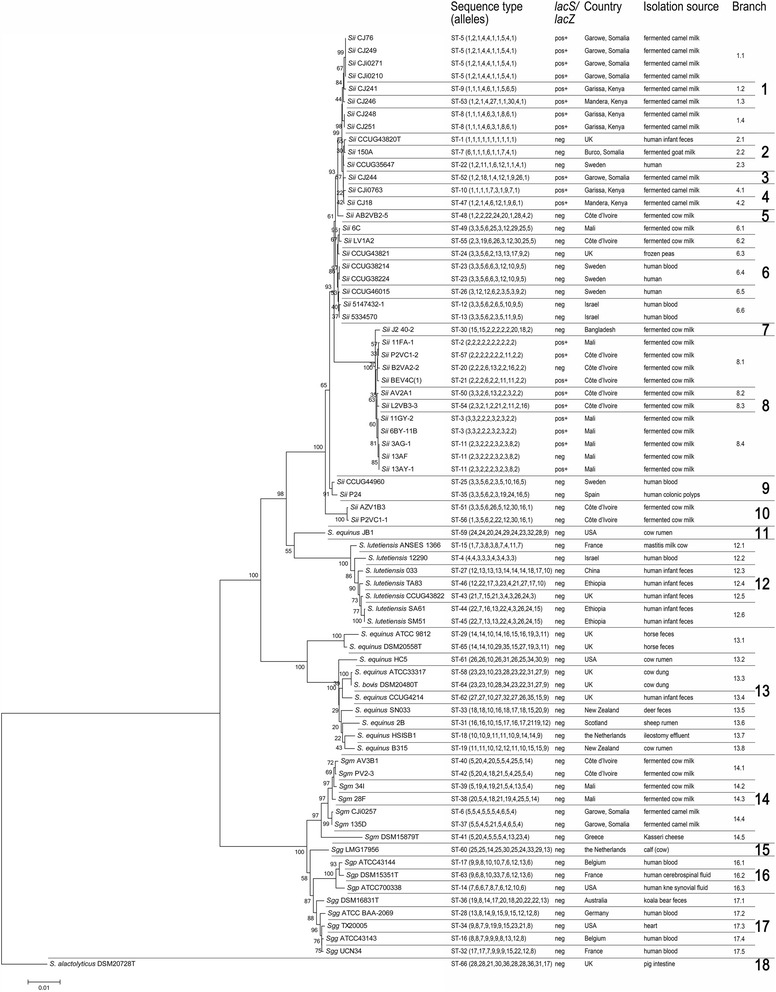
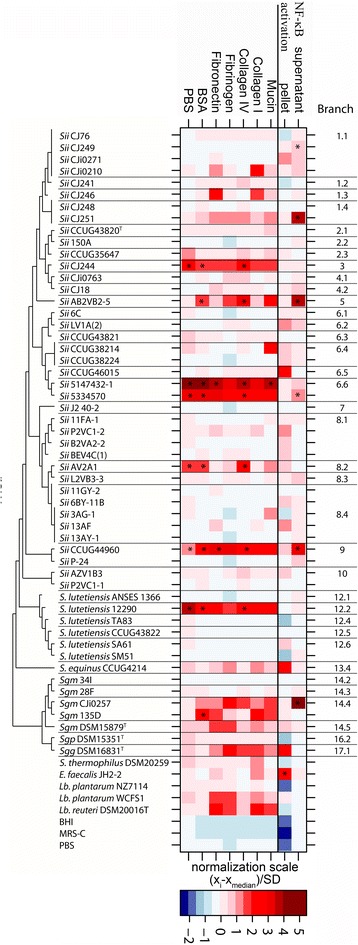
Commensal and pathogenic SBSEC strains (n = 74) of human, animal and food origin from Europe, Asia, America and Africa were used in the MLST scheme yielding 66 sequence types and 10 clonal complexes differentiated into distinct habitat-associated and mixed lineages. Adhesion to ECMs collagen I and mucin type II was a common characteristic (23 % of strains) followed by adhesion to fibronectin and fibrinogen (19.7 %). High adhesion abilities were found for East African dairy and human blood isolate branches whereas commensal fecal SBSEC displayed low adhesion. NF-KB activation was observed for a limited number of dairy and blood isolates suggesting the potential of some pathogenic strains for reduced immune activation. Strains from dairy MLST clades displayed the highest relative survival to SGJ independently of dairy adaptation markers lacS/lacZ.
Combining phylogenetic and functional analyses via SBSEC MLST enabled the clear delineation of strain clades to unravel the complexity of this bacterial group. High adhesion values shared between certain dairy and blood strains as well as the behavior of NF-KB activation are concerning for specific lineages. They highlighted the health risk among shared lineages and establish the basis to elucidate (zoonotic-) transmission, host specificity, virulence mechanisms and enhanced risk assessment as pathobionts in an overarching One Health approach.
牛链球菌/马链球菌复合体(SBSEC)由七个(亚)种组成,这些(亚)种被分类为人类和动物的共生菌、新兴机会致病菌以及食品发酵菌。分类学的变化、共享栖息地、自然感受态以及水平基因转移的证据给确定它们的系统发育、流行病学和毒力机制带来了困难。因此,需要新的系统发育和功能分类。开发并验证了一种针对10个管家基因的SBSEC总体多位点序列分型(MLST)方案,并将其与宿主相关特性相结合,这些特性包括对细胞外基质蛋白(ECM)的粘附、通过NF-κB激活免疫反应以及在模拟胃液(SGJ)中的存活能力。
来自欧洲、亚洲、美洲和非洲的人类、动物和食品来源的共生和致病性SBSEC菌株(n = 74)用于MLST方案,产生了66种序列类型和10个克隆复合体,分为不同的与栖息地相关的和混合的谱系。对ECM中I型胶原蛋白和II型粘蛋白的粘附是一个共同特征(23%的菌株),其次是对纤连蛋白和纤维蛋白原的粘附(19.7%)。东非乳制品和人类血液分离株分支具有较高的粘附能力,而共生粪便SBSEC的粘附能力较低。在有限数量的乳制品和血液分离株中观察到NF-κB激活,这表明一些致病菌株可能具有降低免疫激活的潜力。来自乳制品MLST分支的菌株对SGJ显示出最高的相对存活率,与乳制品适应标记lacS/lacZ无关。
通过SBSEC MLST将系统发育和功能分析相结合,能够清晰地划分菌株分支,以揭示这一细菌群体的复杂性。某些乳制品和血液菌株之间共有的高粘附值以及NF-κB激活的行为与特定谱系有关。它们突出了共享谱系中的健康风险,并为在总体的“同一健康”方法中阐明(人畜共患)传播、宿主特异性、毒力机制以及加强作为条件致病菌的风险评估奠定了基础。