McLaren Ruth, Joseph Frances, Baguley Craig, Taylor Denise
Health and Rehabilitation Research Institute, Faculty of Health and Environmental Science, AUT University, Private Bag 92006, Auckland, 1142, New Zealand.
CoLab: Creative Technologies Research Centre, Faculty of Design and Creative Technologies, AUT University, Private Bag 92006, Auckland, 1142, New Zealand.
J Neuroeng Rehabil. 2016 Jun 21;13(1):59. doi: 10.1186/s12984-016-0167-0.
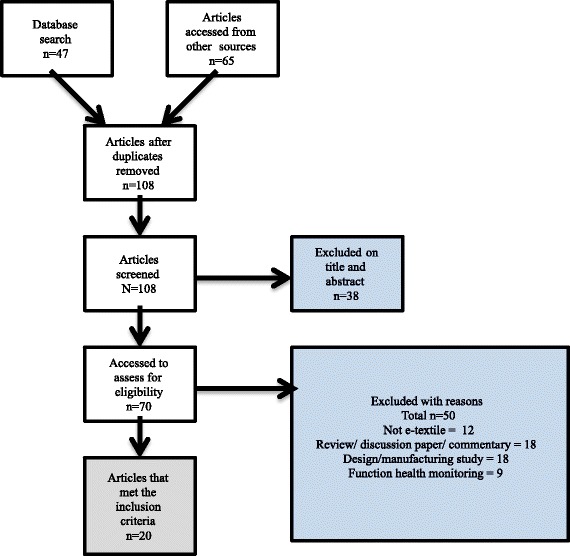
Textiles able to perform electronic functions are known as e-textiles, and are poised to revolutionise the manner in which rehabilitation and assistive technology is provided. With numerous reports in mainstream media of the possibilities and promise of e-textiles it is timely to review research work in this area related to neurological rehabilitation.This paper provides a review based on a systematic search conducted using EBSCO- Health, Scopus, AMED, PEDro and ProQuest databases, complemented by articles sourced from reference lists. Articles were included if the e-textile technology described had the potential for use in neurological rehabilitation and had been trialled on human participants. A total of 108 records were identified and screened, with 20 meeting the broad review inclusion criteria. Nineteen user trials of healthy people and one pilot study with stroke participants have been reported.The review identifies two areas of research focus; motion sensing, and the measurement of, or stimulation of, muscle activity. In terms of motion sensing, E-textiles appear able to reliably measure gross movement and whether an individual has achieved a predetermined movement pattern. However, the technology still remains somewhat cumbersome and lacking in resolution at present. The measurement of muscle activity and the provision of functional electrical stimulation via e-textiles is in the initial stages of development but shows potential for e-textile expansion into assistive technologies.The review identified a lack of high quality clinical evidence and, in some cases, a lack of practicality for clinical application. These issues may be overcome by engagement of clinicians in e-textile research and using their expertise to develop products that augment and enhance neurological rehabilitation practice.
能够执行电子功能的纺织品被称为电子纺织品,它们有望彻底改变康复和辅助技术的提供方式。随着主流媒体对电子纺织品的可能性和前景进行了大量报道,现在是时候回顾一下这一领域与神经康复相关的研究工作了。本文基于使用EBSCO-Health、Scopus、AMED、PEDro和ProQuest数据库进行的系统检索,并辅以从参考文献列表中获取的文章进行综述。如果所描述的电子纺织技术有用于神经康复的潜力并且已经在人类参与者身上进行了试验,则纳入这些文章。总共识别并筛选了108条记录,其中20条符合广泛的综述纳入标准。已报道了19项针对健康人的用户试验和1项针对中风参与者的试点研究。该综述确定了两个研究重点领域:运动传感,以及肌肉活动的测量或刺激。在运动传感方面,电子纺织品似乎能够可靠地测量总体运动以及个体是否实现了预定的运动模式。然而,目前该技术仍然有些笨重且分辨率不足。通过电子纺织品测量肌肉活动并提供功能性电刺激尚处于开发初期,但显示出电子纺织品扩展到辅助技术的潜力。该综述发现缺乏高质量的临床证据,并且在某些情况下缺乏临床应用的实用性。通过让临床医生参与电子纺织品研究并利用他们的专业知识来开发增强和改善神经康复实践的产品,这些问题可能会得到解决。