Hasan Md Mehdi, Hossain Md Milon
Department of Textile Engineering, Khulna University of Engineering & Technology, Khulna, 9203 Bangladesh.
UNAM - National Nanotechnology Research Center and, Institute of Materials Science and Nanotechnology, Bilkent University, Ankara, 06800 Turkey.
J Mater Sci. 2021;56(27):14900-14942. doi: 10.1007/s10853-021-06248-8. Epub 2021 Jun 28.
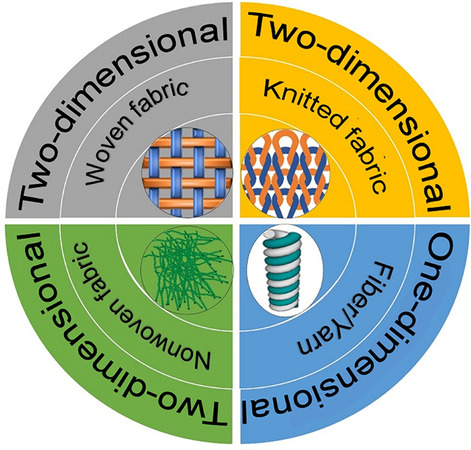
Electrodes fabricated on a flexible substrate are a revolutionary development in wearable health monitoring due to their lightweight, breathability, comfort, and flexibility to conform to the curvilinear body shape. Different metallic thin-film and plastic-based substrates lack comfort for long-term monitoring applications. However, the insulating nature of different polymer, fiber, and textile substrates requires the deposition of conductive materials to render interactive functionality to substrates. Besides, the high porosity and flexibility of fiber and textile substrates pose a great challenge for the homogenous deposition of active materials. Printing is an excellent process to produce a flexible conductive textile electrode for wearable health monitoring applications due to its low cost and scalability. This article critically reviews the current state of the art of different textile architectures as a substrate for the deposition of conductive nanomaterials. Furthermore, recent progress in various printing processes of nanomaterials, challenges of printing nanomaterials on textiles, and their health monitoring applications are described systematically.
在柔性基板上制造的电极,因其重量轻、透气性好、舒适度高以及能够灵活贴合身体曲线形状,成为可穿戴健康监测领域的一项革命性进展。不同的金属薄膜和塑料基基板在长期监测应用中缺乏舒适性。然而,不同的聚合物、纤维和纺织基板的绝缘特性需要沉积导电材料,以使基板具有交互功能。此外,纤维和纺织基板的高孔隙率和柔韧性对活性材料的均匀沉积构成了巨大挑战。印刷因其成本低和可扩展性强,是生产用于可穿戴健康监测应用的柔性导电纺织电极的绝佳工艺。本文批判性地综述了作为导电纳米材料沉积基板的不同纺织结构的当前技术水平。此外,还系统地描述了纳米材料各种印刷工艺的最新进展、在纺织品上印刷纳米材料的挑战及其健康监测应用。