Misgna Haftom Gebrehiwot, Gebru Haftu Berhe, Birhanu Mulugeta Molla
Department of Nursing, College of Health Sciences, Mekelle University , Mekelle, Ethiopia.
BMC Pregnancy Childbirth. 2016 Jun 21;16(1):144. doi: 10.1186/s12884-016-0931-y.
Around the world, more than three million newborns die in their first months of life every year. In Ethiopia during the last five years period; neonatal mortality is 37 deaths per 1000 live births. Even though there is an improvement compared to the past five years, there is still high home delivery 90 %, and high neonatal mortality about the Millennium Development Goal, which aims to be less than 32/1000 live births in Ethiopia. The purpose of this study is to assess maternal knowledge, practice and associated factors of essential newborn care at home in Gulomekada District Eastern Tigray, Ethiopia.
A community-based cross-sectional study is conducted in 296 mothers from Gulomekada District by using simple random sampling technique. Data entry and analysis is carried out by using Statistical Package for Social Sciences-20. The magnitude of the association between different variables about the outcome variable is measured by odds ratio with 95 % confidence interval. A binary logistic regression analysis is made to obtain odds ratio and the confidence interval of statistical associations. The goodness of fit had tested by Hosmer-Lemeshow statistic and all variables with P-value greater than 0.05 are fitted to the multivariate model. Variables with P < 0.2 in the bivariate analysis are included in the final model, and statistical significance is declared at P < 0.05.
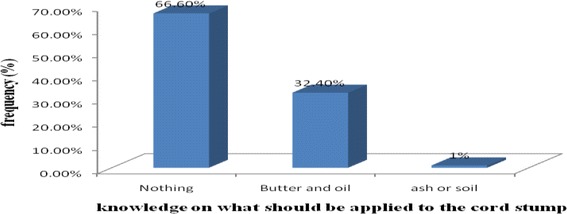
Eighty percent (80.4 %) study participants had good knowledge on essential new born care and 92.9 % had the good practice of essential new born care. About 60 % of mothers applied butter or oil on the cord stump for their last baby. Marital status and education are significantly associated with knowledge, whereas urban residence mothers with good knowledge on essential newborn care and employed mothers are significantly associated with mothers' practice of essential newborn care.
Almost all mothers know and practice essential newborn care correctly except oil or butter application to the cord stump is highly practiced which should be avoided. Only marital status and educational status are significantly associated with mothers' knowledge.
全球每年有超过300万新生儿在出生后的头几个月死亡。在埃塞俄比亚过去五年期间,新生儿死亡率为每1000例活产中有37例死亡。尽管与过去五年相比有所改善,但家庭分娩率仍高达90%,新生儿死亡率仍高于千年发展目标,该目标旨在使埃塞俄比亚的新生儿死亡率低于每1000例活产32例。本研究的目的是评估埃塞俄比亚提格雷东部古洛梅卡达区家庭中产妇对基本新生儿护理的知识、实践及相关因素。
采用简单随机抽样技术,对古洛梅卡达区的296名母亲进行了一项基于社区的横断面研究。使用社会科学统计软件包-20进行数据录入和分析。通过比值比及95%置信区间来衡量不同变量与结果变量之间关联的强度。进行二元逻辑回归分析以获得比值比和统计关联的置信区间。通过Hosmer-Lemeshow统计量检验拟合优度,所有P值大于0.05的变量都纳入多变量模型。双变量分析中P<0.2的变量纳入最终模型,P<0.05时具有统计学意义。
80.4%的研究参与者对基本新生儿护理有良好的知识,92.9%的人有良好的基本新生儿护理实践。约60%的母亲在其最后一个孩子的脐带残端涂抹了黄油或油。婚姻状况和教育程度与知识显著相关,而对基本新生儿护理有良好知识的城市居住母亲和就业母亲与母亲的基本新生儿护理实践显著相关。
几乎所有母亲都正确知晓并实践基本新生儿护理,但脐带残端涂抹黄油或油的做法非常普遍,应予以避免。只有婚姻状况和教育程度与母亲的知识显著相关。