Robert W. Franz Cancer Research Center, Earle A. Chiles Research Institute, Providence Portland Medical Center, 4805 NE Glisan St. 2N35, Portland, OR 97213 USA.
Robert W. Franz Cancer Research Center, Earle A. Chiles Research Institute, Providence Portland Medical Center, 4805 NE Glisan St. 2N35, Portland, OR 97213 USA ; Department of Molecular Microbiology and Immunology, School of Medicine, Oregon Health and Science University, Portland, OR 97239 USA.
J Immunother Cancer. 2016 Jun 21;4:31. doi: 10.1186/s40425-016-0135-z. eCollection 2016.
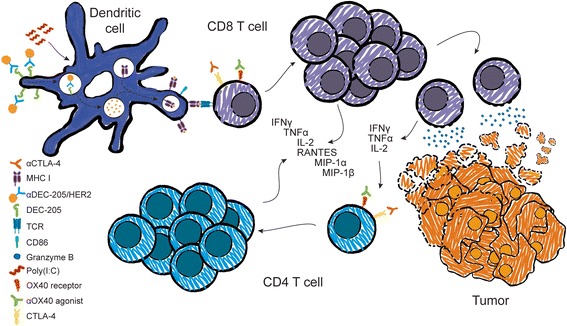
Mounting an immune response sufficient to eradicate a tumor is the goal of modern immunotherapy. Single agent therapies with checkpoint inhibitors or costimulatory molecule agonists are effective only for a small portion of all treated patients. Combined therapy, e.g., CTLA-4 and PD-1 checkpoint blockade, is a more effective treatment modality, but in preclinical studies OX40 agonism with CTLA-4 blockade using monoclonal antibodies (aOX40/aCTLA-4) failed to induce tumor regression of larger, more established tumors. We hypothesized that administration of a vaccine with a tumor-associated antigen targeted to the appropriate antigen presenting cell could make combined aOX40/aCTLA-4 therapy more effective. We administered an antibody-based vaccine targeting HER2 to the DEC-205 endocytic receptor on cross-presenting dendritic cells (anti-DEC-205/HER2; aDEC-205/HER2) and a potent adjuvant (poly (I:C)) to assist with maturation, along with aOX40/aCTLA-4 therapy. This therapy induced complete regression of established tumors and a pronounced infiltration of effector CD8 and CD4 T cells, with no effect on regulatory T cell infiltration compared to aOX40/aCTLA-4 alone. To be maximally effective, this therapy required expression of both OX40 and CTLA-4 on CD8 T cells. These data indicate that vaccination targeting cross-presenting dendritic cells with a tumor-associated antigen is a highly effective immunization strategy that can overcome some of the limitations of current systemic immunotherapeutic approaches that lack defined tumor-directed antigenic targets.
激发足以消灭肿瘤的免疫反应是现代免疫疗法的目标。单药治疗使用检查点抑制剂或共刺激分子激动剂,仅对所有接受治疗的患者中的一小部分有效。联合治疗,例如 CTLA-4 和 PD-1 检查点阻断,是一种更有效的治疗方式,但在临床前研究中,使用单克隆抗体的 OX40 激动剂与 CTLA-4 阻断(aOX40/aCTLA-4)未能诱导更大、更成熟的肿瘤的肿瘤消退。我们假设,用针对适当抗原呈递细胞的肿瘤相关抗原进行疫苗接种,可以使联合 aOX40/aCTLA-4 治疗更有效。我们用针对 DEC-205 内吞受体的基于抗体的疫苗(抗 DEC-205/HER2;aDEC-205/HER2)和一种有效的佐剂(聚(I:C))来辅助成熟,同时进行 aOX40/aCTLA-4 治疗。这种治疗方法诱导了已建立的肿瘤完全消退,并显著浸润效应性 CD8 和 CD4 T 细胞,与单独使用 aOX40/aCTLA-4 相比,对调节性 T 细胞浸润没有影响。为了达到最大效果,这种治疗需要 CD8 T 细胞同时表达 OX40 和 CTLA-4。这些数据表明,用肿瘤相关抗原靶向交叉呈递树突状细胞的疫苗接种是一种非常有效的免疫策略,可以克服当前缺乏明确肿瘤靶向抗原的全身性免疫治疗方法的一些局限性。