Xie Jingxiu, Torres Galvis Hirsa M, Koeken Ard C J, Kirilin Alexey, Dugulan A Iulian, Ruitenbeek Matthijs, de Jong Krijn P
Inorganic Chemistry and Catalysis, Debye Institute for Nanomaterials Science, Utrecht University , Universteitsweg 99, 3584 CG Utrecht, The Netherlands.
Dow Benelux B.V., P.O. Box 48, 4530 AA Terneuzen, The Netherlands.
ACS Catal. 2016 Jun 3;6(6):4017-4024. doi: 10.1021/acscatal.6b00321. Epub 2016 May 13.
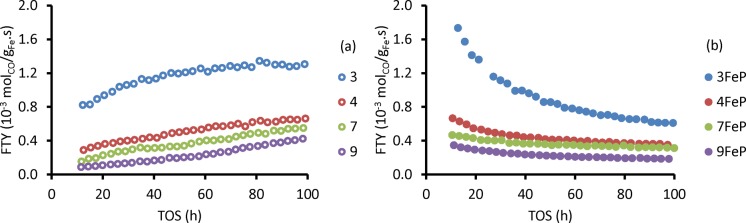
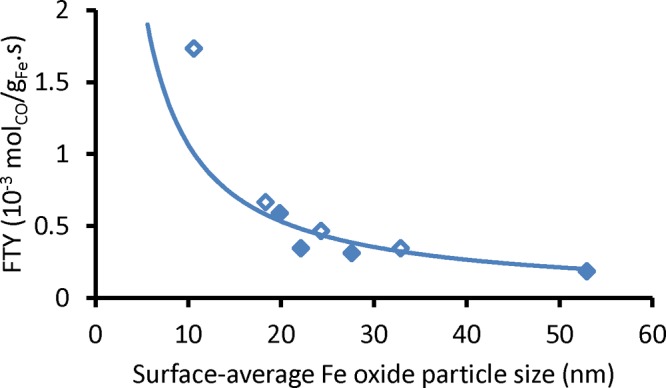
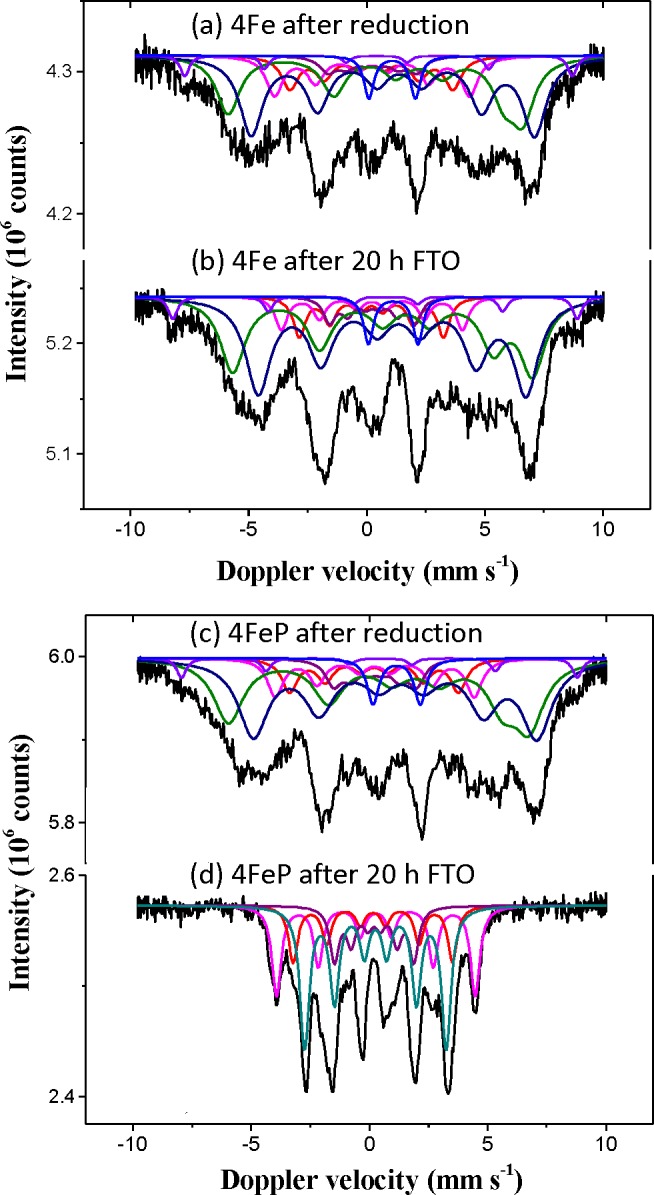
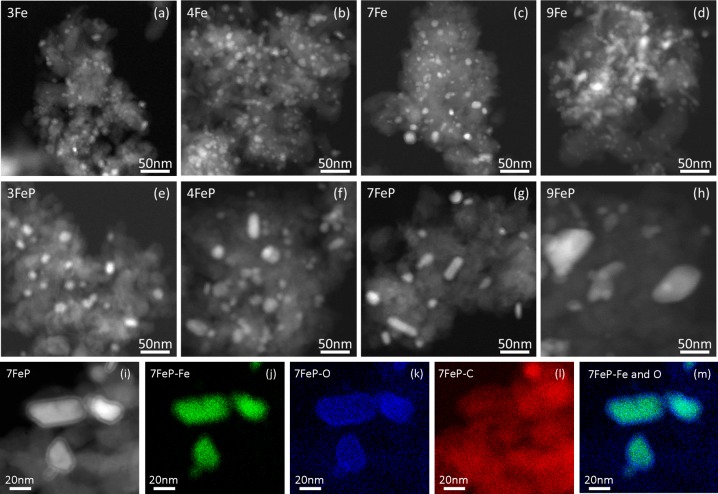
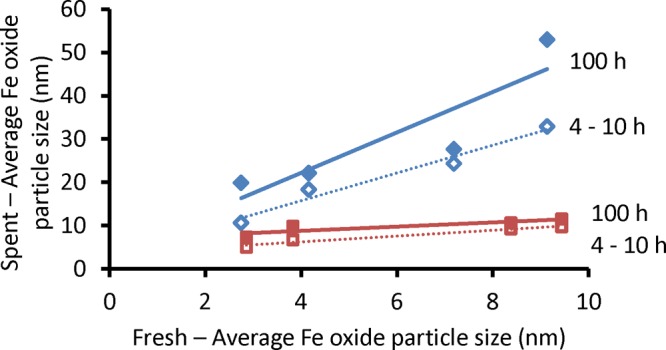
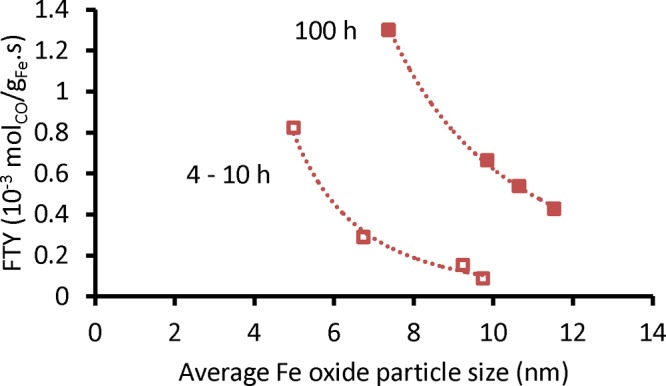
The Fischer-Tropsch Synthesis converts synthesis gas from alternative carbon resources, including natural gas, coal, and biomass, to hydrocarbons used as fuels or chemicals. In particular, iron-based catalysts at elevated temperatures favor the selective production of C-C olefins, which are important building blocks for the chemical industry. Bulk iron catalysts (with promoters) were conventionally used, but these deactivate due to either phase transformation or carbon deposition resulting in disintegration of the catalyst particles. For supported iron catalysts, iron particle growth may result in loss of catalytic activity over time. In this work, the effects of promoters and particle size on the stability of supported iron nanoparticles (initial sizes of 3-9 nm) were investigated at industrially relevant conditions (340 °C, 20 bar, H/CO = 1). Upon addition of sodium and sulfur promoters to iron nanoparticles supported on carbon nanofibers, initial catalytic activities were high, but substantial deactivation was observed over a period of 100 h. In situ Mössbauer spectroscopy revealed that after 20 h time-on-stream, promoted catalysts attained 100% carbidization, whereas for unpromoted catalysts, this was around 25%. In situ carbon deposition studies were carried out using a tapered element oscillating microbalance (TEOM). No carbon laydown was detected for the unpromoted catalysts, whereas for promoted catalysts, carbon deposition occurred mainly over the first 4 h and thus did not play a pivotal role in deactivation over 100 h. Instead, the loss of catalytic activity coincided with the increase in Fe particle size to 20-50 nm, thereby supporting the proposal that the loss of active Fe surface area was the main cause of deactivation.
费托合成将来自替代碳资源(包括天然气、煤炭和生物质)的合成气转化为用作燃料或化学品的碳氢化合物。特别是,高温下的铁基催化剂有利于选择性生产C-C烯烃,而C-C烯烃是化学工业的重要基石。传统上使用的是块状铁催化剂(含助剂),但这些催化剂会因相变或积碳而失活,导致催化剂颗粒解体。对于负载型铁催化剂,铁颗粒的生长可能会导致催化活性随时间丧失。在这项工作中,研究了助剂和粒径对负载型铁纳米颗粒(初始粒径为3-9纳米)在工业相关条件(340°C、20巴、H/CO = 1)下稳定性的影响。在碳纳米纤维负载的铁纳米颗粒中添加钠和硫助剂后,初始催化活性很高,但在100小时内观察到显著失活。原位穆斯堡尔光谱显示,在运行20小时后,促进型催化剂达到了100%的碳化,而未促进型催化剂的碳化率约为25%。使用锥形元件振荡微天平(TEOM)进行了原位积碳研究。未促进型催化剂未检测到积碳,而促进型催化剂的积碳主要发生在前4小时,因此在100小时的失活过程中不起关键作用。相反,催化活性的丧失与铁颗粒尺寸增加到20-50纳米同时发生,从而支持了活性铁表面积的丧失是失活主要原因的观点。