Kim Kyoung Min, Jang Hak Chul, Lim Soo
Department of Internal Medicine, Seoul National University Bundang Hospital, Seongnam, Korea.
Korean J Intern Med. 2016 Jul;31(4):643-50. doi: 10.3904/kjim.2016.015. Epub 2016 Jun 22.
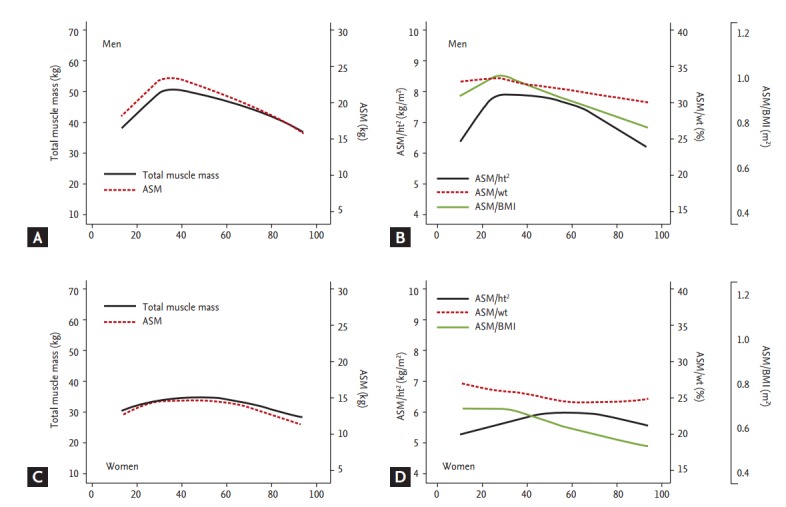
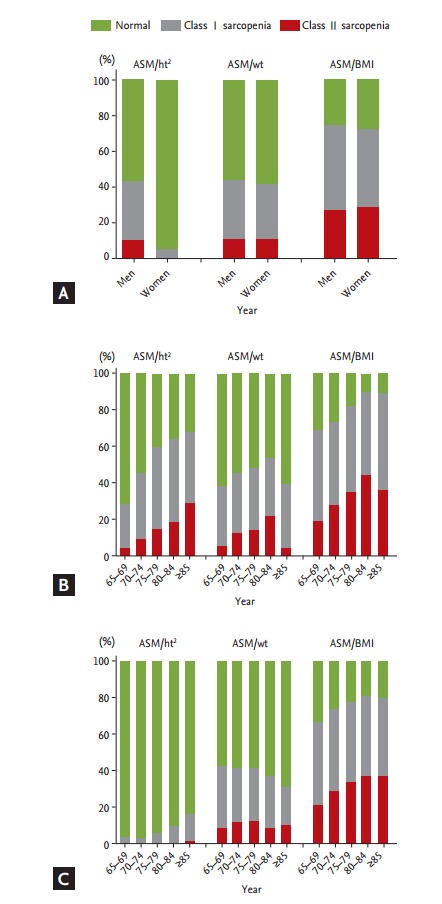
Aging processes are inevitably accompanied by structural and functional changes in vital organs. Skeletal muscle, which accounts for 40% of total body weight, deteriorates quantitatively and qualitatively with aging. Skeletal muscle is known to play diverse crucial physical and metabolic roles in humans. Sarcopenia is a condition characterized by significant loss of muscle mass and strength. It is related to subsequent frailty and instability in the elderly population. Because muscle tissue is involved in multiple functions, sarcopenia is closely related to various adverse health outcomes. Along with increasing recognition of the clinical importance of sarcopenia, several international study groups have recently released their consensus on the definition and diagnosis of sarcopenia. In practical terms, various skeletal muscle mass indices have been suggested for assessing sarcopenia: appendicular skeletal muscle mass adjusted for height squared, weight, or body mass index. A different prevalence and different clinical implications of sarcopenia are highlighted by each definition. The discordances among these indices have emerged as an issue in defining sarcopenia, and a unifying definition for sarcopenia has not yet been attained. This review aims to compare these three operational definitions and to introduce an optimal skeletal muscle mass index that reflects the clinical implications of sarcopenia from a metabolic perspective.
衰老过程不可避免地伴随着重要器官的结构和功能变化。骨骼肌占体重的40%,会随着衰老在数量和质量上逐渐退化。众所周知,骨骼肌在人类身体和代谢中发挥着多种关键作用。肌肉减少症是一种以肌肉质量和力量显著丧失为特征的病症。它与老年人群随后出现的虚弱和身体不稳定有关。由于肌肉组织参与多种功能,肌肉减少症与各种不良健康后果密切相关。随着对肌肉减少症临床重要性的认识不断提高,几个国际研究小组最近发布了关于肌肉减少症定义和诊断的共识。实际上,已经提出了各种骨骼肌质量指数来评估肌肉减少症:根据身高平方、体重或体重指数调整的四肢骨骼肌质量。每个定义所强调的肌肉减少症的患病率和临床意义各不相同。这些指数之间的不一致已成为定义肌肉减少症的一个问题,目前尚未达成统一的肌肉减少症定义。这篇综述旨在比较这三种操作定义,并从代谢角度介绍一种能反映肌肉减少症临床意义的最佳骨骼肌质量指数。