Liep Julia, Kilic Ergin, Meyer Hellmuth A, Busch Jonas, Jung Klaus, Rabien Anja
Department of Urology, Charité - Universitätsmedizin Berlin, Berlin, Germany.
Berlin Institute for Urologic Research, Berlin, Germany.
PLoS One. 2016 Jun 23;11(6):e0157801. doi: 10.1371/journal.pone.0157801. eCollection 2016.
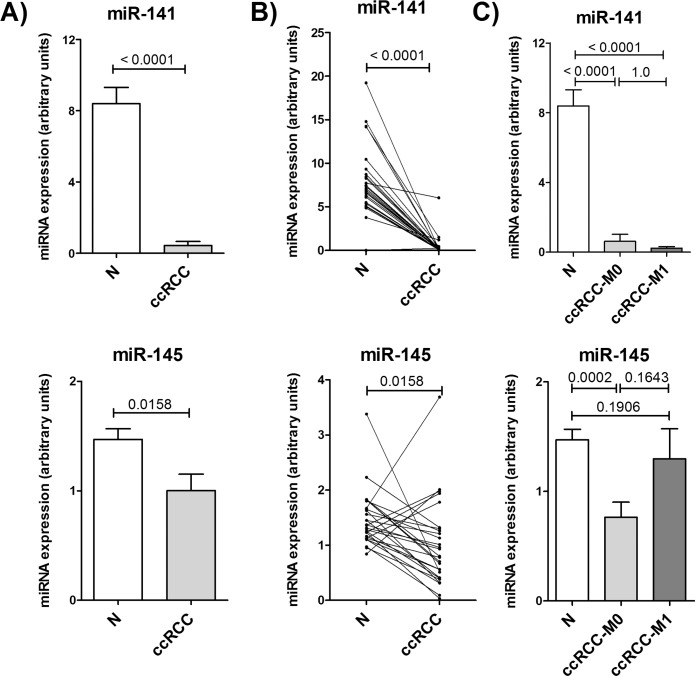
Due to the poor prognosis for advanced renal cell carcinoma (RCC), there is an urgent need for new therapeutic targets and for prognostic markers to identify high risk tumors. MicroRNAs (miRNAs) are frequently dysregulated in tumors, play a crucial role during carcinogenesis and therefore might be promising new biomarkers. In previous studies, we identified miR-141-3p and miR-145-5p to be downregulated in clear cell RCC (ccRCC). Our objective was to investigate the functional association of these miRNAs, focusing on the cooperative regulation of new specific targets and their role in ccRCC progression.
The effect of miR-141-3p and miR-145-5p on cell migration was examined by overexpression in 786-O cells. New targets of both miRNAs were identified by miRWalk, validated in 786-O and ACHN cells and additionally characterized in ccRCC tissue on mRNA and protein level.
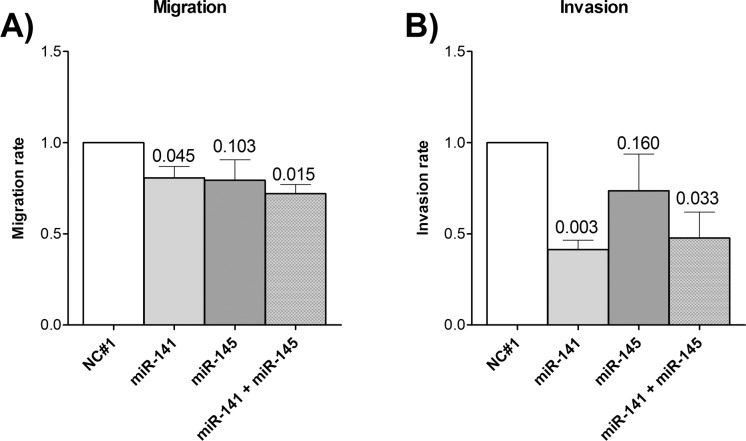
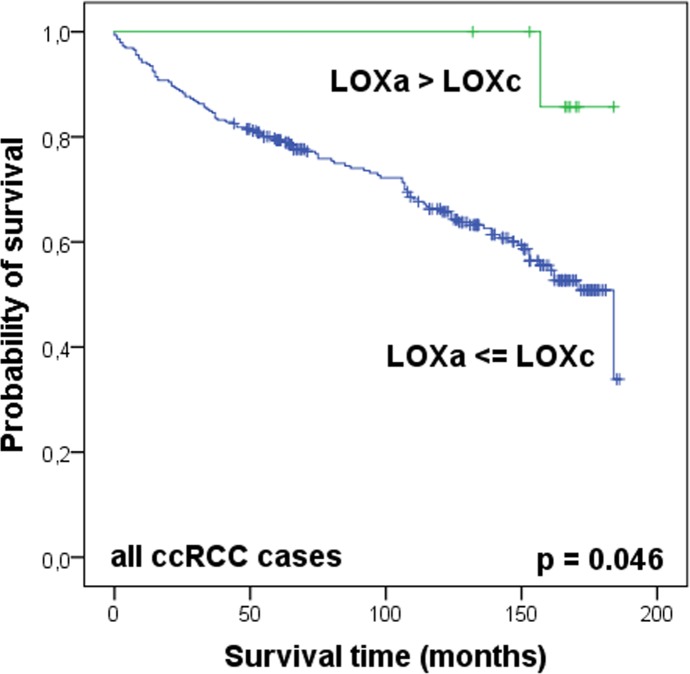
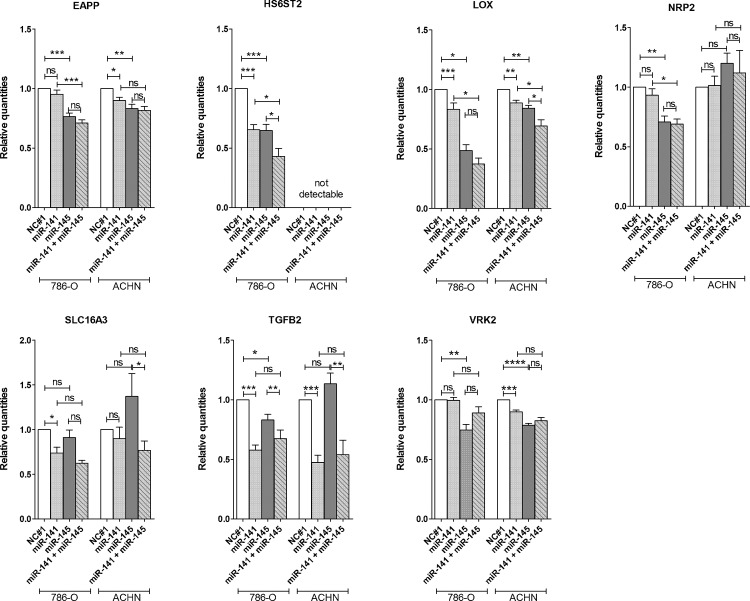
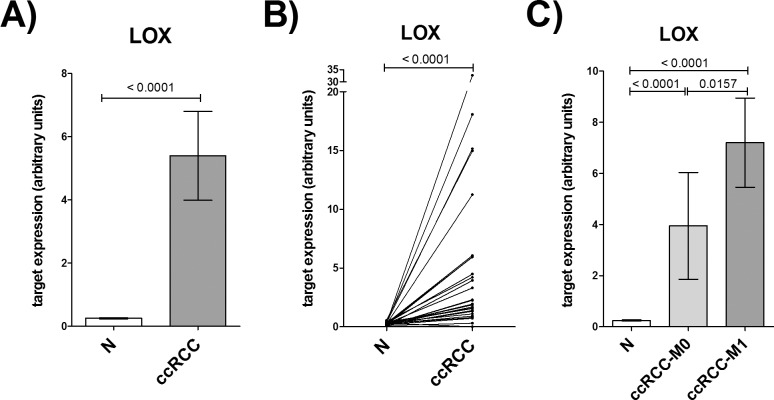
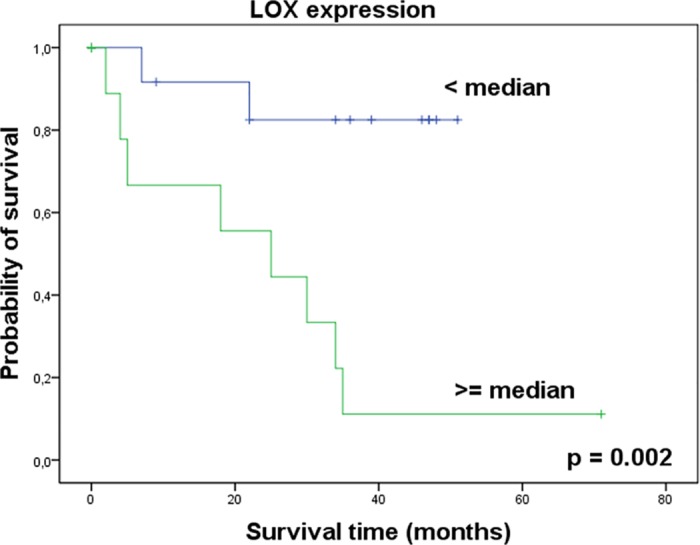
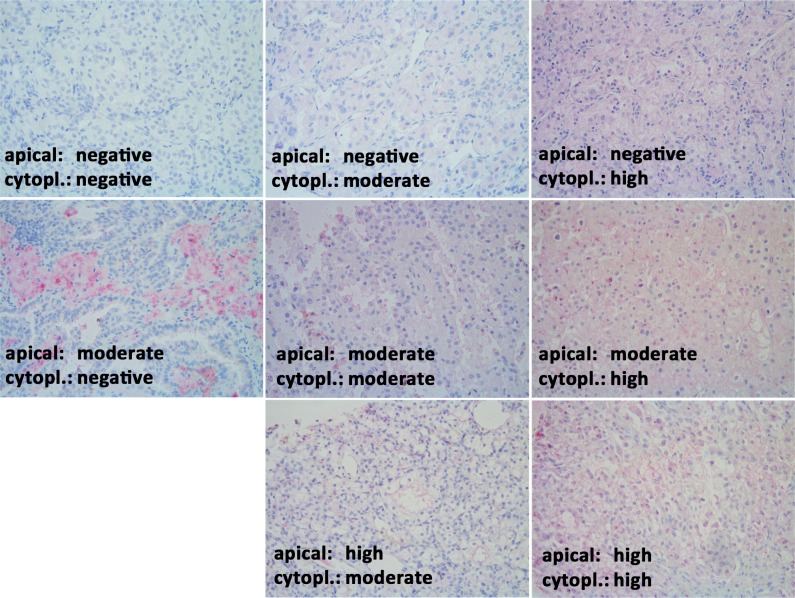
In functional analysis, a tumor suppressive effect of miR-141-3p and miR-145-5p by decreasing migration and invasion of RCC cells could be shown. Furthermore, co-overexpression of the miRNAs seemed to result in an increased inhibition of cell migration. Both miRNAs were recognized as post-transcriptional regulators of the targets EAPP, HS6ST2, LOX, TGFB2 and VRK2. Additionally, they showed a cooperative effect again as demonstrated by a significantly increased inhibition of HS6ST2 and LOX expression after simultaneous overexpression of both miRNAs. In ccRCC tissue, LOX mRNA expression was strongly increased compared to normal tissue, allowing also to distinguish between non-metastatic and already metastasized primary tumors. Finally, in subsequent tissue microarray analysis LOX protein expression showed a prognostic relevance for the overall survival of ccRCC patients.
These results illustrate a jointly strengthening effect of the dysregulated miR-141-3p and miR-145-5p in various tumor associated processes. Focusing on the cooperative effect of miRNAs provides new opportunities for the development of therapeutic strategies and offers novel prognostic and diagnostic capabilities.
由于晚期肾细胞癌(RCC)预后较差,迫切需要新的治疗靶点和预后标志物来识别高危肿瘤。微小RNA(miRNA)在肿瘤中经常失调,在致癌过程中起关键作用,因此可能是有前景的新生物标志物。在先前的研究中,我们发现miR-141-3p和miR-145-5p在透明细胞RCC(ccRCC)中表达下调。我们的目的是研究这些miRNA的功能关联,重点关注新的特异性靶点的协同调控及其在ccRCC进展中的作用。
通过在786-O细胞中过表达来检测miR-141-3p和miR-145-5p对细胞迁移的影响。通过miRWalk鉴定这两种miRNA的新靶点,并在786-O和ACHN细胞中进行验证,并在ccRCC组织的mRNA和蛋白质水平上进行进一步表征。
在功能分析中,可显示miR-141-3p和miR-145-5p通过降低RCC细胞的迁移和侵袭具有肿瘤抑制作用。此外,miRNA的共过表达似乎导致对细胞迁移的抑制增加。这两种miRNA均被认为是靶点EAPP、HS6ST2、LOX、TGFB2和VRK2的转录后调节因子。此外,如同时过表达两种miRNA后对HS6ST2和LOX表达的抑制作用显著增加所示,它们再次显示出协同作用。在ccRCC组织中,与正常组织相比,LOX mRNA表达强烈增加,这也使得能够区分非转移性和已转移的原发性肿瘤。最后,在随后的组织芯片分析中,LOX蛋白表达对ccRCC患者的总生存具有预后意义。
这些结果说明了失调的miR-141-3p和miR-145-5p在各种肿瘤相关过程中的联合增强作用。关注miRNA的协同作用为治疗策略的开发提供了新机会,并提供了新的预后和诊断能力。